 12 min read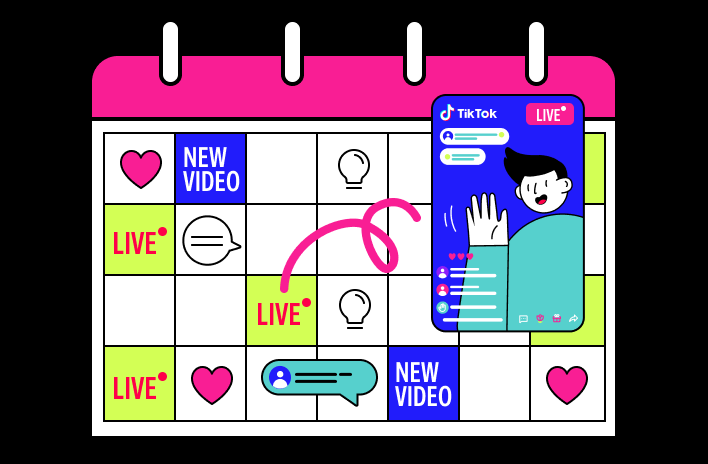

TL;DR
- There is no single best time to go live on TikTok in 2026, and the two largest studies disagree. Sprout Social’s analysis of nearly 2 billion engagements points to Tuesday–Thursday, 2–6 p.m.; Buffer’s analysis of 7.1 million posts puts evenings (6–11 p.m.) ahead and ranks Saturday as the strongest day.
- Both studies report times in your audience’s local time, so 2 p.m. means 2 p.m. wherever your followers are, not 2 p.m. ET.
- Both studies measure posts, not LIVE streams. Use them to shortlist two or three slots, then pick the one that overlaps with your own followers’ activity.
- Your own data lives in TikTok Studio: Analytics → Followers → Most active times shows when your followers were on the app over the past week.
- To host a TikTok LIVE you must be 18 or older, and in most regions you need 1,000 followers; TikTok notes the follower threshold varies by region.
- Announce every stream with a LIVE Event: followers who register get a notification when you start.
What time is best to go live on TikTok in 2026?
Start with weekday afternoons and evenings in your audience’s local time, then let your own analytics decide. That is where the two biggest 2026 datasets overlap, even though they disagree on almost everything else.
The first is Sprout Social’s 2026 report, built on about 2 billion engagements across 307,000 profiles collected between November 27, 2025, and February 27, 2026. It finds the strongest engagement Tuesday through Thursday between 2 and 6 p.m. and advises against weekends. The second is Buffer’s study of 7.1 million TikTok posts, published in September 2026. Buffer sees engagement peak between 6 and 11 p.m. on most days, ranks Saturday as the best day, and names Sunday at 9 a.m. as the single strongest slot of the week.
| Day | Peak window (Sprout Social) | Top hour (Buffer) | Backup hours (Buffer) |
|---|---|---|---|
| Monday | 3–5 p.m. | 1 p.m. | 11 a.m., 8 a.m. |
| Tuesday | 2–6 p.m. | 6 a.m. | 10 p.m., 7 a.m. |
| Wednesday | 1–8 p.m. | 10 p.m. | 6 a.m., 9 p.m. |
| Thursday | 1–5 p.m. | 1 p.m. | 10 p.m., 6 a.m. |
| Friday | 3–5 p.m. | 6 p.m. | 10 p.m., 8 p.m. |
| Saturday | Low engagement | 5 p.m. | 4 p.m., 3 p.m. |
| Sunday | Low engagement | 9 a.m. | 1 p.m., 12 p.m. |
All times are in your audience’s local time. Sources: Sprout Social, “Best times to post on TikTok in 2026” (March 2026); Buffer, “The Best Time to Post on TikTok in 2026” (September 2026).
Read the table as a shortlist, not a schedule. Both studies measure engagement on posts, and a post can collect likes for days, while a LIVE only counts the people who are free while you are on air. The practical overlap is weekday late afternoons and early evenings, plus a Saturday afternoon test if your niche is entertainment rather than work-adjacent. Weekdays still look safer than weekends for most accounts, but Buffer’s Saturday result is a good reason to test one weekend slot before ruling it out.
TikTok peak hours in your time zone
Plan in your audience’s time zone, not yours. Sprout Social and Buffer both normalize their data to local time, so “7 p.m.” in either study means 7 p.m. for the viewer. The conversion only matters when you and your followers live in different places, or when your followers are split across regions.
The table below shows what one evening slot looks like across the four zones creators ask about most. ET and PT are US Eastern and Pacific time; UK time is GMT in winter and BST in summer; Central European time is CET in winter and CEST in summer.
| If your followers are in | Their 7 p.m. in ET | In PT | In UK time |
|---|---|---|---|
| US East Coast (ET) | 7 p.m. | 4 p.m. | 12 a.m. |
| US West Coast (PT) | 10 p.m. | 7 p.m. | 3 a.m. |
| United Kingdom | 2 p.m. | 11 a.m. | 7 p.m. |
| Central Europe (CET) | 1 p.m. | 10 a.m. | 6 p.m. |
The US and Europe switch to and from daylight saving time on different dates, so for a few weeks in March and around the end of October the gap shrinks by one hour. If you stream to both regions, check the offset again in those weeks instead of relying on last month’s schedule.
If you also stream on YouTube, Instagram or Facebook, compare these windows with the best time to go live on other social media platforms: each platform peaks at different hours, and a slot that works on TikTok can be a weak one elsewhere.
What the TikTok algorithm looks for in a LIVE in 2026
Timing gets viewers into the room; what they do once they are there decides how far TikTok pushes the stream. TikTok’s own explanation of the For You feed names the signals it ranks content by: user interactions such as likes, shares, comments and follows, information about the content itself such as captions, sounds and hashtags, and device and account settings.
For a LIVE host, those signals translate into three practical habits:
- Search and titles. Captions and titles are part of the content information TikTok ranks by. A LIVE title with the words your viewers actually type (“ASMR sleep,” “gaming tips,” “Q&A”) gives the system something concrete to match.
- Chat over taps. Comments, follows and shares are interactions TikTok lists by name. A stream where viewers talk to you and to each other produces more of them than one where they only watch.
- A full room early. A stream that opens with followers already chatting has interactions to show from its first minutes instead of its last. That is the practical reason the start time matters, and why announcing the stream in advance pays off.
Tools for scheduling TikTok LIVE streams
A consistent TikTok LIVE schedule helps followers build a habit of showing up at the same time each week. These are the tools creators use to manage it.
LIVE Events (native)
TikTok’s built-in scheduling tool is LIVE Events. You create an event in LIVE Center with a title, date, time and short description, TikTok reviews it, and followers can register. Registered followers get a notification when your stream begins, and you can see how many people have registered while the event is still upcoming.
TikFinity
TikFinity is a third-party tool for engagement rather than scheduling. It adds interactive widgets, sound alerts for gifts and text-to-speech for chat, which gives viewers more reasons to comment and send gifts during the stream.
OBS + SE.Live
For streams produced on a computer, creators pair OBS Studio with the SE.Live plugin. The setup allows vertical scene layouts and proper audio mixing, which mobile streaming can’t match. It depends on desktop streaming access through TikTok LIVE Studio or a stream key, and not every eligible account has it.
How to promote a TikTok LIVE in advance
Announce every stream at least a day ahead, in two places: a LIVE Event that followers can register for, and a regular video that points to it.
- Create the LIVE Event in LIVE Center and wait for TikTok’s review to clear it.
- Post an announcement video with the LIVE countdown sticker, which links viewers to the event.
- Share the event link in your bio, your other channels and direct messages to your most active followers.
- Repeat the announcement a few hours before the start, when people are deciding what to do that evening.
How long and how often to go live on TikTok
Stay live long enough for late arrivals to catch the main part of the stream; a practical starting point is 30 to 60 minutes. Viewers find a LIVE gradually through notifications, the For You feed and shares, so a ten-minute stream ends before most of them see it. After a few streams, open your LIVE results and adjust the length to the point where viewers typically leave.
Frequency matters less than regularity. One stream at the same time every week trains followers to expect you; three streams at random times train them to ignore the notification. Pick a cadence you can keep for at least a month before judging the results.
TikTok LIVE requirements in 2026
You need to be at least 18 years old to host a TikTok LIVE, according to TikTok’s LIVE Safety Guide. In most regions you also need 1,000 followers, and TikTok notes that this threshold varies by region.
The account has to be in good standing: recent Community Guidelines violations can restrict LIVE access. TikTok’s safety guide also says new hosts may not get every LIVE feature at once and get the full set over time if they follow its policies. Receiving LIVE Gifts has its own conditions, including an age limit of 18 and a location where Gifts are available. Streaming from a computer through LIVE Studio or a stream key is a separate permission, so check it before you plan a produced, multi-camera stream.
How to find your best time in TikTok analytics
General data gives you a shortlist; your follower activity in TikTok analytics gives you the answer. These three checks turn the shortlist into a schedule.
Find your audience’s locations
Open TikTok Studio, go to Analytics and choose the Followers tab. On desktop, the same data sits under Business Suite → Analytics → Followers. The tab shows which countries and cities your followers come from, which tells you which time zone to plan in.
Use analytics to check when your followers are most active
On the same Followers tab, scroll to Most active times. It shows when your followers were on TikTok by hour and day over the past week. If your analytics show a spike at 8 p.m., ignore the general global stats and go live at 8 p.m. Personal data always beats global averages.
Check LIVE results after every stream
After each stream, open LIVE Center and note the views, new followers and gifts for that session next to its start time. Three or four weeks of these notes will tell you more about your slot than any industry chart, because they measure your audience on your format.
Keep an eye on your competitors
Don’t forget to check the streaming timing chosen by your competitors from your region. If a major competitor goes live every Friday at 7 p.m., you have two choices: go live at the same time to draft off their traffic (risky) or choose an alternative slot, such as 6 p.m. or 9 p.m., to capture the overflow audience.
Key Takeaways
- Treat 2026 studies as a starting point: shortlist two or three slots from Sprout Social and Buffer, then let Most active times in TikTok analytics make the final call.
- Plan every stream in your audience’s time zone, and recheck the offset in the weeks when the US and Europe change clocks on different dates.
- Pick one weekly slot and keep it, so followers learn when to expect you.
- Announce each stream with a LIVE Event and a countdown-sticker video at least a day ahead, and use the registration count to judge the slot.
- Give each tested slot three weeks with the same format, then compare viewers and watch time in LIVE Center before you commit.
FAQ
What is the best time to go live on TikTok?
Weekday afternoons and evenings in your audience’s local time are the safest start. Sprout Social’s 2026 data favors Tuesday–Thursday from 2 to 6 p.m., while Buffer sees the strongest engagement between 6 and 11 p.m.; confirm either window against Most active times in your own analytics.
What are the best days to go live on TikTok?
The 2026 studies disagree. Sprout Social ranks Tuesday through Thursday highest and calls weekends weak, while Buffer ranks Saturday as the best day, so test one midweek slot and one Saturday slot before deciding.
How many followers do you need to go live on TikTok?
In most regions you need 1,000 followers, and you must be at least 18 years old. TikTok notes the follower threshold varies by region, and recent Community Guidelines violations can block LIVE access even above it.
How long should a TikTok LIVE last?
Viewers join gradually, so very short streams rarely build an audience. Start with 30 to 60 minutes, then check when viewers leave in your LIVE results and adjust.
Does my time zone matter?
Yes. What matters is when your followers are online, so check where they live and when they are active in TikTok analytics, then convert those times to your own zone.
Can you schedule a TikTok LIVE?
Yes, with LIVE Events. You set the title, date and time in LIVE Center, TikTok reviews the event, and followers who register get a notification when you go live.