11 min read

TL;DR
- Gyre’s stream scheduler (Streams Scheduler in your account) starts, stops, or starts and stops a pre-created stream at the date and time you set, so you don’t have to be online at launch.
- The 7-day Free Trial includes the scheduler, and so do the Start+ and PRO+ plans. The Start plan doesn’t.
- Every scheduled event uses one of three formats: Auto-start, Auto-start & Auto-stop, or Auto-stop. Auto-stop only works on a stream that’s already running.
- Each event has its own time zone, set as a fixed offset from UTC-12 to UTC+12, so you can plan around your audience’s local hours instead of yours.
- Streams run from Gyre’s cloud on YouTube, Facebook, Twitch, Instagram, Kick, Telegram, X, and Mixcloud, and your computer can stay off the whole time.
- By default a Gyre stream plays its content 24/7. Auto-stop mode in the stream settings ends it after one full pass instead.
How the Streams Scheduler works
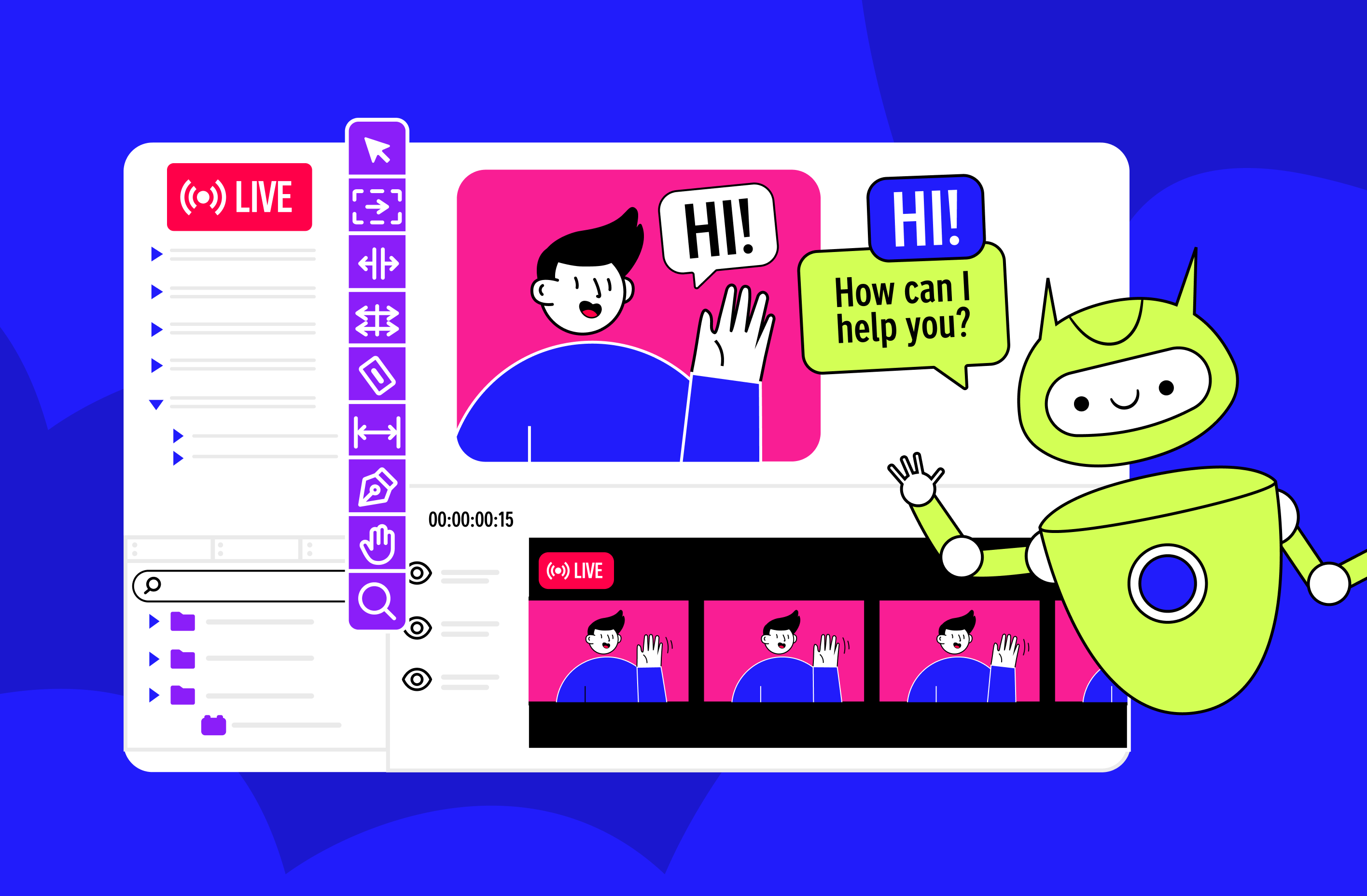
The Streams Scheduler is a calendar inside your Gyre account that launches and ends streams for you. You create a stream as usual and leave it stopped, then add it to the calendar as an event with a date, a time, a time zone, and a format. At the set time, Gyre starts or stops the broadcast from its own servers.
The scheduler comes with the 7-day Free Trial and with the Start+ and PRO+ plans. The entry-level Start plan doesn’t have it, so check your plan before you build a weekly schedule around it. Current prices and limits are on the Gyre pricing page.
| Feature | What it does for scheduling | Plans |
|---|---|---|
| Stream scheduler | Starts, stops, or starts and stops a stream at a set date and time | Free Trial, Start+, PRO+ |
| Playlists | Plays several videos in a set order inside one scheduled stream | Free Trial, Start+, PRO+ |
| Simultaneous streams | Sets how many broadcasts can run on their own schedules at the same time | 1 HD on Free Trial and Start; 4 HD or 1 4K on Start+; 8 HD or 2 4K on PRO+ |
| Storage | Holds the videos your scheduled streams play | 20 GB (up to 15 files) on Free Trial; 35 GB on Start; 75 GB on Start+; 150 GB on PRO+ |
| Platforms | Defines where a scheduled stream can go | The same list on every plan |
Before you add a stream to the calendar, follow these four steps:
- Create your stream in YouTube Studio and in your Gyre account, but don’t start it.
- Turn on auto-start and auto-stop for the broadcast when you create it in YouTube Studio.
- Check the stream’s visibility on YouTube and make sure it’s set to “Public.”
- Open the Streams Scheduler and plan your stream.
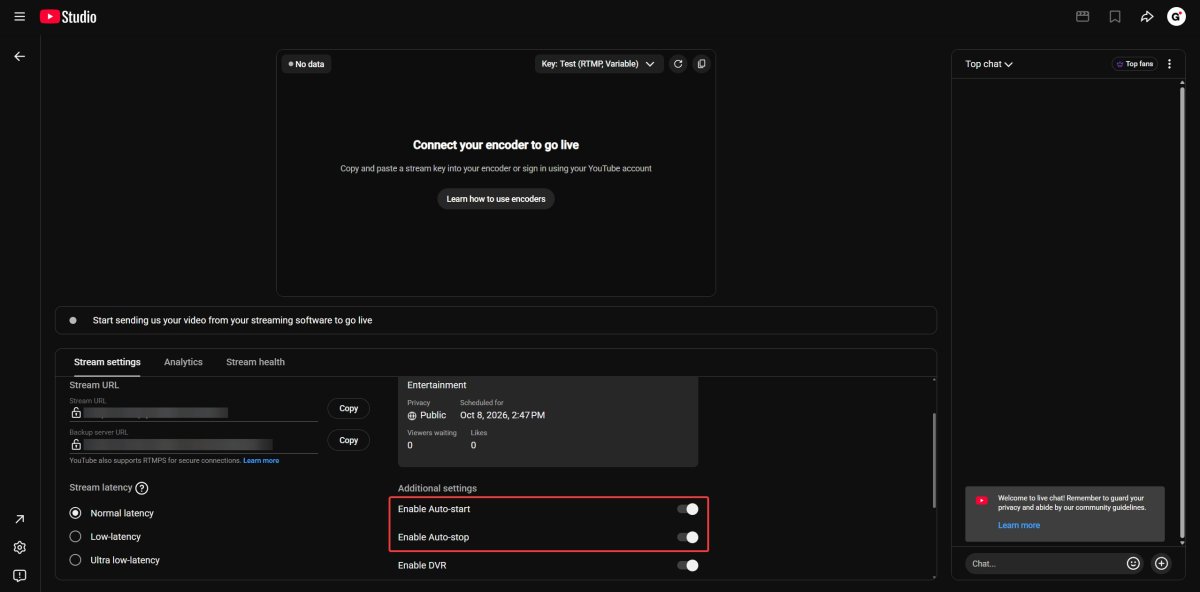
These YouTube steps apply to the manual setup, where Gyre sends the stream to YouTube with a stream key from YouTube Studio. According to YouTube Help, once auto-start and auto-stop are turned on, the broadcast starts and ends with the signal from the encoder, which in this case is Gyre’s server. If you connect your channel with “Connect with YouTube” instead, Gyre sets up the broadcast through the YouTube API.
How to schedule the start and end of a continuous stream in Gyre
To open the planning section, click “Streams Scheduler” in the left sidebar. You’ll see a calendar of your scheduled events, and you can switch it between a month, a week, or a single day.
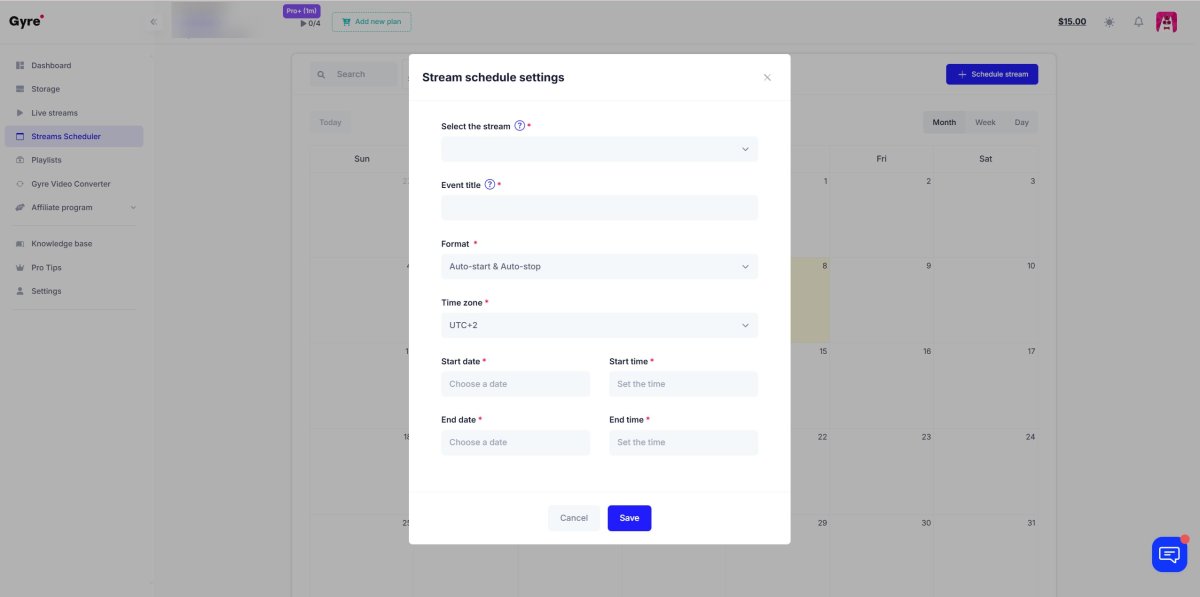
Next, click “Schedule stream.” The “Stream schedule settings” window opens. Choose a pre-created stream in “Select the stream” and give the event a name in “Event title.” That name only shows up in the Streams Scheduler, so write it for yourself: the channel, the content, the slot.
In the “Format” field, pick one of three options:
- Auto-start launches the stream at the start date and time you enter.
- Auto-start & Auto-stop adds an end date and time, so the stream runs for a fixed window.
- Auto-stop ends a stream that’s already live. Gyre accepts this format only for streams that were started earlier and are still active.
Then set the “Time zone,” enter the dates and times, and click “Save.” The event appears in the calendar right away.
You can always manage your scheduled streams, and there are two ways to do it. The first is the “Search” field in the top left corner: type the stream’s name, and the calendar shows only the matching event. Say you have four streams scheduled for June and you need the music one. Type the keyword, and only that event stays highlighted in the calendar.
Next to the search, the “Completed events” filter lets you show or hide events that have already run, which keeps a busy month readable.
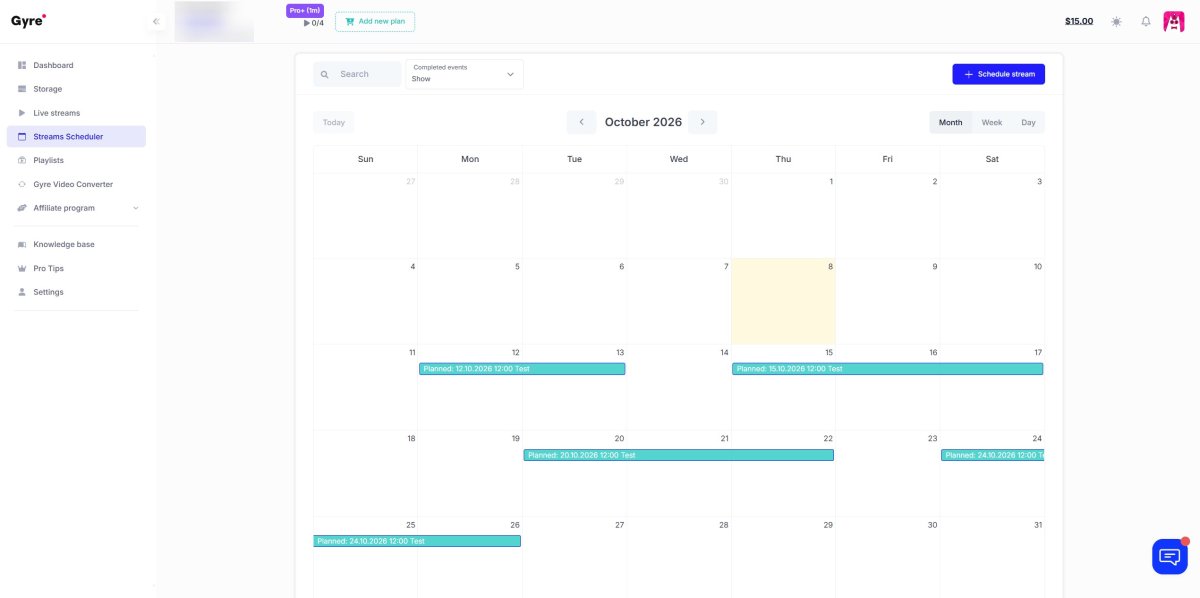
The second way is to click any stream directly in the calendar. A window opens with the event details, and from there you can edit the scheduled stream or delete it.
Scheduler use cases: time zones, weekends, and holidays
The scheduler pays off whenever a stream has to start or stop at a time you won’t be at your desk. Most creators use it in one of these five setups.
Reach viewers in other time zones
The Audience tab in YouTube Studio shows when your viewers are on YouTube. If it points to a second audience on another continent, give that audience its own stream at their local evening instead of shifting your main broadcast. Our breakdown of the best time to go live on each platform helps you pick the window. Then set the event’s time zone to the region you’re targeting and enter the time the way those viewers see it on their clocks.
Start+ runs up to 4 HD streams at once and PRO+ up to 8, so each region can get a separate broadcast on its own timetable.
Weekend-only schedules
Some channels only need a live presence when their audience has free time. One Auto-start & Auto-stop event from Friday evening to Sunday night covers the whole weekend. The scheduler has no repeat setting, so you add one event per weekend. Planning a month ahead in the Month view takes a few minutes.
Holidays and time off
Holidays give viewers the most free time and creators the least. A themed stream, such as a holiday music playlist, scheduled with Auto-start & Auto-stop for the days you’re away, starts and ends on its own. Your laptop can stay closed the entire time, because the broadcast runs from Gyre’s servers.
Restart a stream on a set cycle
Gyre’s own data shows that views on a stream peak in its first 3 days, which is why the team recommends restarting a stream every 3 days. The scheduler has no separate restart option, so plan the restart as two events on the same stream: an Auto-stop when the current run should end and an Auto-start for the new session.
Line up streams around a release
When a new video or album drops, schedule a themed stream to go live at the same minute, so the release has a live entry point on your channel. On Start+ and PRO+ it runs next to your main 24/7 stream rather than replacing it.
A fully automated setup: the scheduler plus 24/7 playback
The scheduler decides when a stream runs. The stream’s own settings decide what plays and what happens when the content runs out, and together they cover the whole broadcast without a manual launch.
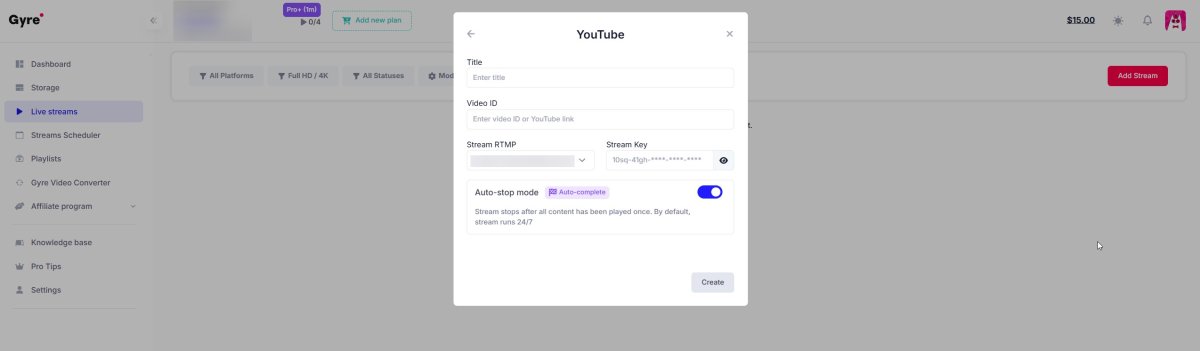
A Gyre stream plays a video or a playlist from your Gyre storage. By default it runs 24/7: when the last video ends, playback starts again from the first one. If you want the stream to end after every video has played once, turn on “Auto-stop mode” when you create it.
Don’t confuse this setting with the Auto-stop format in the scheduler. The stream setting ends the broadcast when the content runs out, while the scheduler ends it at a clock time.
Playback and scheduling both run on Gyre’s servers, so your computer can be off at launch time and through the whole broadcast. In 2026 you can create streams for YouTube, Facebook, Twitch, Instagram, Kick, Telegram, X, and Mixcloud, and each one launches independently. One calendar can drive different content on different platforms: a music stream on YouTube every evening and a highlights stream on Twitch every weekend. If you haven’t built a stream yet, start with our guide to streaming pre-recorded video as live with Gyre.
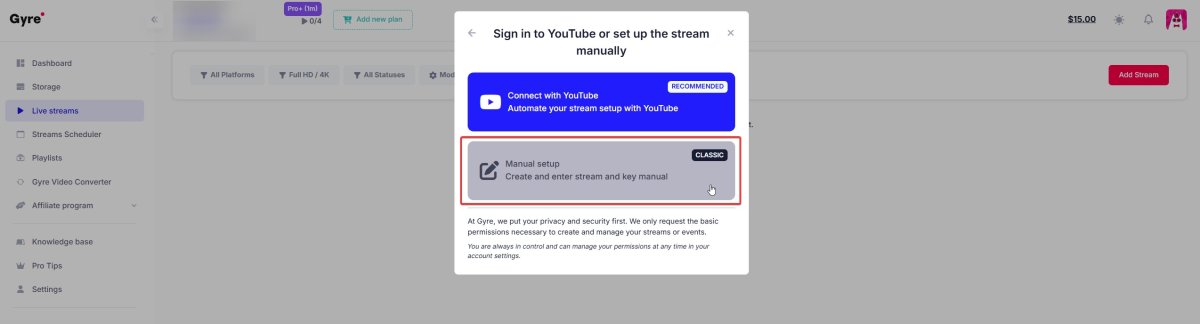
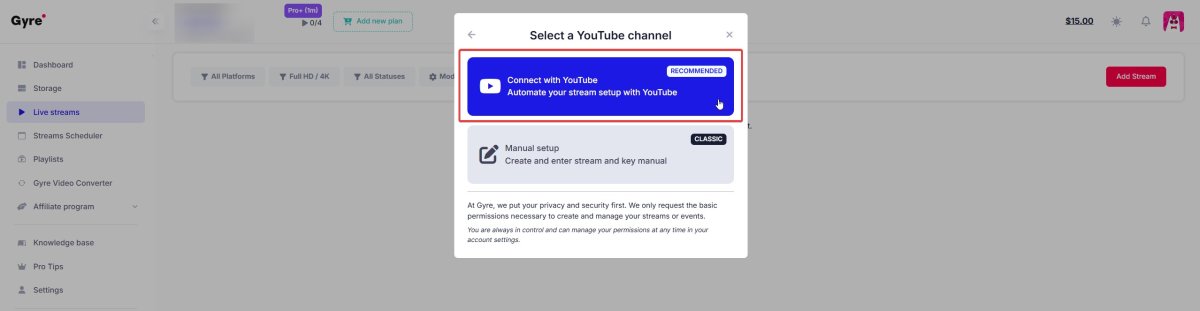
For YouTube, the stream setup screen offers two paths. “Connect with YouTube” is marked as recommended: Gyre connects to your channel through the YouTube API and prepares the broadcast for you. “Manual setup” is the classic route, where you paste the video ID, the RTMP address, and the stream key from YouTube Studio. The auto-start and auto-stop settings from the steps above matter on this route.
Key Takeaways
- Move one stream you currently launch by hand into the Streams Scheduler first. A single stream is enough to test the workflow before you plan a full month.
- Check every event date against daylight saving changes in your audience’s region, and choose the UTC offset that applies on that day.
- Use Auto-start & Auto-stop for weekends, holidays, and release windows, and keep your main stream running 24/7 alongside them on Start+ or PRO+.
- If you follow the 3-day refresh cycle, put each restart in the calendar as an Auto-stop and Auto-start pair.
- Try the full setup on the 7-day Free Trial before you pick a plan, and remember that Start doesn’t include the scheduler.
FAQ
What is Gyre’s stream scheduler?
It’s a calendar in your Gyre account that starts, stops, or starts and stops a pre-created stream at the date and time you choose. The broadcast runs from Gyre’s cloud, so you don’t need to be online when it begins.
Is the stream scheduler available on the free plan?
Yes. The 7-day Free Trial includes the scheduler, and so do the Start+ and PRO+ plans. The Start plan doesn’t.
Can I schedule streams for different time zones?
Yes. Each scheduled event has its own time zone, set as a UTC offset from UTC-12 to UTC+12. The offsets are fixed, so account for daylight saving time yourself.
Does a scheduled stream keep running 24/7?
By default, yes: when the playlist ends, playback starts again from the first video. To end the stream after one pass, turn on Auto-stop mode in the stream settings or set an end time in the scheduler.
Can I schedule a stream that’s already live?
Only to stop it. The Auto-stop format works for streams that were started earlier and are still active. To schedule a start, create the stream first and leave it stopped.
Which platforms does the scheduler work with?
Any platform you can create a Gyre stream for: YouTube, Facebook, Twitch, Instagram, Kick, Telegram, X, and Mixcloud.