 16 min read

TL;DR
- Gyre is a cloud platform that broadcasts pre-recorded video as 24/7 live streams on YouTube, Twitch, Kick, Facebook, Instagram, X, MixCloud, and any service that accepts a Real-Time Messaging Protocol (RTMP) stream key. No computer has to stay on.
- The longest stream on Gyre has run on the same YouTube broadcast since November 13, 2021: over 1,780 days as of September 30, 2026.
- Over 1 million streams have launched on Gyre’s infrastructure, and videos streamed through it have gathered nearly 8 billion views, replays included.
- 184 customers have kept a single stream live for more than a year, and 43 of them are running one right now.
- YouTube allows 10 active streams per channel and 3 per stream key. One customer channel has run 243 at once, but the official limit is still the number to plan around.
- In 2025, Gyre added full YouTube API integration, improved Auto-Stop Mode and the Streams Scheduler, and launched Gyre Enterprise.
- Since the December 2025 release, your content stays with you when you change plans, you can pick YouTube’s backup RTMP server, and plans run on capacity slots: Full HD uses 1, 4K uses 4.
Scale in numbers, explained for creators
In live streaming, numbers only matter when you understand where they come from and what they actually bring to a channel. Every figure below comes from Gyre’s production data as of late September 2026.
Over 1,780 days on the same YouTube broadcast
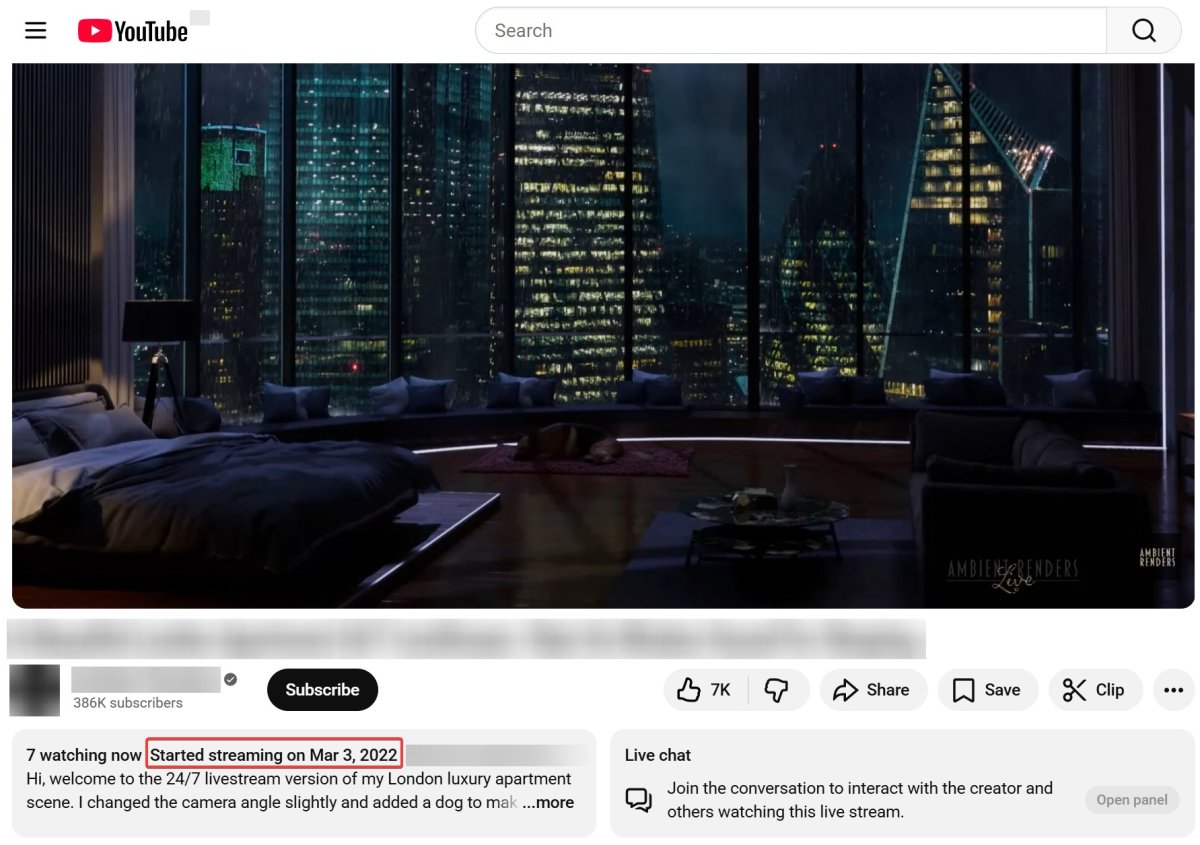
The longest stream on Gyre has been live on the same YouTube broadcast since November 13, 2021. On September 30, 2026, that was over 1,780 days, close to five years. For comparison, most YouTube channels completely change their content strategy several times over that period.
In all that time, the stream has paused exactly once: for 10 seconds, during a restart on February 24, 2022. On June 19, 2024, we moved it to a different server, and the YouTube broadcast stayed the same. The screenshot below dates from December 2025, when the counter passed 1,500 days.
Over 230 million views from a single 24/7 live stream
One of the streams on Gyre reached 230,602,460 views at its last recorded count in March 2026. This is a key distinction: all of those views went to one continuous live stream rather than a video series or Shorts.
Hundreds of millions of additional views were generated without producing new content, purely thanks to stable 24/7 streaming. The channel didn’t invest in production, yet gained additional traffic, watch hours, and revenue. And there can be many more scenarios like this when a stream runs reliably without downtime.
Over 40,000 concurrent viewers on a single live stream
On December 11, 2024, one stream on Gyre peaked at 41,336 concurrent viewers, and the audience stayed above 20,000 for days. That’s the scale of major live events.
But the more important question is different: how many of those viewers became subscribers and returned to the channel later? That’s where live streams start driving long-term channel growth instead of one-off view spikes.
Over 1 million streams launched on Gyre’s infrastructure
Since launch, 1,013,416 streams have started on Gyre. This is the total across every customer on the platform, all of it running within one streaming infrastructure.
Up to 243 concurrent live streams on one YouTube channel
Start with YouTube’s official position. The YouTube Help Center sets a limit of 10 active streams per channel and 3 per stream key, and both limits apply at the same time.
Our customers’ experience shows that the situation differs from channel to channel. One channel on Gyre first reached 144 simultaneous streams on November 17, 2024. On April 13, 2026, the same channel ran 243 different videos at once, each live for more than 10 minutes, and YouTube’s own status data confirmed 238 of them as live.
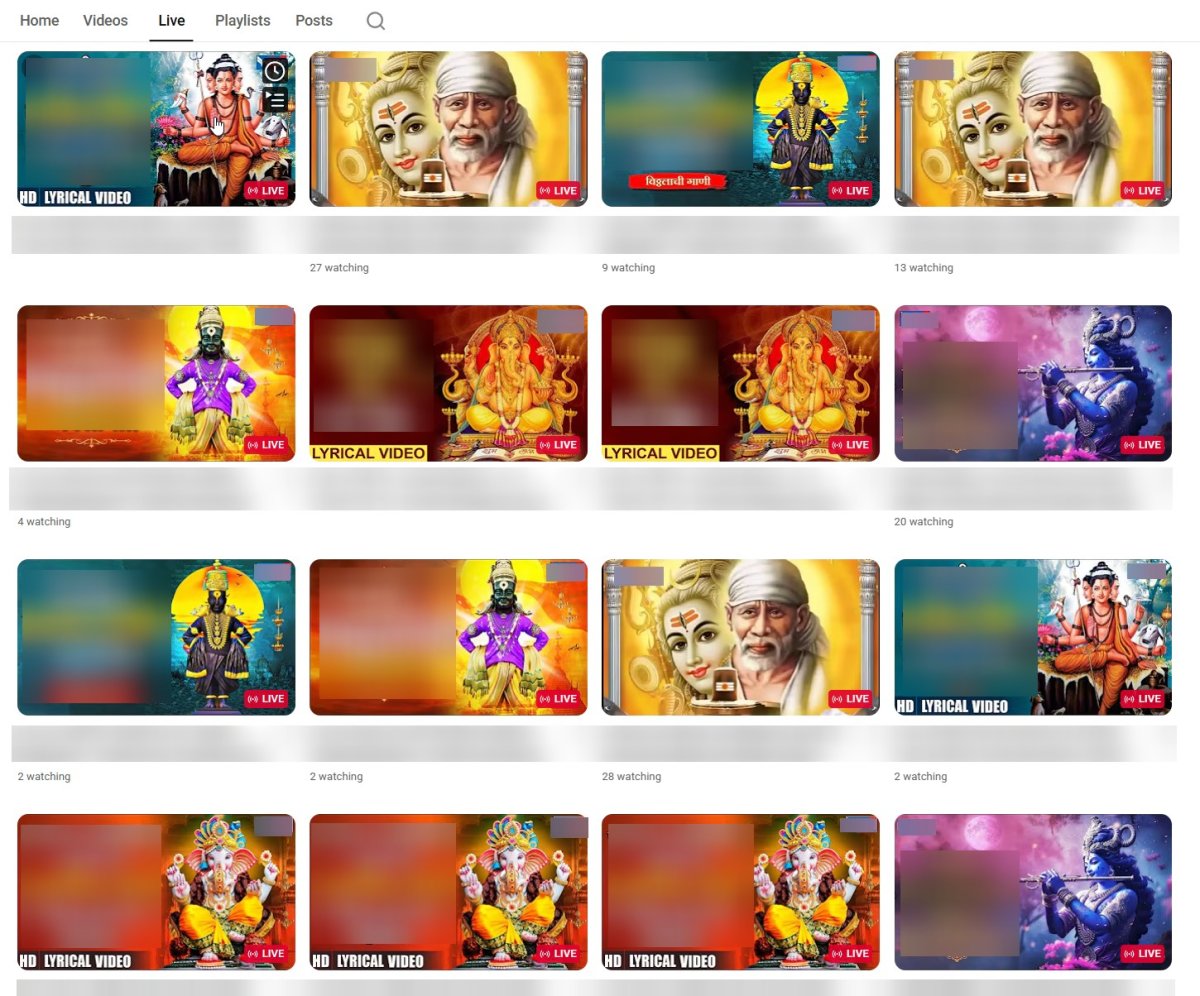
Each of them is an independent content unit capable of generating views, watch time, and revenue. You can launch a large number of streams even in a single day, have them run in parallel, and keep them on the channel as regular content after the live broadcast ends, where they keep working for you long term.
At this level, streaming stability stops being a technical detail and becomes the foundation for scaling content and revenue.
Stability measured across customers, not one record
Records show what’s possible. Stability shows up in what ordinary customers do month after month, so we looked at that too.
184 Gyre customers have kept a single stream live for more than a year, and 43 of them have one running right now. More than a quarter of our current paying customers have been with Gyre for over a year. Videos streamed through Gyre have gathered nearly 8 billion views, a total that includes replays watched after a broadcast ends.
The channel-level side of this, with views, watch time, and revenue before and after, is in our customer success stories.
Gyre timeline, from 2021 to 2026
The milestones below are the ones we can date precisely from our own data and releases.
| When | Milestone |
|---|---|
| November 2021 | The longest stream on Gyre goes live on the YouTube broadcast it still uses today |
| June 2024 | That stream moves to a new server without leaving its YouTube broadcast |
| November 2024 | A customer channel reaches 144 simultaneous streams |
| December 2024 | A single stream peaks at 41,336 concurrent viewers |
| 2025 | YouTube API integration, Auto-Stop Mode and scheduler upgrades, Gyre Enterprise, and appearances at VidCon, VidSummit, and LiveCon |
| December 10, 2025 | The 2025 product updates ship in one release |
| February 2026 | Your content stays with you when you change plans |
| April 2026 | 243 simultaneous streams on one YouTube channel |
| May–August 2026 | Capacity slots replace separate Full HD and 4K limits |
| September 2026 | Over 1 million streams launched; the longest stream passes 1,780 days |
2025: from manual work to a system
As a product grows, the biggest enemy is manual work. Copying stream keys, checking multiple tabs, repeating the same actions: none of this scales.
So in 2025 we put quality control and predictability ahead of shipping “another feature.”
YouTube API: launching and managing streams without manual setup
The biggest update of the year was full integration with YouTube via API.
Streams are now created where you actually manage them:
- you connect your channel once,
- set stream parameters, metadata, and scheduling,
- and Gyre automatically creates the live stream on your channel.
No switching to YouTube Studio. No manual copying of stream keys or stream URLs. No extra steps where errors usually happen.
This may sound like a small thing until you’re running dozens or hundreds of streams.
24/7 streaming you can control
Launching a continuous stream and keeping it live 24/7 is only half the job. How it ends, and how you work with it in between, matters just as much.
In practice, the most effective 24/7 streaming strategies rely on continuous testing, restarts, and iterative format adjustments. Creators adjust playlists, launch times, titles, and thumbnails, rotate streams, and watch what the algorithm picks up and amplifies.
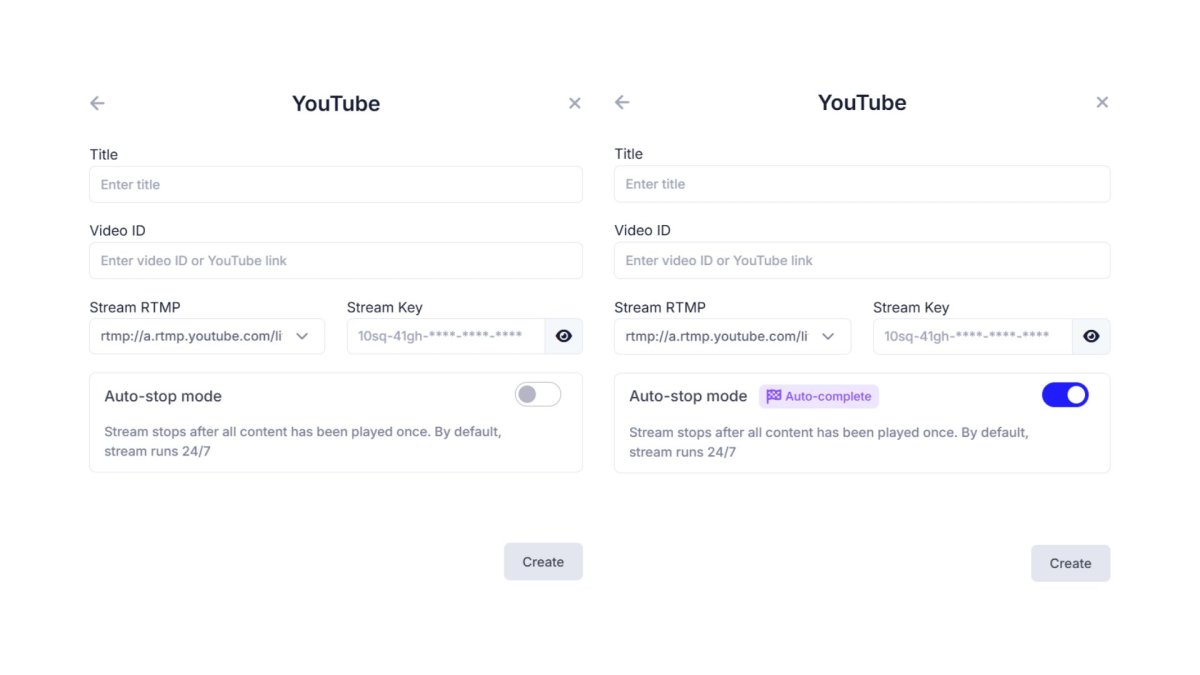
That’s why control over how a stream ends is critical. In 2025, we significantly improved Auto-Stop Mode, allowing streams to end cleanly once a playlist finishes. This makes it possible to treat streams as a fully controlled growth tool, not a one-time setup you hope will work forever.
For music channels, online radio, and background content, this is especially important. Content should run long, but never chaotically.
Scheduling you can rely on
When 24/7 streams become part of a regular strategy, scheduling stops being a convenience and becomes a requirement. You need to know that a stream will start and end exactly when planned, without manual checks or constant oversight.
That’s why in 2025 we focused heavily on calendar reliability. With Streams Scheduler, creators can define start and end times in advance and manage streams as a system rather than isolated events. If a stream is on the calendar, it launches automatically.
As a result, stream launch strategies become much simpler. There’s no need to return to settings every day or keep everything under constant supervision. You can plan weeks, or even months, of streams in advance in a single day.
This frees up time for what actually matters: creating content, testing formats, and growing your channel. Fewer manual actions mean more predictability and trust in the process.
Files, speed, and pre-stream preparation
Most streaming issues start before you hit “Go Live.” That’s why we focused on everything that happens before the stream starts.
In 2025, Gyre introduced:
- file compliance checks for YouTube requirements,
- upload success verification,
- video imports via Google Drive and Dropbox.
Plus a technical upgrade:
- noticeably faster file uploads,
- a modernized tech stack,
- faster page loads and a smoother interface.
Fewer surprises, more stable streams.
Gyre as an ecosystem: the partner program
In 2025, Gyre fully evolved from a tool into a platform with a growing ecosystem. The partner program is one of the clearest examples of that shift.
Over the year, Gyre partners earned tens of thousands of dollars, and for many of them the income kept recurring long after the first payout. In many cases, a single review or video was enough to generate subscriptions that continued converting over time.
There’s a broader context here. Truly high-quality creator tools are rare, especially ones you can recommend without compromise. Gyre became one of those products: creators use it themselves, it delivers clear results, and demand is consistent. That’s why recommendations work and the partner program feels natural rather than forced.
In 2025, we also upgraded the partner program:
- added SWIFT payouts,
- rebuilt dashboards for clearer analytics,
- prepared promotional materials for creators and influencers.
Below is a concrete example of how this works in practice. The screenshot shows one Gyre partner’s results over a single month. No large campaigns or complex funnels, just one service review that led to subscriptions. From there, revenue is generated through recurring payments, which is clearly visible in the sales breakdown.
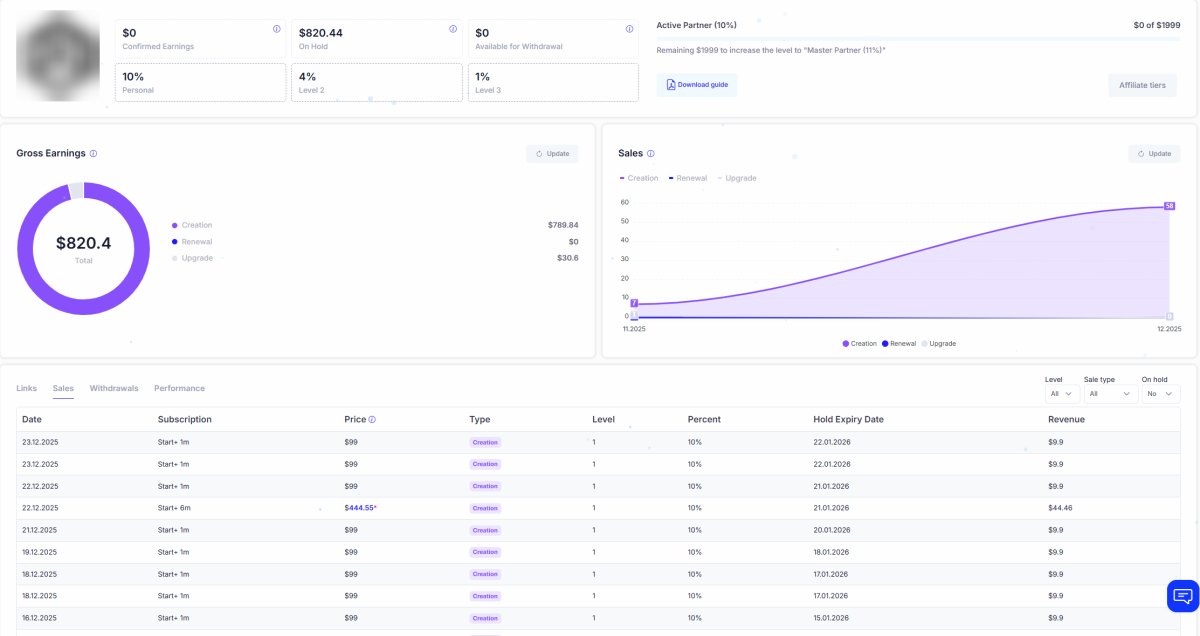
The partner works under standard program terms, without maximum commission tiers or special privileges. However, because Gyre solves a real problem and has steady demand, the recommendation continues to work long after the review is published.
Many creators who talk about Gyre in their videos are also active partners themselves. And that makes sense: when you already share a tool you trust and use, the partner model becomes a natural extension of that recommendation.
Gyre in the industry: events, influencers, trust
In 2025, we were present where industry trends take shape:
- VidCon in Anaheim,
- VidSummit in Dallas, plus a creator meet-up outside the main program,
- LiveCon in London.
LiveCon was especially significant. It sent a clear signal: YouTube supports live formats, including long-running and 24/7 streams. For many creators, this removed the lingering question: “Is this risky?”
Throughout the year, dozens of YouTube influencers from Europe, Asia, Latin America, and Africa covered 24/7 streaming with Gyre in their videos. We read that as a sign the format has matured.
Why Gyre Enterprise exists, and why it matters even for solo creators
When creators from over 150 countries and territories run streams within one platform, requirements change. That’s why in 2025 we launched Gyre Enterprise, a dedicated B2B solution for large YouTube streaming infrastructures.
It’s already used by NBCUniversal, BBC Studios, and WildBrain, and this is only part of the list.
This matters beyond recognition. A product that meets the standards of major media companies becomes more stable and secure for every user on the platform.
What changed after the December 2025 release
The 2025 updates shipped in one release on December 10, 2025. Everything in this section came after it and is live in production as of September 29, 2026. Most of it serves the same goal as the rest of this article: keeping streams on air and showing you their real state at every step.
The biggest stability change is how plan changes work. Since February 2026, your videos, playlists, streams, and schedule move to the new server with you, and the old server stays on until your streams start on the new one.
When a stream crashes, it restarts automatically on its streaming server. YouTube launches got more dependable too: broadcasts start cleanly, without the “Invalid transition” error, and Gyre saves its retries for starts that can actually go through. You can also pick YouTube’s primary or backup RTMP server for a stream, and the stream key stays locked while the broadcast is live.
The rest of the changes are smaller, and together they remove a lot of friction from day-to-day work:
| Area | What changed | Since |
|---|---|---|
| Stability | Your account and storage keep working through network failures and incomplete server responses | Apr–May 2026 |
| Stability | The converter and watermark removal keep running smoothly even when GPU capacity runs short | Aug 2026 |
| Stability | Storage marks a file as ready only when it has real playable content | Aug 2026 |
| YouTube | Reconnect a channel with updated permissions, and its streams carry over automatically | Dec 2025 |
| YouTube | 4K and HD control: the server checks format support, and the stream list labels each stream’s format | Dec 2025 |
| YouTube | A live streaming status badge next to each channel, with an activation button and clearer YouTube errors | Feb–Mar 2026 |
| YouTube | A video walkthrough and YouTube’s requirements on the channel connection page | Dec 2025 |
| Plans | Capacity slots: Full HD uses 1 slot, 4K uses 4, and you can mix both within your plan; 4K starts at plans with 4 slots | May–Aug 2026 |
| Plans | Pay for a subscription yourself by card, PayPal, or Gyre Balance, and see why a payment failed | Jan 2026 |
| Plans | PDF invoices for balance top-ups and Vcoin purchases, plus Gyre Balance history in your profile | Dec 2025–Jan 2026 |
| Files | A “Format” column in storage and correct orientation for vertical videos | May 2026 |
| Files | Search and sorting inside folders, with a refreshed storage layout | Aug 2026 |
| Files | The converter and playlists get their own menu items, and the converter gets filters and pagination | Jul–Aug 2026 |
| Scheduler | The calendar shows each event’s real state: scheduled, running, completed, or failed | Sep 2026 |
Capacity slots change how you budget a plan more than any other item on this list, and the logic behind them is covered in our breakdown of the new capacity-based pricing.
Stable, controlled streams let content work around the clock, without downtime or losses from technical or operational issues. That’s the standard we’ll keep holding. Thank you for choosing Gyre. If it was useful to you, we’d love to hear your feedback, and if you’re just exploring 24/7 streaming, test Gyre free for 7 days and see how it fits into your strategy.
Key Takeaways
- Judge a streaming setup by how long a stream stays on the same broadcast, not by how fast the first one starts. On Gyre, 184 customers have kept one stream live for more than a year.
- Plan multi-stream launches around YouTube’s published limit of 10 active streams per channel and 3 per stream key, and treat anything above it as specific to a channel rather than something to count on.
- If you still copy stream keys by hand, connecting your channel through the YouTube API is the fastest way to cut setup errors as the number of streams grows.
- Your library now stays with you when you upgrade, because content moves to the new server automatically. Take a minute after the switch to confirm every stream is live again.
- Spend capacity slots deliberately: test ideas on Full HD streams and keep 4K for the broadcasts where picture quality is the reason people watch.
FAQ
What is Gyre?
Gyre is a cloud-based platform that broadcasts pre-recorded video as continuous 24/7 live streams on YouTube, Twitch, Kick, and other platforms. Your files sit in Gyre’s storage and the stream goes out from Gyre’s servers, so your computer doesn’t need to stay on. The full setup is in our guide on how to stream a pre-recorded video as live with Gyre.
How long has Gyre been running streams?
Gyre’s longest stream has been live on the same YouTube broadcast since November 2021, which made it over 1,780 days old on September 30, 2026. In total, over 1 million streams have launched on the platform.
How is Gyre different from OBS Studio and Restream?
OBS Studio is encoder software that runs on your own computer, so a stream lasts only as long as that computer and its connection stay on. Restream can broadcast a pre-recorded video as a scheduled event and, on its higher add-on plans, repeat it up to 10 times. Gyre is built for broadcasts that keep running from the cloud for months or years, with playlists, a scheduler, and automatic restarts.
Which platforms does Gyre support?
Gyre streams to YouTube, Twitch, Facebook, Instagram, X, Kick, and MixCloud, plus any platform that accepts an RTMP stream key. You can send the same playlist to several of them at once, as described in our guide on how to live stream to multiple platforms at once.
What happens if a Gyre stream crashes?
It restarts automatically on its streaming server. For YouTube, you can also switch a stream to the backup RTMP server by hand. When you change plans, your streams move to the new server with you, and support restarts any stream there that needs a hand.
What’s new in Gyre in 2026?
The biggest changes are content migration on plan changes, capacity slots that let you mix Full HD and 4K, a live streaming status badge for YouTube channels, and self-serve subscription payments. Storage got search, sorting, and a format column, and the scheduler calendar now shows whether each event is scheduled, running, completed, or failed.