 13 min read

TL;DR
- Four steps create a playlist: in YouTube Studio, open Content, click Create → New playlist, fill in title, description, visibility and video order, then add videos.
- Playlists have three visibility settings: public, unlisted, private. Only public and unlisted playlists can be shared by link or opened to collaborators.
- Autoplay starts the next video on its own, so one click becomes a session instead of a single view.
- Playlist titles and descriptions are metadata YouTube search matches against queries, and every playlist sits on its own page with its own URL.
- A series playlist marks videos as an official set. A series playlist needs a verified account, accepts only your own uploads, and holds each video exclusively.
- The channel home tab holds up to 12 custom sections, and playlists are one of the section types you can add and reorder.
- A finished playlist doubles as a content group for a 24/7 stream through Gyre.
Recording and uploading is half of a content strategy. Past two dozen videos, navigation becomes the bottleneck: viewers can’t tell which video comes first in a series, which ones belong together, or what to watch next. Playlists answer all three questions. Below is the full setup in the 2026 YouTube Studio, plus the settings that decide whether a playlist pulls views or sits idle on your channel page.
What is a YouTube playlist?
A YouTube playlist is a set of videos grouped under one theme and played in sequence. Each playlist gets its own page, URL, title, and description, so it behaves like a small content hub rather than a folder. Playlists appear in the Playlists tab of your channel and can be featured on your channel home page.
Two things separate a playlist from a plain list of videos. First, playback continues automatically, so the next video starts without the viewer choosing it. Second, a playlist can hold videos from other channels alongside your own. One exception applies: a series playlist accepts only videos you uploaded and own the rights to.
Why should you create a playlist on YouTube?
Playlists do four jobs. They cut navigation time for viewers, keep people watching past the first video, give YouTube extra context about your topics, and give you a unit you can feature on the channel page.
Faster navigation for viewers
Sorting content into topics means viewers find what they came for without scrolling a feed of unrelated uploads. Someone who arrives through a beginner tutorial can move straight into the rest of the beginner series instead of guessing which video comes next.
A clear entry point for new visitors
A playlist carries its own cover, title, and description, so a first-time visitor judges a set of videos rather than a grid of unrelated thumbnails. You also control the order, which means you decide what a new viewer watches first instead of leaving that to upload dates.
Better YouTube SEO
Playlist titles and descriptions tell YouTube which topics your channel covers, and each playlist page can surface in search on its own. Specifics are further down.
Longer watch time
Autoplay inside a playlist removes the decision between one video and the next, which stretches a single visit into a session. Cards and end screens extend the same effect from inside the video.
How do you make a playlist on YouTube?
Four steps, all inside YouTube Studio: open Content, click Create → New playlist, fill in the title, description, visibility, and video order, then add videos and click Create. The whole process takes about two minutes.
Building playlists early saves a cleanup job later. Retrofitting an existing library works too, and on an older channel it’s usually the fastest structural win available.
Step 1. Open the Content section in YouTube Studio
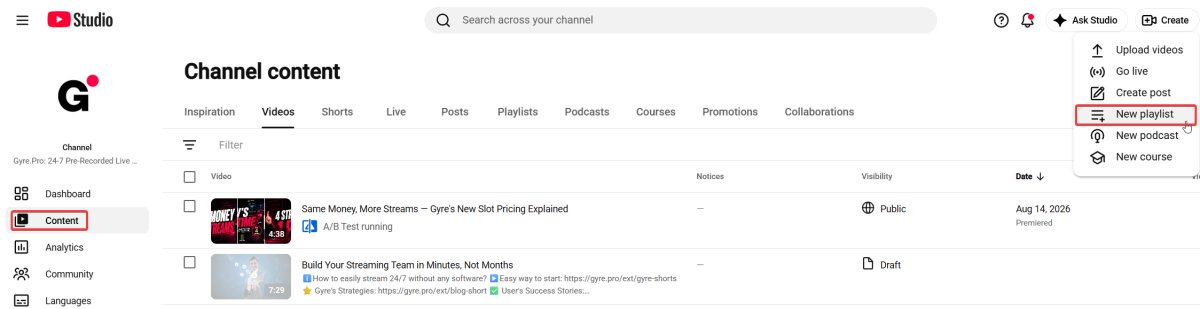
Sign in to YouTube Studio and click Content in the left menu. The tab row across the top holds Videos, Shorts, Live, Posts, Playlists, Podcasts, Courses, Promotions, and Collaborations. Everything you build will live under Playlists.
Step 2. Start a new playlist
Click Create in the top-right corner, then choose New playlist from the drop-down.
Step 3. Fill in the title, description, and settings
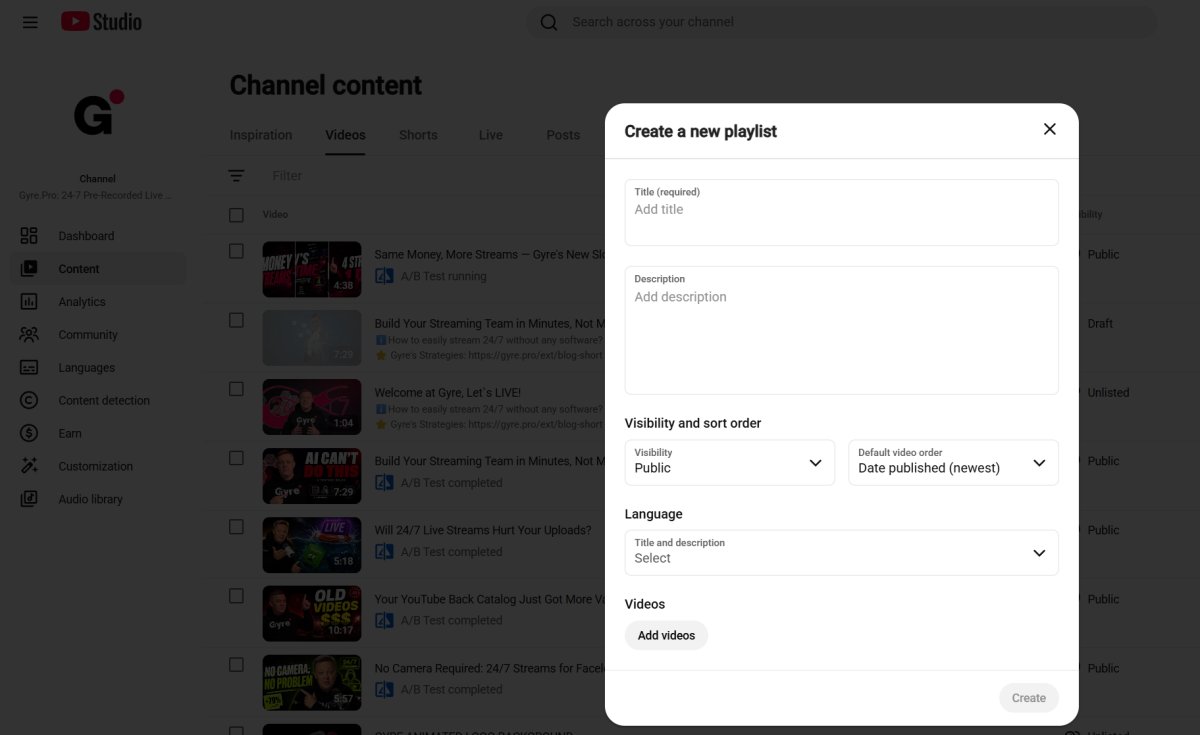
The Create a new playlist window puts every field on one screen:
- Title (required) describes what the playlist contains. Write it for search, not for your internal filing system.
- Description is optional in the interface and worth treating as mandatory. Two or three sentences cover it.
- Visibility sets who can see the playlist: public, unlisted, or private.
- Default video order controls sequencing. Date published (newest) comes preselected, and you can switch to date added, most popular, or a manual order.
- Language tells YouTube which language your title and description use.
Step 4. Add videos and create
Click Add videos to pull in content from your channel, from a YouTube search, or from a URL. Click Create, and the playlist goes live.
What do the playlist visibility settings mean?
YouTube offers three visibility settings for playlists: public, unlisted, and private. Creators trip over this one most often by leaving a playlist private and wondering why the link opens for nobody.
| Visibility | Who can open it | Where it appears | Use it for |
|---|---|---|---|
| Public | Anyone | Channel page, YouTube search, recommendations | Every playlist meant to grow the channel |
| Unlisted | Anyone with the link | Nowhere on your channel page or in search | Client reviews, drafts, sharing with a closed group |
| Private | You and viewers you choose | Nowhere | Internal collections and work in progress |
Two limits apply. YouTube caps how many public playlists one channel creates per day across the main app, YouTube Music, and the API, and access to advanced features raises the cap. Playlist creation may also be unavailable on supervised accounts.
To change visibility later, open Content → Playlists, click Details on the playlist, pick a new setting under Visibility, and save.
How to manage your YouTube playlist
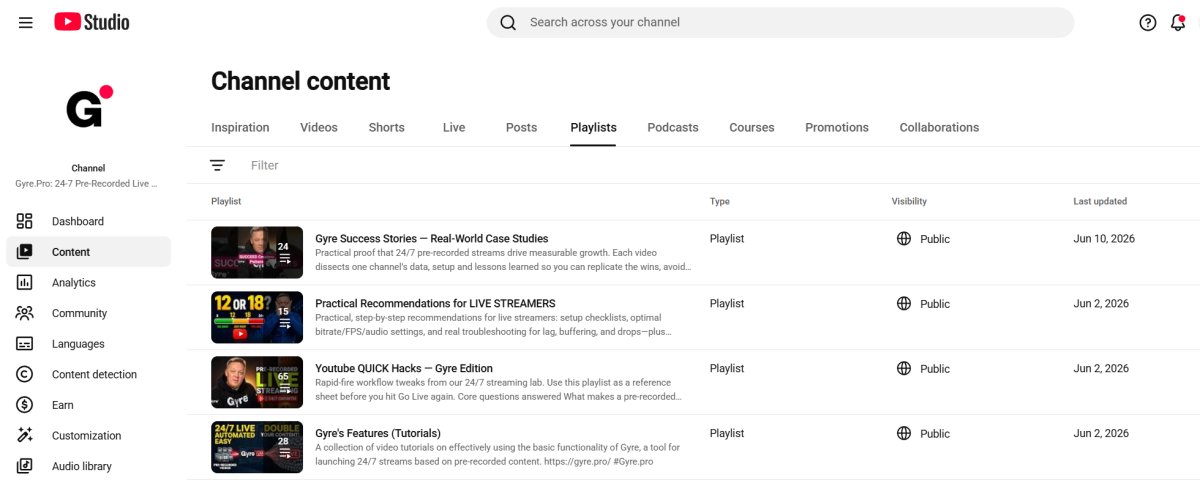
Everything you build sits in Content → Playlists, with columns for type, visibility, and date of the last update. The Last updated column is the fastest way to spot collections that have gone stale.
How do you edit a playlist?
Click a playlist, then the pencil icon. From there you can rewrite the title and description, change the playback order, remove individual videos, and set the playlist cover. Reordering is drag-and-drop, and it matters more than it sounds: position one decides whether a viewer stays past the first minute.
How do you add videos to a playlist?
Two routes work. From YouTube Studio, open Content → Playlists, find the playlist, and use Add video to pick from your channel or paste a link. From a video page, click Save below the player and tick the playlist you want. Route two is faster for single videos, route one for bulk work.
How do you set up a collaborative playlist?
Open the playlist, select Share, then Invite collaborators, and choose who to invite. If the playlist is still private, YouTube asks you to make it shareable before the invite goes out. The flow changed from the old menu-based version, so older guides describing a Collaborate toggle are out of date.
Collaboration scales further than most creators expect: hundreds of collaborators and thousands of videos are supported, and ranked voting lets contributors settle the running order between them. Switching collaboration off removes every collaborator at once, so treat it as a hard reset rather than a pause.
How do you share a playlist?
Open the playlist, click the share icon, and copy the link. Check two things before sending. The URL has to contain the word playlist rather than a single video ID, otherwise recipients land on one video with no queue behind it, and the playlist has to be public or unlisted for anyone to open it.
What is a series playlist?
A series playlist marks a set of videos as an official group meant to be watched together, which makes YouTube more likely to feature and recommend the rest of the set to someone already watching one part. Three conditions apply: a verified account, videos you uploaded and hold the rights to, and one series playlist per video. Turn it on from playlist settings on desktop with Set as official series for this playlist.
Use it where order genuinely matters, like a course or a multi-part tutorial. Applying it to a loose topical collection sends a confusing signal, because nothing in that set actually follows from the previous video.
How do playlists increase watch time?
Through autoplay. Inside a playlist the next video starts on its own, and what would have been one view becomes a session. Session length matters beyond the individual video, because it reflects how long your content held someone on the platform.
YouTube says its recommendation system learns from more than 80 billion signals a day, with watch history among the primary ones, including how long and how much of a video someone watches. What a viewer does after your video is part of that record.
Four habits move the number:
- Front-load your strongest video. Slot one has to earn the rest of the sequence. Sorting by upload date buries your best work in the middle, where nobody reaches it.
- Order by intent, not by date. A tutorial series should run from simplest to hardest, and topical clusters from foundational to advanced.
- Keep playlists tight. One clear topic outperforms a catch-all of forty loosely related uploads, because autoplay only keeps working while each video still feels relevant.
- Trim friction inside the sequence. Long intros and logo animations were built for standalone viewing. In autoplay they land as an interruption between two videos someone is already watching.
Playlists are one lever among several. Our guide on how to increase average YouTube watch time covers retention editing, hook structure, and the benchmarks worth measuring against.
How do you optimize a playlist for search in 2026?
Write the title as the query a viewer would type, add two or three sentences of description, set the language field, and keep each playlist to one topic. YouTube describes search ranking as a mix of relevance, engagement, and quality, with relevance estimated from how well titles, descriptions, and content match a query. Playlist metadata feeds that first part.
Write the title as a search query
Put the searchable term at the front. “Lightroom editing tutorials for beginners” works; “Season 2” tells neither YouTube nor a viewer anything. Keep the title under roughly 60 characters so it doesn’t truncate in the channel grid.
A free research shortcut: type your topic into the YouTube search bar and read the autocomplete suggestions. Autocomplete returns real queries, ordered by volume.
Make the first line of the description do the work
Playlist descriptions get truncated in most surfaces, so the opening sentence has to state what the playlist covers and who it’s for. Two or three sentences total is plenty. Add related terms rather than repeating one keyword, which tells the algorithm nothing new about your topical range.
Set the language field
The Language field in the creation window is easy to skip and worth filling in. The setting tells YouTube which language your title and description use, which matters for any channel publishing to more than one market.
Keep one topic per playlist
A playlist built around one subject gives YouTube an unambiguous signal about what it covers. Grab-bag collections dilute that signal. Single-video playlists dilute it further and give viewers no reason to keep watching, so skip them.
How do you feature playlists on your channel home page?
Open YouTube Studio → Customization → Home tab, then click ADD section under Layout and pick a playlist section. YouTube allows up to 12 custom sections on the home tab, and a new channel starts with four pre-populated ones: short videos, uploads, created playlists, and public subscriptions.
You can feature a single playlist, several playlists, or every playlist you’ve created. Order does the heavy lifting, because most visitors never scroll past the third section on mobile. A layout that works for a focused channel runs channel trailer, then your strongest playlist, then Shorts or live streams, then recent uploads.
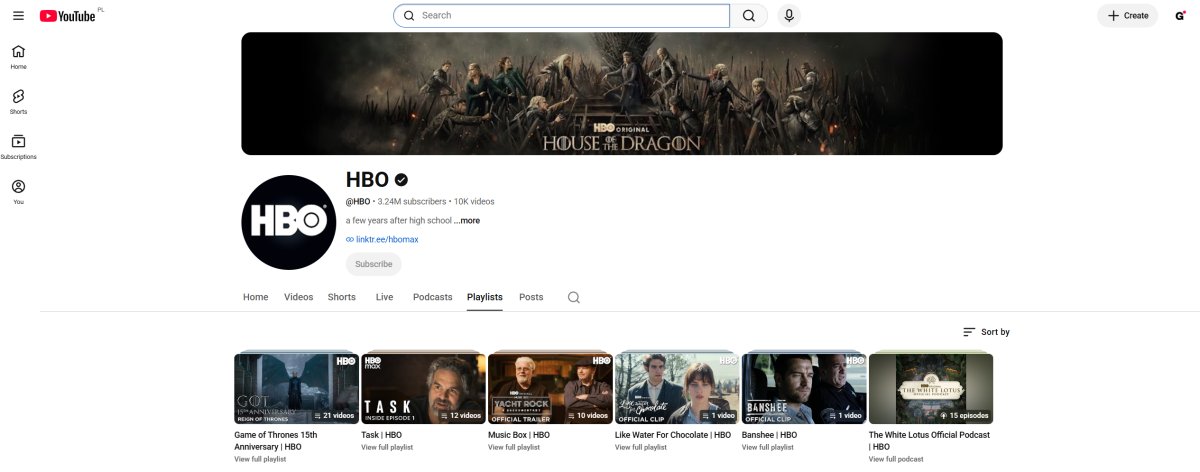
Sections interact with the rest of the page, from the banner to the first 100 characters of your channel description. Our complete checklist for optimizing a YouTube channel covers the rest of that layout.
How to optimize your playlist for maximum views
Four habits keep a playlist working after publication: consistent cover design, a monthly analytics check, end screen links, and regular content updates.
Create engaging thumbnails
Every video inside a playlist still competes on its thumbnail, and the playlist cover is what viewers judge from the channel grid. Consistent design across a series signals that the videos belong together, which pushes viewers to start at video one rather than dipping in at random.
Check your playlist analytics
Look at which videos get watched and where viewers drop out of the sequence. A steep fall after video two usually means the ordering is wrong rather than the content being weak, and reordering costs seconds. Our complete guide to YouTube analytics covers the retention and traffic-source reports behind those calls.
Use end screens and cards
Linking a playlist from an end screen triggers autoplay through the whole sequence, which beats linking one video when the goal is session length. Cards do the same job mid-video, for the moment a viewer needs context you covered elsewhere. There’s a full breakdown in our guide to high-converting YouTube end screens.
Update your playlists regularly
Add new uploads to the playlists where they belong, and pull out videos that no longer fit or have dated badly. A refreshed playlist also gives returning viewers a reason to open something whose cover they’ve already seen.
Can you turn a playlist into a 24/7 stream?
Yes. A topic playlist is already sequenced and thematically coherent, which is what a continuous broadcast needs. Instead of a random mix of uploads, you get a stream that plays as one program.
Gyre streams pre-recorded video as a live broadcast, so a playlist you’ve already built can run around the clock on YouTube, Twitch, or Kick without you being online. You upload the files, arrange them into a stream playlist, and the broadcast runs from the cloud. Our guide to streaming pre-recorded video as live covers the setup. Give it a try for free.
Key Takeaways
- Audit what you already have before uploading anything new. Grouping an existing library into topic playlists is usually the fastest structural win on an older channel.
- Rewrite playlist titles around the query a viewer would type, then add two or three sentences of description underneath.
- Move your highest-retention video into slot one of every playlist, and order the rest by what someone would want next.
- Feature two or three playlists on the home tab, then open your channel on a phone to check what lands above the fold.
- Point end screens at playlists rather than single videos when you want autoplay to carry the session.
- Feed your strongest playlist into a 24/7 stream so the same content keeps working during weeks you aren’t publishing.
FAQ
How do I create a YouTube playlist?
In YouTube Studio, go to Content → Playlists and click Create → New playlist. Add a title and description, choose a visibility setting and default video order, then add videos from your library or by link and click Create.
Do playlists help grow my channel?
Yes. Playlists keep viewers watching several videos in one session, which raises total watch time. Higher session watch time signals that your channel holds attention, and that feeds into how widely YouTube recommends your content.
Should I optimize playlist titles for SEO?
Yes. Use your target keyword in the playlist title and write a short description underneath. Playlist pages have their own URLs, and YouTube estimates relevance partly from how well titles and descriptions match a viewer’s query.
How many playlists should I have?
There’s no ideal number. Create one for every content series or topic cluster on your channel. Avoid single-video playlists and collections with no clear theme, since neither gives viewers a reason to keep watching.
What’s the difference between a playlist and a series playlist?
Both group videos, but a series playlist marks the set as official content meant to be watched together, which makes YouTube more likely to recommend the rest of the series to someone watching one part. A series playlist requires a verified account, works only with videos you uploaded, and holds each video exclusively.
Can other people add videos to my playlist?
Yes. Open the playlist, select Share, then Invite collaborators and choose who to invite. The playlist has to be public or unlisted first, and collaborators can add videos and take part in ranked voting on the running order.
Can I change a playlist from private to public later?
Yes. Open Content → Playlists in YouTube Studio, click Details on the playlist, pick the new setting under Visibility, and save. The change applies immediately.