 10 min read

That silent exit is exactly the problem end screens solve.
Consider what YouTube's own data tells us: roughly 70% of total watch time comes from recommended content, not from search. End screens give you rare direct control over what gets recommended next. DataGlobeHub's 2026 analysis found that playlist links in end screens add an average of 3.2 extra minutes of watch time per session. TubeBuddy ran their own test and saw end screen clickers watch for 3:32 on average, while the video's overall average view duration sat at just 1:40. More than double.
A well-built end screen doesn't close a video. It opens the next one.
This guide walks through everything: YouTube end screen design, step-by-step setup, CTA psychology, real channel examples, analytics, and the latest 2026 best practices.
TL;DR
- End screens occupy the last 5–20 seconds of your video. You get up to four clickable elements: video, playlist, subscribe button, channel, and external link.
- Healthy end screen click rate sits at 3–7%. Series content with strong CTAs regularly hits 8–10%. Small improvements compound fast. (Source)
- Silent end screens underperform. Pair every end screen with a verbal CTA telling viewers what to click and why.
- Plan the end screen before you film. Leave clean visual space in your final 15–20 seconds so elements don't bury important content.
What are YouTube end screens and why they matter
YouTube end screens are interactive overlays that appear during the final 5–20 seconds of a video. They show clickable elements: video thumbnails, playlist links, subscribe buttons. When a viewer taps one, they stay on your channel instead of wandering off.
But there's a deeper layer at play here. End screens also function as an algorithmic signal.
YouTube's recommendation engine tracks session watch time, the total minutes a viewer spends on the platform after clicking your video. Each time your end screen funnels someone into another video and they keep watching, YouTube reads that as a quality indicator. Your content starts showing up in more recommendations, reaching broader audiences.
That's why end screen click rate deserves a seat next to CTR and audience retention in your analytics routine. ScriptStorm's 2025 algorithm breakdown benchmarks a healthy rate at 3–7%, with channels consistently above 8% on series content seeing compounding growth in suggested traffic.
The stakes keep rising. YouTube's December 2025 expansion of Test & Compare now lets creators A/B test both titles and thumbnails, optimizing every touchpoint before a viewer even hits play. End screens are the last touchpoint in that chain. The moment where a retained viewer either converts into a session viewer or disappears.
YouTube end screen elements: what you can add
Every end screen supports up to four elements on standard 16:9 video. One rule applies universally: at least one element must be a video or playlist.
- Video is the most flexible option. Three flavors exist: your most recent upload, a video YouTube picks as "best for viewer" based on the individual's history, or a specific video you select yourself. Go with "specific video" when you've referenced it in your outro. That alignment between spoken CTA and clickable thumbnail is what drives high engagement. "Best for viewer" works better when your channel spans diverse topics and the algorithm knows your audience better than you do.
- Playlist links to a public YouTube playlist and triggers autoplay. Videos roll one after another without requiring any decision from the viewer. For tutorial series, episodic content, or progressive how-to guides, this element quietly outperforms everything else in watch time impact.
- Subscribe shows up as a circular button with your channel icon that expands into a subscribe prompt on hover. You can't customize the button itself, but you can shape your video's background to draw attention to it (more on that in the design section).
- Channel promotes another YouTube channel with a custom message. Most useful for collaborations and cross-promoting a second channel you run.
- Link sends viewers to an approved external website, available only to YouTube Partner Program members. Think merch stores, courses, crowdfunding pages. Use it deliberately: every outbound click chips away at your session watch time.
How to add an end screen to a YouTube video
The whole process takes about a minute inside YouTube Studio.
Step 1. Open YouTube Studio on your desktop. End screen editing isn't supported on mobile.
Step 2. Go to Content in the left menu. Locate your video and click its title or thumbnail.
Step 3. Select Editor from the left panel.
Step 4. Hit the End screen button in the editor timeline. Two paths open up: pick a pre-built template or build from scratch with individual elements.
Step 5. Add elements by clicking + Element. Options include Video, Playlist, Subscribe, Channel, and Link.
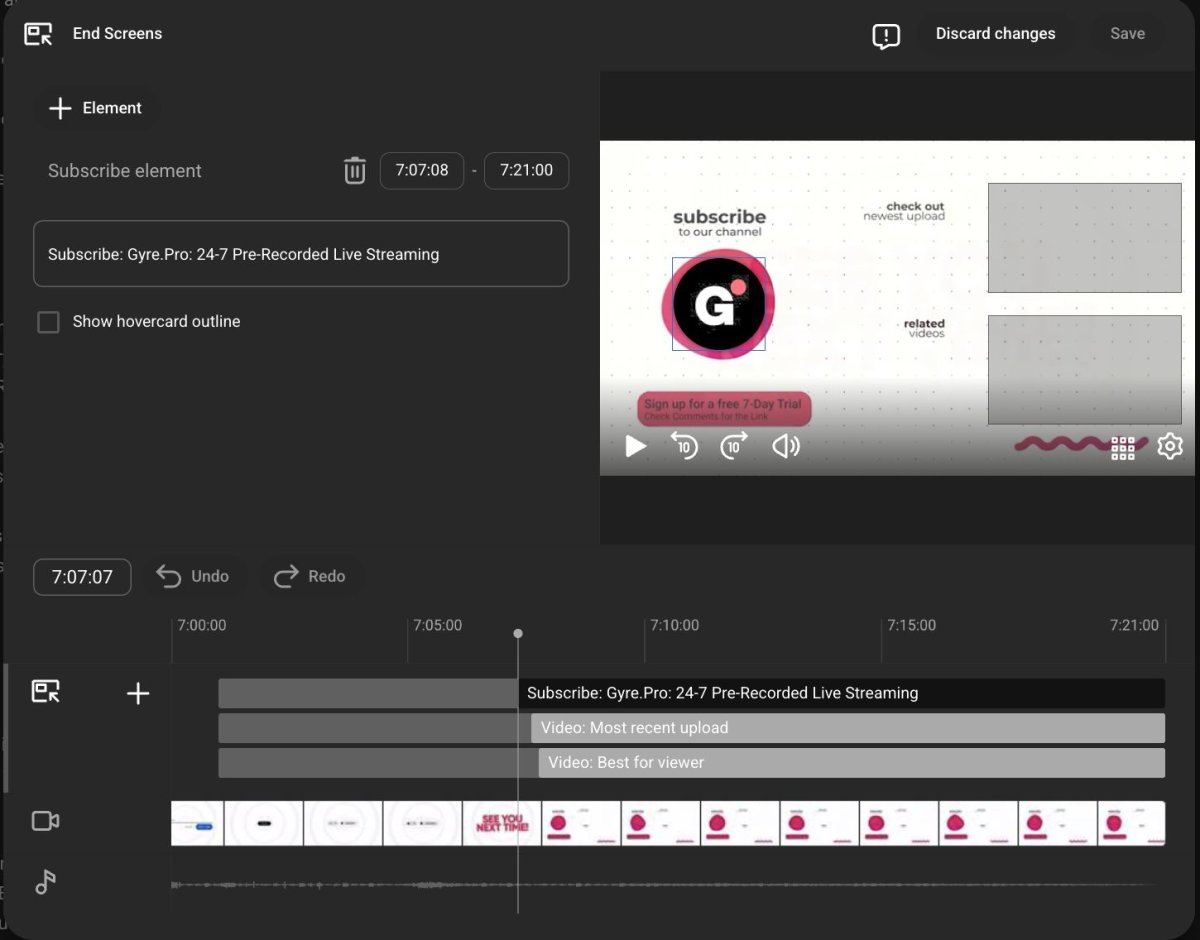
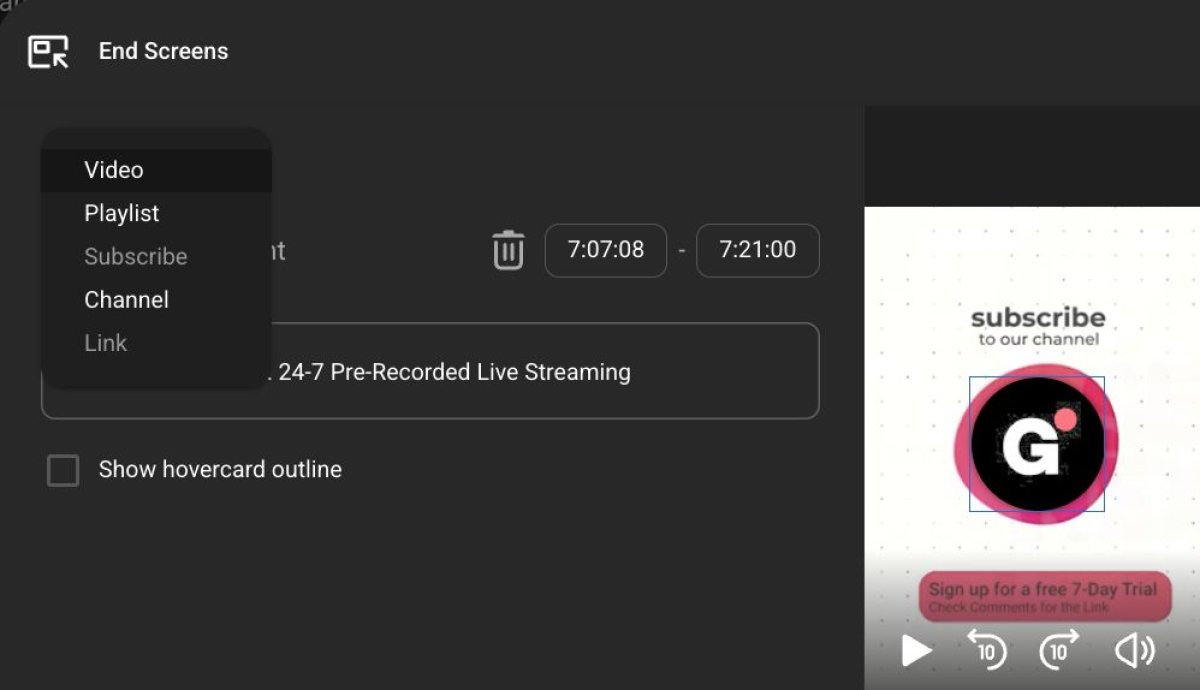
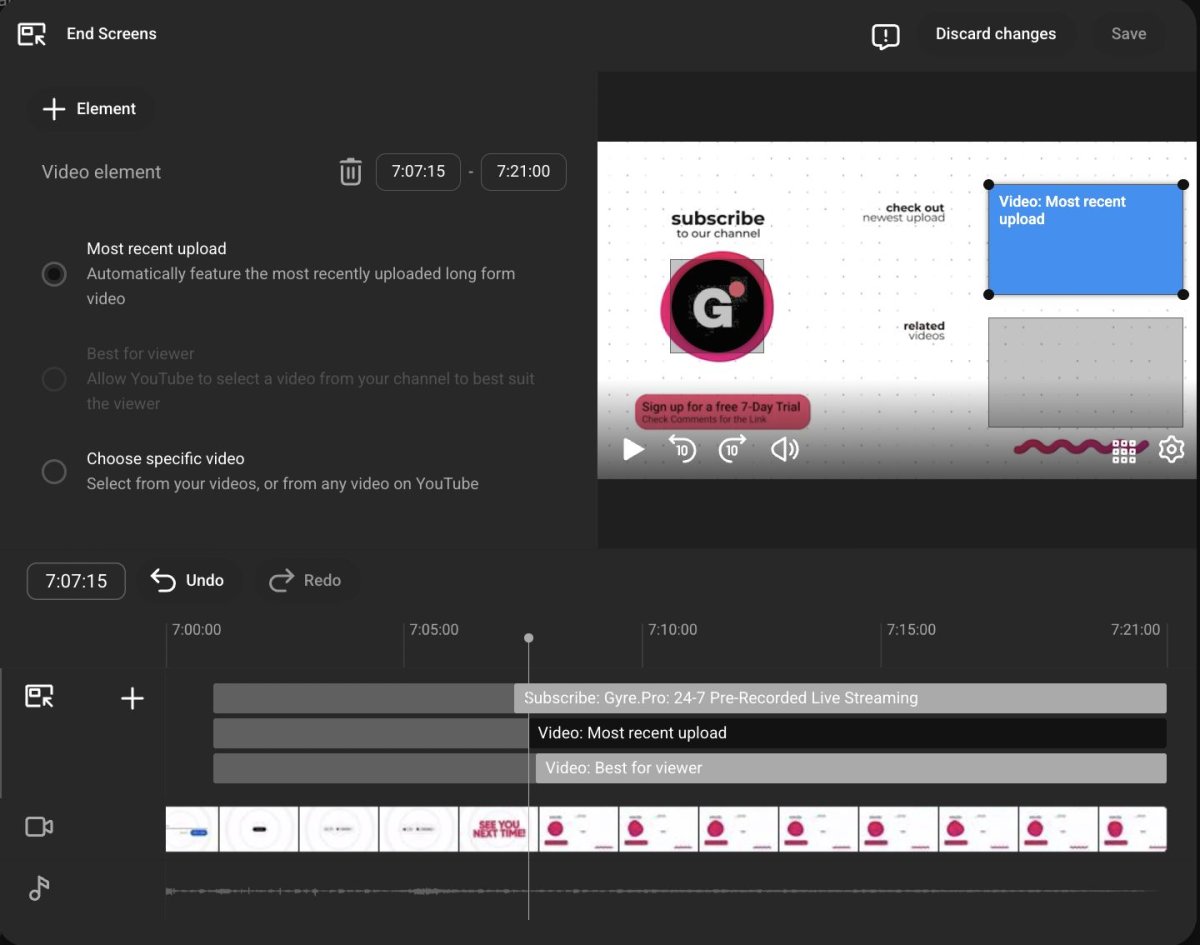
When adding a video, you'll choose between "Most recent upload," "Best for viewer," or “Specific video.”
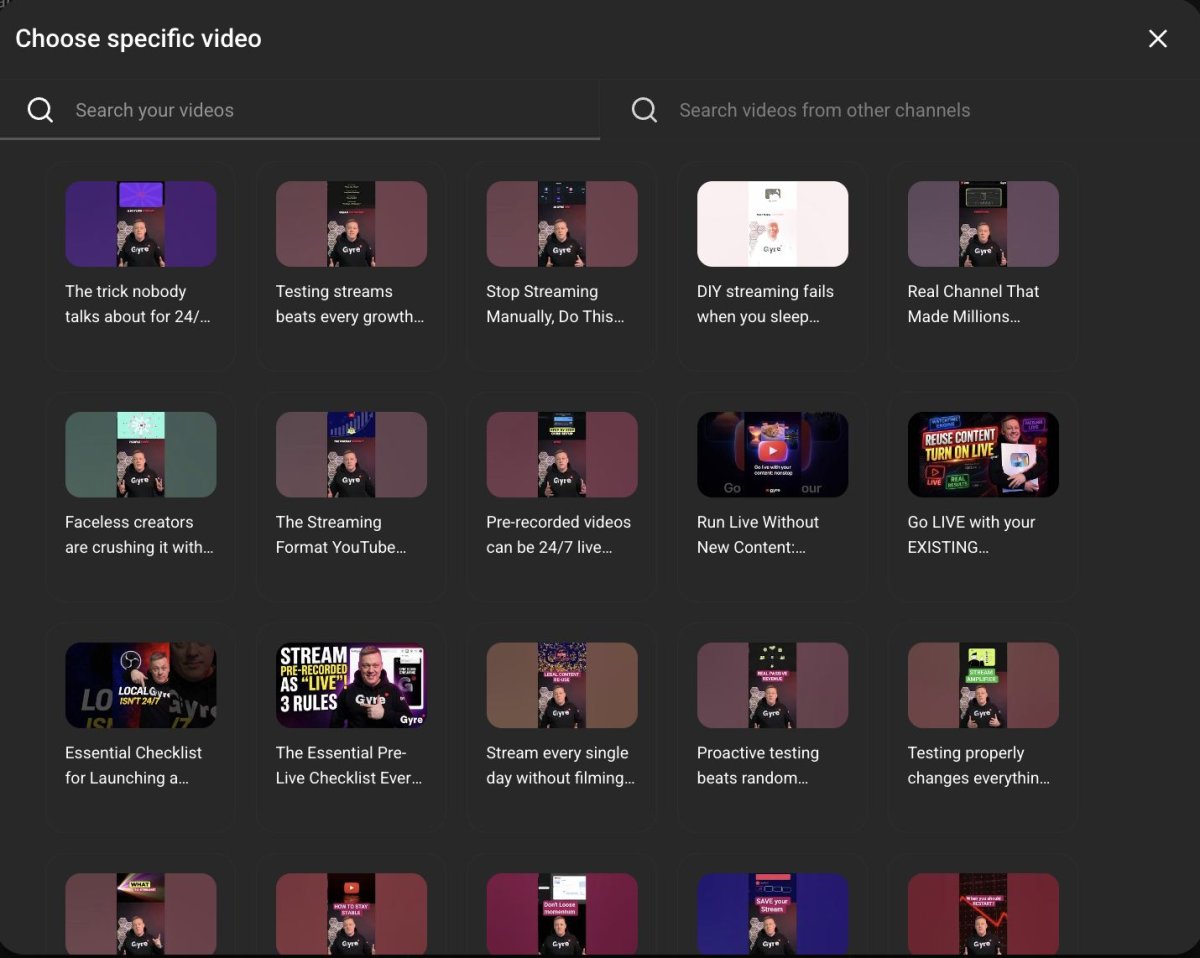
Selecting "Choose specific video" opens your full video library where you can search your uploads or videos from other channels.
Step 6. Drag elements into position within the video preview. Toggle the grid overlay for alignment help, and use "Snap to grid" or "Snap to element" for precision. Check spacing carefully so nothing overlaps.
Step 7. Fine-tune timing in the timeline below. Pull the start and end handles for each element. You can stagger them: maybe the video suggestion appears 15 seconds before the end while the subscribe button pops in at 10 seconds.
Step 8. Hit play in the video player to preview the full end screen over your actual footage.
Step 9. Click Save.
Worth knowing
- Videos must be at least 25 seconds long to support end screens.
- "Made for Kids" videos can't have end screens.
Watermarks and other overlays vanish while end screen elements are visible. - End screens won't render on mobile web (iPad is the exception), YouTube Music, or YouTube Kids.
YouTube end screen design best practices
Design the end screen before you press record. Every decision below flows from that principle.
Build clean space into your final 15–20 seconds
Creators who finish their video with important visuals on screen, then layer end screen elements over everything, end up with a visual mess viewers either ignore or resent.
Film your outro with specific zones left open for elements. A branded background, a subtle animation loop, or a talking-head shot with empty space on both sides all work. Brief your editor: the last 15–20 seconds need clear zones, planned in advance.
Know the dimensions
YouTube end screen dimensions follow the standard 16:9 ratio (1280×720 or 1920×1080). Element sizes are fixed: video and playlist thumbnails run approximately 615×345 pixels, subscribe buttons, channel circles, and link squares are each about 294×294. Shape your background artwork around these exact footprints.
Make elements pop with contrast
Whatever remains on screen during the final seconds competes with your end screen overlays. Darken or blur the background behind element zones. If you design custom artwork, carve out high-contrast landing areas for thumbnails. Bold colors on dark backgrounds boost visibility, especially important given that 70% of YouTube viewing happens on mobile.
Account for the living room
YouTube now holds the title of top streaming platform on TV screens. Your end screen needs to read from a couch ten feet away. Larger text, strong color contrast, zero fine print. Quick test: view the end screen on your phone at arm's length. Readable? It'll work on a TV.
Brand every end screen consistently
Recognition lowers resistance. Same fonts, same color palette, same layout across every video. When returning viewers spot a familiar end screen, they process it instantly and click faster. That consistency isn't cosmetic. It's a conversion tool. (You'll see this in action in the MKBHD example below.)
How to write a CTA that actually gets clicks
An end screen with no verbal CTA is a billboard nobody looks at. You have to tell viewers to click.
Mention the next video out loud
Simplest tactic, biggest impact. In the last 15–20 seconds, point to the video you're linking. Name it. Explain what the viewer will get.
- Flat: “Thanks for watching. See you next time.”
- Effective: “I applied this exact strategy to a live campaign and the results were wild. That video is right here.”
The effective version names a specific video, sells its value, and builds a bridge from the content the viewer just consumed.
Frame CTAs around outcomes, not actions
"Check out this video" gives zero reason to act. Reframe around what the viewer will learn, discover, or see:
- “Watch this next to see the 30-day results.”
- “Start this playlist from video one for the full setup.”
- "Subscribe. New guides land every Tuesday."
Each line answers the real question behind every click: What's in it for me?
Bridge one video to the next
The strongest CTAs create continuity. If your video about how to get more views on YouTube closes with a watch time tip, bridge naturally to a video that dives deeper into watch time optimization. Viewers follow the thread because it feels like a logical next chapter, not a redirect. (Ali Abdaal's approach to this is worth studying — see the examples section.)
Rotate your approach
Repeating the same outro script on every video trains viewers to tune out. Mix it up:
- Teaser: “I almost crammed this into today's video. It needed its own deep dive. Here it is.”
- Challenge: “Go try the technique I just showed you. Then watch this to take it further.”
- Direct ask: “Hit subscribe if this helped. New stuff drops every Tuesday.”
- Curiosity hook: "This next video covers the single mistake I catch on nearly every channel I audit."
How end screens boost watch time and subscriber growth
YouTube's algorithm doesn't simply reward individual videos. It rewards sessions: how long a viewer stays on the platform after watching your content.
End screens plug directly into that metric. When someone clicks through into another video and keeps watching, YouTube credits that extended session to your channel. Repeat this across hundreds of videos and YouTube starts distributing your content more broadly through Browse Features and Suggested Videos — the two surfaces responsible for most views on successful channels.
The numbers from the intro are worth contextualizing here. That 112% watch time lift TubeBuddy documented? It came from a single end screen click. And the 3.2 extra minutes DataGlobeHub measured from playlist end screens happen because autoplay carries viewers through two or three episodes without requiring another decision. Passive binge behavior is exactly what the algorithm rewards.
Subscriber growth works through a less direct but equally real mechanism. Longer sessions mean more exposure to subscribe prompts across your channel. People who watch several of your videos in one sitting convert at a much higher rate than one-and-done viewers.
For more on building total channel watch time, see our guide on how to increase average YouTube watch time and why it matters.
Common end screen mistakes to avoid
Every one of these errors quietly erodes performance. Some are obvious. Others are sneaky.
- Treating end screens as an afterthought. If your video has no clean outro space, elements will land on faces, text, and key visuals. The fix is upstream: plan the outro during pre-production, not post-export.
- Linking to something unrelated. A cooking tutorial that end-screens to a random vlog confuses viewers. Quick gut check: would at least 70% of the audience who made it to the end want that next video?
- Going silent. End screen elements that appear without a verbal introduction get far fewer clicks. Tell the viewer it's there. Say why it matters.
- Overcrowding. Two well-placed, relevant elements beat four competing ones. Clutter triggers paralysis.
- Set-and-forget syndrome. Running the same end screen for months without checking analytics likely means stale links. Pull up the End Screen report at least monthly.
- Skipping device testing. What looks sharp on desktop may be hard to tap on a phone or illegible on a TV. Test across screens.
- Ignoring your back catalog. Older content still pulling organic traffic deserves fresh end screens. Budget one minute per video — it's one of the fastest wins available.
How to track end screen performance in YouTube Analytics
YouTube offers dedicated end screen reporting. Knowing where to find it and what to focus on makes all the difference.
Where to look
Channel-level view:
- Open YouTube Studio, head to Analytics, then the Reach tab.
- Find "Top end screen element types" to compare which element categories attract the most clicks across your channel.
- Check "Top videos by end screen" to identify which videos generate the most end screen engagement.
Single-video view:
- In YouTube Studio, open a specific video, go to Analytics, then Reach.
- Look for "End screen element click rate" to see how often viewers clicked each element.
What to measure
- End screen element click rate is your core conversion number: the percentage of viewers who clicked versus how many saw the element. Benchmarks are covered in the "What are end screens" section above.
- Shown vs. clicked volume gives you raw scale. A video pulling 100,000 views with a 5% click rate generates 5,000 extra video starts. Meaningful traffic.
- Element type comparison reveals which format works hardest. Video and playlist elements typically eclipse subscribe buttons in click rate. Let this shape how you allocate slots.
- Performance over time matters most when you swap an element (say, changing the linked video). Compare click rates before and after. This is essentially a manual A/B test, and the results can be surprisingly decisive.
For a fuller picture of reading your YouTube data, see our complete YouTube Analytics guide.
YouTube end screen examples: real channels, real strategies
Theory only goes so far. These four channels each demonstrate a different end screen principle in action.
Link to the logical next video: MrBeast
MrBeast's production philosophy orbits one idea: never signal that the video is ending. His leaked internal guide instructs editors to keep energy high through the absolute final frame. When the end screen appears, it catches viewers at peak engagement. The approach is minimal — one strong, specific video suggestion. After a tense survival challenge, the end screen might feature something tonally different but equally compelling, like a puppy rescue. Just one thumbnail designed to capture momentum and redirect it.
At 300M+ subscribers, the proof is in the numbers. A single well-chosen video, placed after content that retains viewers to the very last second, consistently outperforms a crowded four-element layout.
Leverage playlists for series content: TED-Ed
TED-Ed's end screens link to curated playlists of follow-up lessons. Finish a five-minute animation about the history of democracy and the end screen points to an entire playlist on related topics. Someone who just watched a history lesson probably wants another one. Autoplay carries them through two, three, four lessons without a single additional click.
Educational content has a built-in advantage here. Curiosity isn't satisfied by a single video, and the playlist removes every scrap of friction between "I'm interested" and “I'll keep watching.”
Script the verbal bridge: Ali Abdaal
Productivity creator Ali Abdaal writes his end screen into the script — not as an afterthought, but as part of the content itself. Fifteen seconds before the video ends, he'll say something like: "I made a full walkthrough of how I organize my week using this system. It's linked right here." The viewer hears a reason to click before the element even appears on screen.
He describes this as making end screens a "conversation continuer, not a conversation ender." Viewers who click through arrive already sold on the next video. They're primed to watch, not browse.
Build a recognizable visual template: MKBHD
Tech reviewer Marques Brownlee keeps his end screen stripped down: matte black background, two video thumbnails aligned cleanly, channel subscribe circle. The same layout, every single video. Returning viewers recognize the format in a split second. They don't need to scan or interpret anything. Familiarity eliminates cognitive load, and lower cognitive load translates to faster clicks.
Conclusion
End screens are simple to set up, take one minute to add, and can double your watch time when paired with a strong verbal CTA. The data from this guide tells a clear story: channels that treat those final 20 seconds as a strategic asset grow faster.
If you're running a channel that streams pre-recorded content, whether educational series, music, ambient loops, or 24/7 live programming, Gyre keeps that content live and reaching audiences around the clock. More hours streaming means more entry points for viewers to discover your end-screened videos and stay inside your content ecosystem.
Pick one video today. Add an end screen. Write the CTA into the script. Check the numbers in a week.
FAQ
How do I add an end screen to a YouTube video?
Open YouTube Studio on your desktop, click Content, and select your video. Go to Editor, then click End screen. Apply a template or add individual elements (Video, Playlist, Subscribe, Channel, Link), position them in the preview, and click Save. Videos need to be at least 25 seconds long. The feature is unavailable on content marked “Made for Kids.”
What is the best time to show end screens?
Anywhere in the last 5–20 seconds works, but 15–20 seconds tends to perform best. That window gives viewers enough time to notice elements and decide, without eating into the main content. The key is having clean visual space during that window — many channels film a dedicated outro segment specifically for this.
How many elements should I put on my end screen?
Two or three. YouTube allows four, but more elements create more decision friction. A video suggestion paired with a subscribe button is one of the most proven setups. Add a playlist for series-based channels.
Do end screens work on YouTube Shorts?
They don't. End screens are a long-form feature only. Shorts have their own engagement mechanics: swipe-to-next behavior, a dedicated subscribe button, and a separate discovery algorithm. To bridge Shorts viewers to long-form content, use the description or a pinned comment.
Can I add end screens to older videos?
Yes, at any time. Retrofitting evergreen content with fresh end screen elements is one of the quickest ways to lift overall session watch time. Prioritize videos that still pull organic traffic but link to nothing or to outdated content.
What is a good end screen click rate?
3–7% is solid. Channels that optimize consistently push past 8% on series content. Below 1% usually signals irrelevant elements or a missing verbal CTA. Check the Reach tab in YouTube Analytics to see your numbers.
YouTube end screens vs. cards: what's the difference?
Cards are compact pop-ups that can surface at any point during a video via a small "i" icon. End screens fill the final 5–20 seconds with larger visual overlays. Cards work best as mid-video nudges; end screens handle the closing pitch. Strongest results come from using both together.