 20 min read

Why Psychology-Driven Retention Works
Success on YouTube is determined not so much by the quality of the video itself (its resolution, professional editing, beautiful shots, etc.) as by your understanding of audience behavior patterns. In fact, low retention is often a direct consequence of a structural mismatch between the brain's needs and the way you deliver your content.
As we've written before, viewers make decisions to stay or leave every 3 seconds, which are controlled not by logic but by reward and attention loops in the limbic system. Therefore, your task as a creator is to manage these loops and shape the right curves, constantly providing your audience with microdoses of the reward hormone (dopamine) and the stress hormone (cortisol). This is necessary to avoid sensory adaptation and maintain constant engagement.
Hack #1: Open-Loop Tension
Let’s start the list of our psychology hacks for YouTube with using the Zeigarnik effect, which states that unfinished actions are remembered better than completed ones. The reason is that our brains are constantly itching for a cognitive response until the hormonal loop is closed.
Here's how it might look with a specific example: "I’ve tried 20 ways to make big money, but only my fourth way helped me buy this Porsche". In the video itself, you'll need to ask a question at the beginning of the relevant section and temporarily delay the answer by inserting supporting but related material. For example, if you're posting a video with a cake recipe, you might show the finished cake in the first 10 seconds but promise to reveal the "secret ingredient" only at the end. This way, you'll boost the video watch time simply by closing the loop: “What is that ingredient?”
Hack #2: Micro-Goals for the Viewer
Our second hack is based on reducing cognitive load: in particular, a large goal (for example, watching a half-hour video) will seem daunting to the average viewer; at the same time, achievable "microgoals" will create a sense of progress.
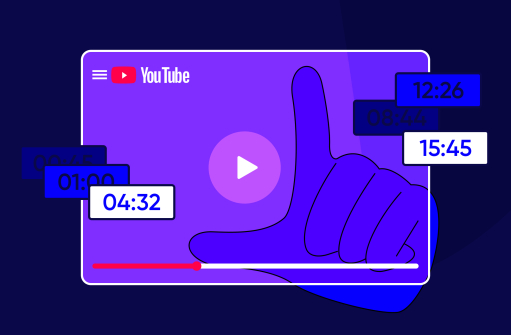
In practice, you simply need to divide your video into clear, named sections, each of which should promise a specific intermediate result – for example, you can start with "solve error #1," followed by "how it affects the result," etc. This is usually done by breaking the video into timecodes or overlaying internal captions with clear titles.
Hack #3: Pattern Interruption
Since our brain quickly adapts to any visual or audio pattern (monotonous frame changes, a quiet voice, a uniform tempo of background music, etc.), all of this ultimately provokes boredom. At the same time, abruptly interrupting monotonous segments recharges attention.
In practice, you can simply change the visual every 30-45 seconds – for example, switch from a panoramic shot to a close-up, insert a meme, or simply change a color palette to another one. This can also work with audio – through changing music, inserting a sharp sound effect, or speeding up or, conversely, slowing the intonation or tempo of speech. Specifically, if you calmly explain a product's features for two minutes, it makes sense to insert a 5-second accelerated montage of the unboxing or use stage.
Hack #4: Reward Prediction Cues
This great hack about storytelling psychology on YouTube involves stimulating the dopamine system – the brain needs to experience pleasure both from receiving a reward and from anticipating it.
For example, you can regularly remind the viewer of what they'll get, like "Watch until the end to learn the most affordable lighting hack that will transform your streams." Or, if you're making a lifestyle video, you can show how you achieve a goal in advance (for example, putting the finishing touches on a specific dish) – this way, the viewer will stick around to see how to achieve the same result.
Hack #5: Narrative Anchors
Our fifth hack is to create recognizable repetition – that is, to provide predictability to recreate a sense of comfort.
In particular, the following combination (or one of these three) would work well: a consistent phrase: "And now, the weekly insight," a familiar visual element, such as a graphic overlay (which appears when you discuss a specific, recurring topic), and the same musical jingle that plays at the beginning of each new section. For example, if you're creating historical videos, each new era overview could begin with the same animated transition and musical intro. This will signal to the viewer: “New information is coming, but in a format you're familiar with.”
Hack #6: Cognitive Contrast
The essence of this hack is to abruptly change scale, perspective, or emotional tone to force the brain to rewire itself and reengage its attentional resources.
It's about transitioning from a very general, philosophical idea to a concrete example. In the context of an educational channel, after several minutes of serious, technical information, you can insert a 15-second humorous scene: that is, after a complex explanation of a formula, you should move on to a simple analogy with an everyday object (a pen, a flea, a chair, etc., just like Scott Clark did in Stranger Things, explaining to children about the transition to another dimension).
Hack #7: Progress Cues and Pacing
The mechanics of this hack are simple: you need to visualize how much progress has been made to maintain viewer motivation, meaning you need to show them that the effort invested in watching your content has been fully rewarded and that their goal is within reach.
The easiest way to implement this is to create a visual progress bar, for example, through an animated list of items you cross off as you complete them. You can also use a faster pace: as you approach a key point in the video, you should boost the volume and/or increase the frames per second. For example, if you create a video overview, you could show a list of 10 features and, when discussing feature #7, clearly indicate to the viewer that there are only three remaining.
Hack #8: Audio-Driven Attention Shifts
Moving on to hack number 8: sound is processed by the brain faster than visual information, so it can be used as a powerful emotional trigger.
The first thing you can do to achieve this is change the pace of speech – for example, from a slow narrative to a fast, tense pace during the climax. You can also establish a sound hierarchy and, at key moments, either remove background music, leaving only the voice, or, conversely, add a powerful sound design. Particularly for faceless video retention, you have to use a simmering, tense ambient sound during the data presentation, and when the graph reaches its peak, insert a sharp "Boom!" followed by silence.
Hack #9: Emotional Sequencing
Another YouTube retention 2026 hack is to alternate emotional intensity to prevent burnout and maintain viewer engagement, as constant high intensity is draining.
To be more precise, after a high-intensity moment (usually a problem, conflict, or climax), you should immediately transition to a low-intensity element (this could be a calm explanation, reflection, or a real-life example). For instance, if you publish travel videos, after a tense moment (when something goes wrong), you might immediately transition to a calm, aesthetically pleasing sunset shot with relaxing music.
Hack #10: The Promise Reset
Finally, as the last of our viewer retention tips, you need to be aware that viewers can forget about the main value you promised in the hook. Conversely, periodic reminders re-ignite motivation to watch your video.
Actually, you can return to the main topic every 3-4 minutes, using phrases like, "All of this brings us closer to answering how..." For example, if you're working on a video about finance, you could include a line like, “We've covered three tools, but the real key to passive income, which I talked about at the very beginning, lies in how you manage your taxes. That's what I'm going to talk about now.”
How to Test Which Psychological Triggers Work on Your Channel
We all know that to understand whether your video psychology tricks are working, you can't do without YouTube analytics, specifically, regularly checking the Audience Retention Graph. Here's what you need to do:
- Identify audience loops. Highs indicate that viewers are rewatching a particular segment, meaning it's the most valuable. Therefore, to understand why watch time increases, you need to identify the attention triggers you used there.
- If you've identified drop-off points, you now know the sections of your video where the psychological trigger didn't work or where you broke your promise.
- Next, move on to testing your hypotheses: for example, your Hypothesis 1 is, "Insert a Pattern Interruption at 1:45 instead of a monotonous explanation. If the retention line levels out or even rises after 1:45, the hack works. If it drops, the insertion was irrelevant or too abrupt." Hypothesis 2 is, “Use a Progress Cue in the Top 5 intro. Now, we can compare retention in the first 30 seconds, as visualizing progress is likely to increase the viewer's initial investment.”
Conclusion
Using these 10 scientifically proven psychological hacks on how to hold an audience, you'll go from creating simply engaging content to something psychologically irresistible, guaranteeing the significant YouTube engagement boost. And don't forget about another secret hack for extending your YouTube watch time – namely, 24/7 streaming, which you can implement with our Gyre tool.