 12 min read

TL;DR
- A stream key is the RTMP password that links your encoder (OBS, Streamlabs, vMix, XSplit, Restream, Gyre) to your channel. Find it in YouTube Studio → Create → Go Live → Live Control Room.
- Going live right away? The key sits on the Stream tab. Scheduling an event? Open Manage → Schedule stream, then open the event itself.
- Before your first broadcast, verify your channel with a phone number and allow up to 24 hours for activation. Two-factor authentication is a smart security habit, not a YouTube requirement.
- YouTube never displays the key in plain text. Copy it with the icon next to the selector, and reset it from the same spot if it leaks.
- A persistent key stays the same across broadcasts; an event key dies with the scheduled event it belongs to.
- Current limits: 10 active streams per channel and 3 broadcasts per stream key.
- With Gyre, channel authorization through the YouTube API creates the broadcast and wires the key for you, so there’s nothing to copy at all.
What is a YouTube stream key?
A stream key is a short string that identifies your channel to an encoder. YouTube describes stream keys as your stream’s password and address: they tell your encoder where to send the feed and let YouTube accept it. Alongside the key you get a Server URL, usually rtmp://a.rtmp.youtube.com/live2 or its encrypted rtmps:// equivalent.
The pair works as a unit. Without both, OBS or any other encoder has no way to tell which channel the video belongs to, and the connection fails at authorization. Treat the key exactly as you’d treat a password: anyone holding it can broadcast on your channel, under your name, to your audience.
What do you need before your first stream?
YouTube won’t show you a stream key until live streaming is enabled on the channel. The requirements are short: a verified channel, no live streaming restrictions in the past 90 days, and a minimum age of 16. Verification runs through a phone number in Settings → Channel → Feature eligibility → Intermediate features.
The first activation takes time. After you enable live streaming, YouTube needs up to 24 hours before the feature actually opens, and there’s no way around the wait. Set this up the day before you plan to broadcast rather than an hour before.
One correction worth making, because it circulates widely: 2-Step Verification on the Google Account is not part of YouTube’s live streaming requirements. It’s still worth turning on. Your stream key is only as safe as the account that generated it, and password-only protection is thin when an automated service holds the credential.
How the Live Control Room is organized
Everything related to live streaming now lives in one place. The standalone “Stream settings” page is gone; the Live Control Room replaced it. To open it, go to studio.youtube.com, click Create in the top right (the camera icon with a plus), and choose Go Live.
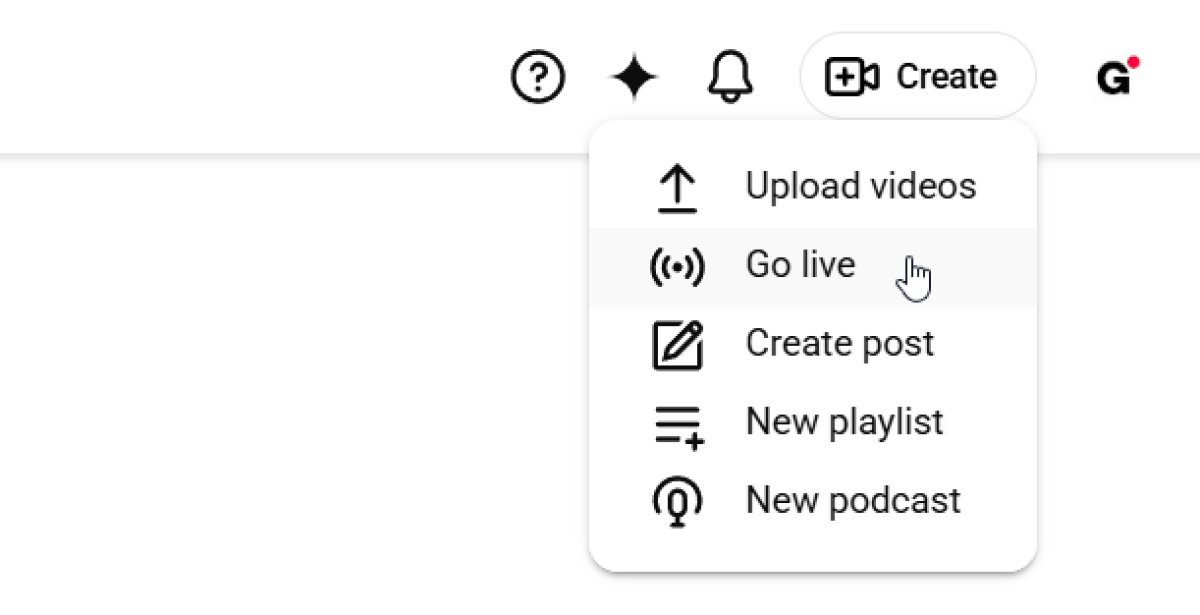
Two tabs matter, and which one you need depends on the broadcast:
- Stream — for going live immediately, or for a single always-on setup. The key here persists between broadcasts: paste it into your encoder once and use it for months.
- Manage → Schedule stream — for planned events. Each event is created separately, with its own thumbnail, description, and start time, and YouTube issues a key for it.
How do you find the stream key for an instant broadcast?
Open the Stream tab and copy the key from the selector above the preview. That’s the whole flow, in detail:
- In the Live Control Room, click Stream in the top left panel.
- Streaming for the first time? YouTube asks for metadata: title, description, category, and privacy setting. Fill those in and click Create stream.
- Streamed before? Your previous settings load automatically, including the same key, so your encoder needs no changes at all.
Find the Stream key selector in the top right corner of the preview block, next to the line about connecting your encoder. It defaults to “Default stream key (RTMP, Variable).” Click the copy icon beside it and the key lands on your clipboard. YouTube keeps the key masked, so copying is the only way to move it.
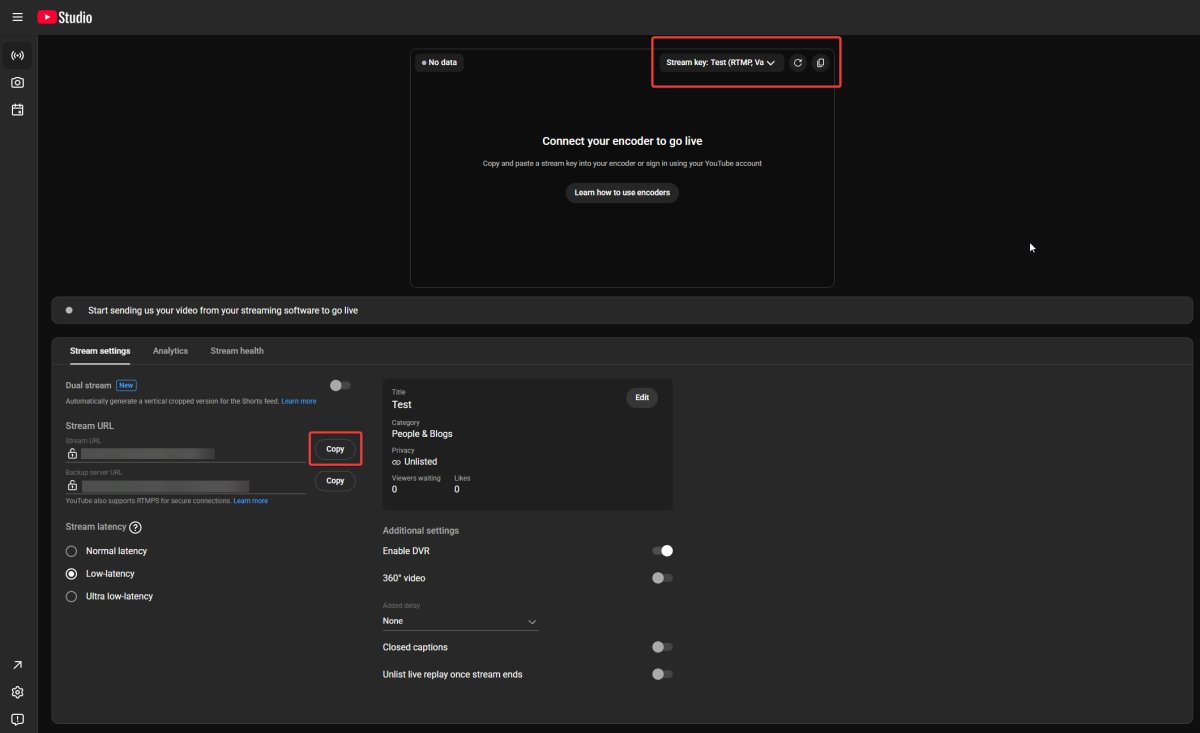
- Scroll below the preview to the panel with the Stream settings, Analytics, and Stream health tabs. Stream settings holds the Stream URL and the Backup server URL, each with its own Copy button. Take both: your encoder needs the URL and key together, and the backup address covers a failover connection.
How do you find the key for a scheduled stream?
Open Manage → Schedule stream, create the event, then copy the key from the same selector above the preview. Scheduling suits any broadcast that benefits from advance notice: subscriber reminders, a shareable URL before the start, or a trailer on the watch page.
- In the Live Control Room, open the Manage tab.
- Click Schedule stream in the top right.
- Choose between Reuse settings, which copies the metadata and stream key from an earlier broadcast, and Create new for an event built from scratch.
- Fill in the metadata: title, description, start date and time, thumbnail, and privacy. Click Create stream.
- The event appears in the list on the Manage tab. Click it to open that specific broadcast.
- The key sits exactly where the persistent one does: in the Stream key selector above the preview, with the same copy icon beside it.
Persistent key vs event key: which one do you need?
Take the persistent key for anything that runs regularly or continuously, and the event key for a single scheduled broadcast. The difference is lifespan:
- Persistent stream key — the one on the Stream tab. It survives between broadcasts, which makes it the right choice for regular streaming from a single encoder and for continuous 24/7 formats. Paste it into OBS once and forget about it.
- Event stream key — the one inside a specific scheduled event on the Manage tab. It lives as long as the event does. Best for one-off broadcasts with metadata, a thumbnail, and a trailer prepared in advance. Trailers, incidentally, become available at 1,000 subscribers.
Planning continuous content? Stay on a persistent key. Running a single announced event with its own artwork? The event key fits better.
Can you skip copying the key entirely?
Yes, if your encoder authorizes the channel instead of taking a pasted credential. Everything above describes the manual route, which works with any software. Gyre offers the other one: the service connects to YouTube through the official API, so the key never passes through your hands.
In practice you authorize the channel once, and Gyre creates broadcasts on it from then on, carrying the title, description, tags, and thumbnail across in the same action. It picks up one of your existing keys or generates a new one and binds it to the broadcast. Running several channels, or dozens of parallel 24/7 streams, is where that saving compounds.
Monetization needs one manual step regardless. For ads to run on API-created broadcasts, open YouTube Studio → Settings → Monetization → Monetization defaults and enable Apply these settings to streams created on third-party tools. Skip it and the stream goes live without ads, even with monetization active everywhere else.
Here’s what the process looks like in the interface:
Manual key entry stays available in Gyre for unusual setups or when you need to work inside Studio directly. For standard 24/7 broadcasts, though, API authorization has become the default path.
Where to paste your stream key: six encoders
The logic is identical everywhere: open the broadcast settings, pick YouTube as the platform or enter the RTMP server manually, then paste the key. The routes differ:
| Encoder | Path to the stream key field | Server URL |
|---|---|---|
| OBS Studio | Settings → Stream → Service: YouTube – RTMPS → Connect Account, or Use Stream Key | Primary or Backup YouTube ingest server |
| Streamlabs Desktop | Settings → Stream → Platform: YouTube → Google login, or manual key entry | selected automatically |
| Restream | Destinations → Add channel → YouTube → OAuth; the key is pulled in automatically | set by the service |
| vMix | Stream → Quality and destination → Destination: Custom RTMP Server → URL + Stream Name (key) | rtmps://a.rtmps.youtube.com/live2 (recommended) |
| XSplit Broadcaster | Broadcast → Set up a new output → YouTube plugin, or Custom RTMP → RTMP URL + Stream Key | set by the plugin, or entered manually |
| Gyre | Channel authorization via the YouTube API, or manual entry in the Stream Key field | set by the service |
For a new setup, pick the RTMPS option rather than plain RTMP. YouTube recommends RTMPS because it encrypts the feed over TLS all the way into Google’s servers. In the Live Control Room, the lock icon in the Stream URL field reveals the RTMPS address.
What to do if your stream key doesn’t work
Most failed connections trace back to five causes. Working through them in order is faster than guessing:
- The channel isn’t verified, or the 24 hours haven’t elapsed. Common on new accounts: the key generates, but YouTube refuses the connection. Check the status in Settings → Channel → Feature eligibility.
- The key was copied with trailing spaces or partially. Use the copy icon next to the Stream key selector rather than selecting the text by hand, which tends to pick up invisible characters at the edges.
- The Server URL is wrong. The primary address is
rtmp://a.rtmp.youtube.com/live2or its RTMPS equivalent; the failover address is the separate Backup server URL on the Stream settings tab. A typo here produces the same symptom as a bad key. - You’re using an event key after the event ended. A key taken from a scheduled broadcast on the Manage tab stops working once that event finishes or is deleted. Go back to the Stream tab and take the persistent key.
- Another encoder already holds the key. One encoder at a time per key: if OBS is already pushing a feed, a second encoder on the same key won’t connect. Stop the first session first.
Worth knowing before you scale up: YouTube caps you at 10 active streams per channel and 3 broadcasts per stream key, and the two limits apply together. If none of the five fixes helps, open the Stream health tab next to Stream settings, where YouTube shows whether the encoder’s signal is arriving and where the chain breaks.
Stream key security: when and how to reset
Reset the key the moment you suspect it has been exposed, and treat any screenshot or shared screen as exposure. A leaked key means someone else can broadcast on your channel, with your name attached. A few rules follow from that:
- Never publish the key in screenshots, open chats, or on stream. Forgetting to blur the OBS field while recording a tutorial is a small mistake with a large blast radius.
- Handing access to a contractor for one job? Create a separate event key through Manage → Schedule stream rather than sharing your persistent one.
- Suspect a leak? Reset immediately. The circular arrow icon next to the Stream key selector triggers it, and YouTube warns that every active stream on that key will end and your software will need the new value. Confirm, and the old key dies on the spot. Note that only a channel owner or manager can reset a key; editors and viewers don’t have the permission.
After a reset, update the key everywhere it was saved: every encoder, every service, every backup configuration. YouTube may also rotate a persistent key on its own after a long stretch of inactivity or suspicious account activity, so if a key stops working for no visible reason, check its current value in Studio before assuming something worse.
Key takeaways
- Your stream key works like a channel password. Nobody outside your team should ever see it, and screenshots count as seeing it.
- If a key is compromised, reset it in the Live Control Room right away, then update every encoder that stored it.
- A persistent key stays constant across broadcasts; an event key expires with the scheduled event it was issued for.
- Every encoder consumes the key the same way, so the paths above differ only in which menu holds the field.
- Phone verification plus a 24-hour wait is what turns live streaming on. Two-factor authentication protects the account behind it, which is a separate and equally worthwhile step.
Running continuous content and tired of launching a stream by hand every day? Use your key in Gyre, a service that broadcasts pre-recorded video as a live stream on YouTube, Twitch, Kick, and other platforms. Channel authorization connects everything in a single click, and you can start with a free trial before committing to a plan.
FAQ
Where do I find my stream key in YouTube Studio?
Go to YouTube Studio → Create → Go Live → Live Control Room. The key sits in the Stream key selector in the top right corner of the preview block, with a copy icon beside it. Use the Stream tab for an instant broadcast and the Manage tab, inside the event itself, for a scheduled one.
What do I do if my stream key doesn’t work?
Check four things in order: whether the channel is verified and the 24-hour activation has passed, whether the key was pasted in full and without spaces, whether the Server URL matches the one on the Stream settings tab, and whether you’re reusing an event key after its event ended. If none of that applies, reset the key and reconnect.
Can I use one stream key in multiple programs at once?
No. Only one encoder can push a feed to a given key at a time, so a second one will break the first connection. For parallel feeds, such as a horizontal broadcast plus a vertical one for Shorts, create separate keys with Create new stream key, or turn on the Dual stream toggle in Stream settings.
How do I reset my stream key?
Click the circular arrow icon next to the Stream key selector and confirm the reset. YouTube warns that all active streams on that key will end and the old value becomes invalid immediately. Only channel owners and managers can perform a reset, and every encoder holding the old key needs updating afterwards.
Do I need two-factor authentication to stream on YouTube?
No. YouTube’s requirements for live streaming are a verified channel, no live streaming restrictions in the past 90 days, and a minimum age of 16. Two-factor authentication protects the Google Account that owns the key, which makes it a sensible precaution rather than a prerequisite.
Do I have to copy a stream key to use Gyre?
No. Gyre can connect your YouTube channel through official API authorization, which means the service creates the broadcast and binds the key itself. Manual entry is still there for advanced setups, but for standard 24/7 streams the API route is faster and holds up better over long broadcasts.