 5 min read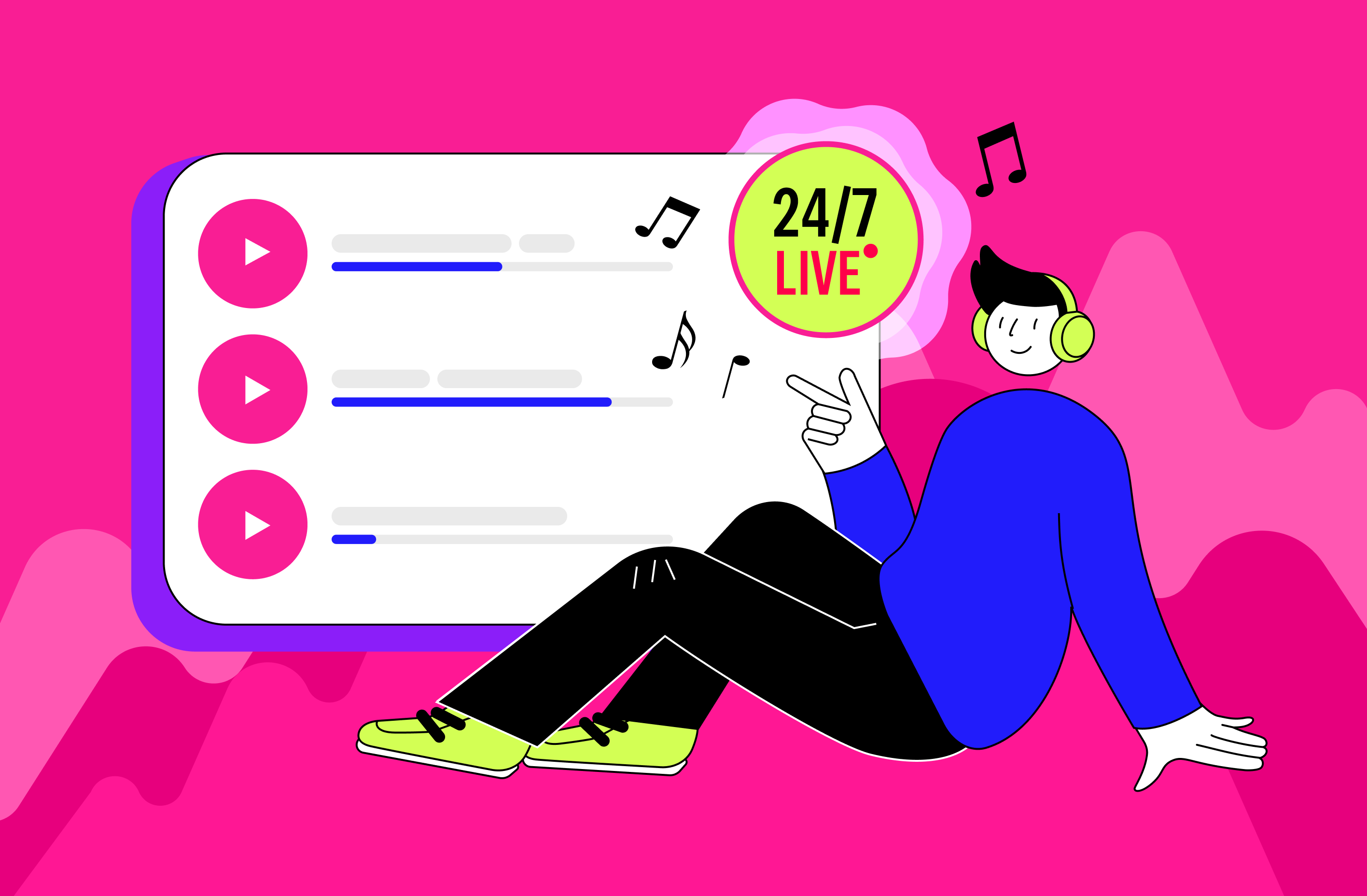

This guide walks you through the whole thing, from prerequisites to monetization, with the specific traps that musicians hit most often. If you’re newer to the format, our complete guide to growing a music YouTube channel covers the broader strategy that 24/7 streams plug into.
TL;DR
- A 24/7 music live stream broadcasts a looping playlist of pre-recorded tracks paired with a static image, GIF, or visualizer. Cloud tools like Gyre run the broadcast on their servers so your laptop doesn’t have to stay on for weeks.
- YouTube Music and YouTube Premium passed 125 million paid subscribers and are likely past 135 million by early 2026.
- Video platforms (YouTube and TikTok) drive 31% of global music engagement hours. 75% of Gen Z listeners discover new music through platform algorithms.
- Live streams get scanned for copyright in real time, which works very differently from how Content ID treats regular uploads. The difference is the single biggest source of avoidable damage to a music channel.
- A young music channel grew views 8.24x, watch time 8.47x, and revenue 11x in 90 days with Gyre. 98% of the new traffic came from streams.
- Brand-new YouTube channels can’t go live for the first 24 hours after activation. Plan around it.
What is a 24/7 music live stream on YouTube?
It’s a continuous broadcast that loops your music alongside a visual layer (cover art, animated GIF, or a real-time visualizer), running on YouTube’s RTMP live protocol. To viewers, it looks and behaves like any live stream. To YouTube, it counts as live content, which means it shows up in the Live tab, gets indexed in search, and competes for the same recommendation slots as regular videos.
The format owns several music sub-niches. Lo-fi hip hop, chillhop, ambient, jazz, sleep, meditation, focus music. Lofi Girl is the classic example: a continuous lo-fi stream that has run for years and now sits at 14 million subscribers and 1.8 billion views, comfortably ahead of most traditional internet radio stations. Independent artists and labels are also using the format outside lo-fi, streaming pre-recorded concerts and live sessions to keep fan engagement steady between releases.
Why does the format work so well in music specifically? Two reasons converge. YouTube’s algorithm rewards long average view duration, and music is one of the few content types people actively want to keep playing for hours. A 12-hour study session doesn’t skip the stream the way it skips a 4-minute pop video. Watch time accumulates without effort.
Why music creators are leaning into 24/7 streams in 2026
The audience side of the equation is unmissable.
YouTube reaches roughly 2.7 to 2.85 billion monthly active users in 2026, with over a billion hours of video watched every day. About 60% of music streaming on the open web happens on video platforms like YouTube, and Gen Z, the most active music-discovery cohort, finds three out of four new artists through algorithmic recommendation rather than search. The recorded-music industry crossed $29.6 billion in revenue in 2025, with streaming responsible for roughly two-thirds of the total.
Stack those numbers next to what continuous streams actually deliver inside a channel and the case writes itself. Across Gyre’s music users, average view duration on 24/7 streams runs three to six times longer than on single-track uploads. That retention multiplier is what kicks the YouTube algorithm into a different gear, and it’s why a channel that ran flat for months can double or triple in 90 days once a stream goes live.
Prerequisites: what you need before going live
Three things have to be in place before your first stream. None of them are difficult, and skipping any one will stall your launch on day one.
A live-enabled YouTube channel. Phone verification is required, and YouTube enforces a 24-hour delay between activating live streaming and your first broadcast. Check your status in YouTube Studio under Settings → Channel → Feature eligibility. Without it, your stream key won’t accept a connection.
Audio plus a video layer. A music stream is, technically, a video file. The audio is your music. The video can be a single high-resolution image, a short looping clip, or a visualizer that reacts to the audio. Recommended specs: H.264 video codec, AAC audio at 192-320 kbps for music-focused channels (don’t compromise here, listeners notice immediately), 1080p resolution at 30 fps, video bitrate around 4500-9000 kbps. 4K is supported but adds load without much benefit if your visual is static.
Rights to every track in the loop. This is where most first-time streams die. We’ll get into the why and how in the Content ID section below, but the rule is simple: own it, license it, or source it from a platform that pre-clears YouTube usage. Anything else is a strike waiting to happen.
How to live stream music on YouTube 24/7: step-by-step
Here’s the full flow from a clean slate to a running stream. Block out an evening for steps 1 through 5, then build a rhythm of weekly tweaks for step 6.
Step 1. Prepare your tracks and visual
Compile your music into a playlist or render it as a single long video file. A 6-12 hour loop is the sweet spot for most music streams. Long enough that listeners don’t hit the same track twice in one session, short enough to keep your file sizes manageable. Then pick a visual to pair with it:
- Static image — a single cover (1920×1080 or larger). Easiest path, lowest CPU load, and quietly effective for sleep, meditation, and ambient streams where most listeners have the screen off anyway.
- Looping GIF or short clip — the Lofi Girl format. 5-30 seconds of subtle motion that loops underneath the audio. Best fit for lo-fi, chillhop, study, cozy aesthetic streams. Catches the eye on the feed without distracting from the music.
- Audio visualizer — waveforms, spectrum analyzers, or generative art that reacts to the music in real time. Best for electronic, EDM, drum and bass, jazz, anywhere the music itself is the focal point rather than background.
Match the visual to the listening context. Background listening calls for a still or near-still frame. Active listening can carry a richer animation.
Step 2. Pre-check your audio for copyright
Before you upload anything to your streaming tool, run your tracks through YouTube Studio’s Checks feature. Drop each track into a short private test video and upload it. Within a few minutes, Studio returns a verdict per track: clear, claimed, or region-blocked. This is the same matching engine that will scan your live stream, so a clean check here is the most reliable predictor you have. Our step-by-step copyright check guide walks through the process with screenshots if you haven’t done it before.
For deeper rights analysis, third-party tools like Tunebat and Chosic catch samples, label affiliations, and rights nuances that Studio sometimes misses. Useful for remixes, edits, or anything pulled from older mixtapes where the chain of ownership isn’t obvious.
One catch worth flagging early: a clean check today doesn’t guarantee a clean stream forever. Rights holders register their catalog with Content ID continuously, so a track that passed last month can get matched next month. Re-check every 30-60 days on long-running loops, and always re-check before swapping in new tracks.
Step 3. Choose your streaming software
You have two real options.
OBS Studio is the free, open-source path. It runs on your computer, encodes the stream locally, and pushes it to YouTube. Reliable, but it ties you to a machine that has to stay on continuously, and a single crash kills the broadcast.
Cloud streaming tools like Gyre handle the encoding and looping on their servers. You upload your files once, build the playlist, set a schedule, and walk away. For anything that genuinely needs to run 24/7, this is the practical choice. Gyre specifically supports up to 8 simultaneous streams in Full HD or 4K, an auto-start and auto-end scheduler for planning months ahead, and an internal video converter that prepares files in the right format without you manually transcoding anything. For a side-by-side look at the major options, see our comparison of live stream software for pre-recorded videos, and our general 24/7 setup walkthrough covers the platform-agnostic version of this flow.
Step 4. Set up the stream on YouTube
In YouTube Studio, go to Create → Go live → Stream (not Webcam). Fill in the title, description, category (Music), and tags. Copy the stream key and stream URL. That’s all you need from YouTube’s side.
A note on titles: music streams are searched in plain language. “lofi hip hop radio - beats to study and relax” outperforms anything cleverer. Look at what’s currently ranking for your niche and write in the same register.
Step 5. Connect your tool and launch
Paste the stream key and URL into your software, point it at the playlist, set the loop behavior, and start. If you’re on a cloud tool, schedule the auto-start window so the broadcast fires whether you’re online or not. With Gyre, you can also queue future restarts via the stream scheduler, which matters because YouTube indexes your stream more favorably when you cycle the broadcast every few days.
Step 6. Monitor and iterate
For the first 72 hours, watch your stream’s performance closely. Average view duration is the headline. Concurrent viewer count by time zone tells you which markets are finding you. Subscriber rate per 1,000 views shows whether the audience that lands actually sticks. If your stream allows live chat, watch that too. Active chat is a signal YouTube uses.
Adjust weekly. Reorder the playlist, refresh thumbnails, test new titles. Don’t expect a peak in week one. Music streams compound: month two and month three usually outperform month one by a clear margin, because the algorithm needs time to index the stream and route a stable audience to it. Check related article about tips for improving audience retention.
Copyright on live streams: how Content ID actually works
This is the section that prevents most of the heartbreak. Get it right and you’ll never think about it again. Get it wrong and you’ll lose your stream, your monetization, and possibly your channel.
The system is called Content ID, and it scans every live broadcast on YouTube against a database of copyrighted audio and video that rights holders have registered. The match runs in real time. There’s no grace period, no review queue. If your stream plays a registered track, the system flags it within minutes.
Here’s where music creators get caught off guard. On a regular upload, a Content ID match usually results in a claim. The video stays up. Ads run. Revenue routes to the rights holder. Annoying, but the content survives. On a live stream, the same match plays out very differently:
- You can’t track the claim or share monetization. Those options simply aren’t available on live broadcasts.
- The stream gets muted, replaced with a placeholder image, or terminated outright depending on what the rights holder configured.
- If the broadcast is removed under copyright, your channel takes a copyright strike, and your live streaming access gets locked for 7 days. A second strike pushes the lock to 14 days. Three strikes inside 90 days terminates the channel.
- Once the stream is over, you can’t change Content ID settings on the recording. Whatever happened, happened.
So the framing flips. On uploads, copyright is a revenue question. On live streams, it’s an existence question. Treat it accordingly. For a deeper look at the prevention side, our guide to avoiding copyright restrictions on YouTube live streams covers the practical workflow.
Where to source music that won’t get flagged
The clean paths are narrower than they look. In rough order of how most channels actually source music:
- Original music you produced. Cleanest possible position. You own the masters and the publishing.
- Royalty-free subscription platforms. Epidemic Sound and Artlist are the two main names. Both pre-clear YouTube usage and run a channel safelist that releases Content ID claims automatically when a track from their catalog matches on your linked channel. For 24/7 music streams, this is the most common professional setup.
- YouTube Audio Library. Free, built directly into Studio. Smaller catalog, but every track is cleared for use including monetization. Solid starting point for new channels.
- Direct artist licensing. How Lofi Girl built its empire. Independent artists license tracks to the channel under revenue-share or flat-fee deals. Slower to scale, but it’s how you build a distinctive sound that subscription catalogs can’t match.
- Creative Commons tracks. Useable, but read the specific license. CC BY allows commercial use with attribution. CC BY-NC blocks monetization entirely, which means ads on your stream become a rights conflict. Don’t treat “Creative Commons” as a single category, it isn’t.
What to avoid completely: Spotify, Apple Music, or any other DSP catalog (their terms forbid redistribution); commercial radio rips; anything you “found on YouTube” without a clear license trail.
Visuals for a music stream: static image vs visualizer vs animated GIF
The visual you pair with the audio shapes your channel’s identity, your CTR on the live feed, and to a smaller degree your watch time. Three formats dominate, each with a clear best-fit niche.
Static image is the simplest and cheapest. One high-resolution cover, displayed for the entire broadcast. Works surprisingly well for sleep, meditation, ambient, and white-noise streams where listeners don’t watch anyway. The downside is feed presence: you only get one shot at catching attention through the thumbnail.
Looping GIF or short video clip is the Lofi Girl playbook. A 5-30 second clip that loops underneath the audio. Adds atmosphere and visual identity without animating the whole broadcast. Strong fit for lo-fi, chillhop, study, and cozy-aesthetic streams. Click-through rates on the live feed tend to outperform static images because subtle motion catches the eye in a scroll.
Audio visualizer reacts to the music in real time. Waveforms, spectrum analyzers, generative animations. Most engaging visually, particularly when the music itself is what people came for, like electronic, EDM, drum and bass, or genre-blending streams. Cloud streaming tools handle the rendering, so the technical lift is smaller than it looks.
A useful rule of thumb: if listeners are doing something else while your stream plays, the visual barely matters. If they’re watching, give them something worth looking at.
Real results: what music creators actually get from 24/7 streams
Numbers carry the argument better than any claim about the format.
A young music channel using Gyre, focused on cozy jazz and ambient compilations, ran an aggressive strategy of 15 to 25 simultaneous streams of varying length, anywhere from 12 hours to several weeks per loop. This is one of the four core streaming strategies Gyre recommends for maximum 24/7 efficiency. Comparing two consecutive 90-day windows, the channel grew views by 8.24x, watch time by 8.47x, subscribers by 5.5x, and revenue by 11x. Roughly 98% of the incremental traffic came from streams. Recommended traffic, the slot that decides whether YouTube actually pushes your channel, climbed from 22% to 41.8% of total discovery. By month three, streams weren’t supplementing the channel; they were the channel.
A different example, a nature-sounds music channel with 300,000+ subscribers, ran a smaller test. 11 simultaneous streams alongside 11 regular video releases over 28 days. The stream RPM came in at $2.96 against $1.80 for regular videos, a 1.6x revenue gap per 1,000 views. Eleven streams generated roughly a third of the channel’s monthly views and 40% of its monthly revenue, against a $99/month subscription cost. Across three months of consistent streaming, the channel saw +27.1% views, +26.6% watch time, and +30.4% new subscribers.
These aren’t outliers. The pattern repeats across music channels of every size: stream RPM consistently outperforms upload RPM, average view duration runs three to six times longer than on regular videos, and the algorithmic compounding kicks in around the 60-90 day mark. The mechanism underneath is just YouTube’s reward structure working as designed. Long retention plus constant activity equals more recommendation surface, which equals more traffic, which equals more revenue.
Can you monetize a 24/7 music stream on YouTube?
Yes, with three conditions. Your channel needs to be in the YouTube Partner Program (the standard threshold: 1,000 subscribers and 4,000 watch hours in the past 12 months, or 1,000 subscribers and 10 million Shorts views in 90 days). Every track in the loop has to be cleared for monetization, which is where the CC BY-NC trap catches inexperienced channels: ads on a stream that contains non-commercial-licensed tracks create a rights conflict that demonetizes the broadcast. And the stream has to comply with YouTube’s advertiser-friendly content guidelines, which most music passes by default; the rare exceptions involve explicit lyrics, age-restricted artwork, or unlicensed samples that introduce third-party rights claims. If your channel has already been hit with monetization issues, our YouTube demonetization guide walks through the recovery path.
When all three line up, music streams often outearn regular uploads on a per-1,000-views basis. Longer average view duration means more ad slots fill, which lifts both impression count and the RPM that advertisers pay for those impressions. Stream RPM in the music niche routinely runs 1.5 to 2 times higher than the same channel’s video RPM. For broader strategies on lifting the metric, see our piece on increasing YouTube CPM.
Ready to launch your first 24/7 music stream?
The setup is one evening. The catalog prep is the longest part, and even that’s hours rather than days if you’re working with royalty-free music or your own catalog. Gyre handles the broadcast side from the cloud, so the stream keeps running whether your laptop is on or off. The 7-day free trial gets you full access to playlist mixing, the auto-start scheduler, and Full HD streaming. Pair it with a clean catalog and a strong cover image, and your channel will keep growing while you sleep.
FAQ
Can I stream Spotify music on YouTube?
No. Spotify’s terms of service prohibit redistribution to any other platform, and tracks pulled from Spotify get matched by Content ID within minutes of going live. The legal paths are: own the rights, license directly from the artist or label, or source from a royalty-free platform with explicit YouTube clearance.
What happens if Content ID flags my live stream?
The system either replaces the stream with a placeholder image, mutes the audio, or terminates the broadcast outright, depending on what the rights holder configured. Sharing monetization, the option you’d have on a regular upload, isn’t available on live streams. If the stream gets removed under copyright, your channel takes a strike and your live access gets locked for 7 days.
Do I need to verify my YouTube channel before going live?
Yes, and there’s a 24-hour activation delay between enabling live streaming and your first broadcast. Plan it at least a day before launch.
Can I monetize a 24/7 music stream?
Yes, if you’re in the YouTube Partner Program and every track is cleared for monetization. Ads run the same way they do on regular videos, and stream RPM is usually higher because of longer view duration.
Can I run multiple 24/7 music streams at once?
Yes. YouTube has no official cap on simultaneous live streams from a single channel. Gyre supports up to 8 streams concurrently on standard plans, and some users push past 100. The real ceiling is content variety, since each stream needs distinct music to avoid duplicate-content signals.
How often should I restart a music stream?
Most Gyre users restart every 3-7 days. Streams under 12 hours get archived to your channel as VOD, which slowly builds a content library. Streams longer than 12 hours typically don’t get preserved as VOD by YouTube, so you lose the long-tail traffic.
Will a 24/7 stream hurt my regular video performance?
On music channels, almost always the opposite. Higher channel-level activity and watch time lift the algorithmic position of every video on the channel, which usually improves recommendation traffic to your uploads. The risk only shows up if the stream’s audience is sharply different from your upload audience, which rarely happens within a single music niche.