 10 min read

TL;DR
- You can go live on Facebook two ways: start streaming right away through Go live (from a webcam or an encoder with a stream key), or plan ahead with a separate Create a live video event, which Facebook recommends setting up at least a week in advance.
- The stream key for an encoder like OBS or Gyre is generated in the Stream setup step, under the Streaming software option, and the same key can send your signal to Facebook and YouTube at once.
- The standalone Facebook Gaming app no longer exists, so streaming now runs entirely through the main Facebook app and Meta Business Suite.
- Monetization in 2026 comes down to two tools: Facebook Stars (a flat $0.01 per star) and in-stream ads, which require specific follower and watch-time thresholds.
- If you already have recorded footage and want it running as a continuous, hands-off broadcast, Gyre can turn pre-recorded video into a 24/7 Facebook Live stream.
What Is Facebook Live?
Facebook Live is a feature on Facebook that went public in 2017. Its main advantage is directly contacting your subscribers through live, real-time broadcasting. You can watch these videos both at the time of their recording or after the end of the broadcasts.
These videos remain on their creator’s page forever, which allows them to be used repeatedly for various purposes, if necessary. This feature is prevalent for business and professional streamers to boost organic reach.
The role of Facebook Live has shifted since then. Stream Hatchet’s Q1 2026 report put quarterly live-streaming viewership at 17 billion hours, the first quarter to fold TikTok Live into the totals, and general-purpose social apps like Facebook now make up a much smaller slice of that pie than dedicated streaming platforms. Where Facebook Live still earns its place is commerce: Coresight Research and Bambuser project the US livestream shopping market will grow from $20 billion in 2022 to roughly $68 billion by 2026, and Facebook remains one of the primary venues retailers use to run those shoppable broadcasts. If you’re weighing Facebook against another Meta property for your streams, our comparison of Instagram Live and Facebook Live breaks down where each one wins.
Facebook Live Features
The Facebook team has enriched Facebook Live with many features that make it a comprehensive tool for online interaction with the audience. In particular, you can use the following:
- Polls to get the answer to your question live and discuss the results with those who watch your broadcast.
- Inserting links to share valuable resources with your audience.
- Adding links to your live broadcasts in stories.
- Moderation of comments online, with the ability both to limit comments for individual Facebook users and set up comments frequency.
- Front row to highlight the most famous followers in a special section of your broadcast.
- Badges to show how actively your followers interact with your content.
- Donations (note that if you are a commercial organization, you’ll have to pay a specific commission to the Facebook platform).
- Live With feature to go live on FB with other users.
- Online shopping feature that allows you to integrate links to your products directly into the live stream.
- Broadcasts Messenger Rooms for creating joint online broadcasts with up to 50 users.
- In-stream advertising to monetize your online broadcasts through the integration of third-party brand advertising.
- Live subscriptions to expand your target audience with those users who have joined your broadcast but have not yet subscribed to you.
Which Way to Go Live on Facebook Should You Choose?
Before jumping into the step-by-step instructions, it helps to compare the three main ways to start a Facebook Live stream. They differ in setup complexity and how much control you get over the broadcast. It’s also worth noting upfront that the standalone Facebook Gaming app was discontinued in 2022, so all three options below now live inside the main Facebook app and Meta Business Suite rather than a separate gaming hub.
| Streaming Method | Complexity | Best For |
|---|---|---|
| Facebook app (mobile) | Low | Anyone who wants to go live quickly without extra hardware or software |
| Stream setup + streaming software (OBS) | Medium | Creators who need scenes, overlays, multiple cameras, and full control over quality |
| Meta Business Suite | Medium | Business Pages that want stream management, publishing, and analytics in one place |
How Do You Go Live on Facebook From A Desktop?
You’ll need a built-in webcam on your PC or laptop, an external camera, and pre-installed streaming software to go live on Facebook from a desktop web browser. If these requirements are met, you can start broadcasting on Facebook from a computer by following these steps:
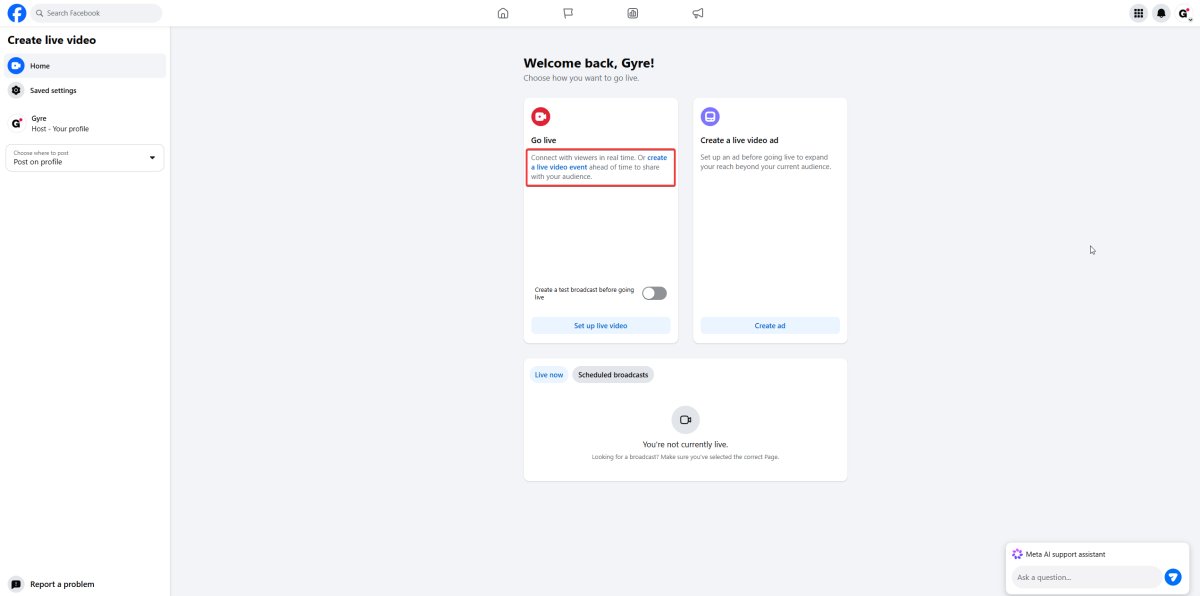
Go to the Create live video page. You’ll see two options: Go live (to connect with viewers right now or shortly) and Create a live video event (to announce an upcoming stream ahead of time and build an audience for it).
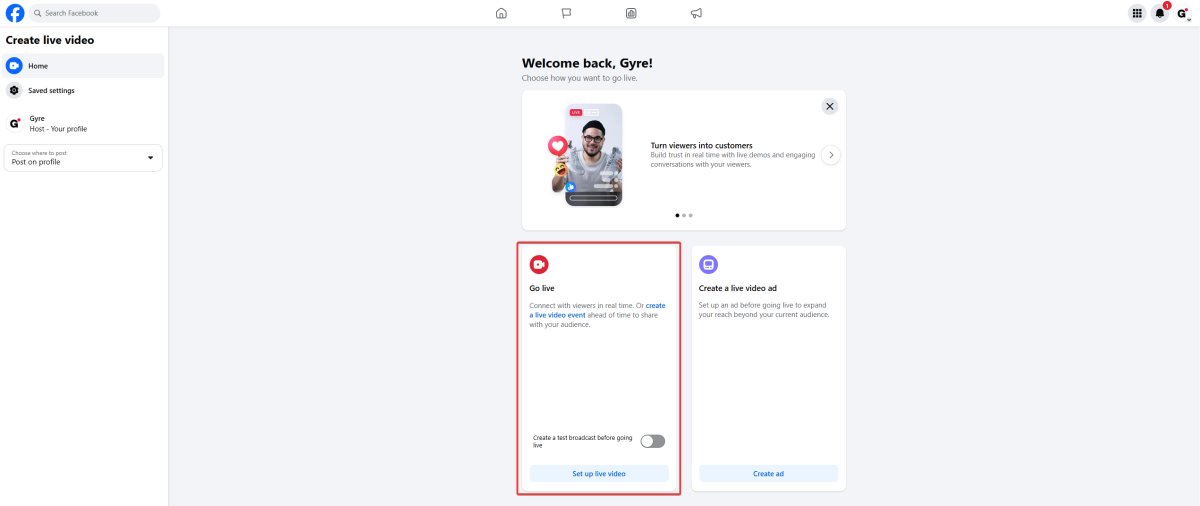
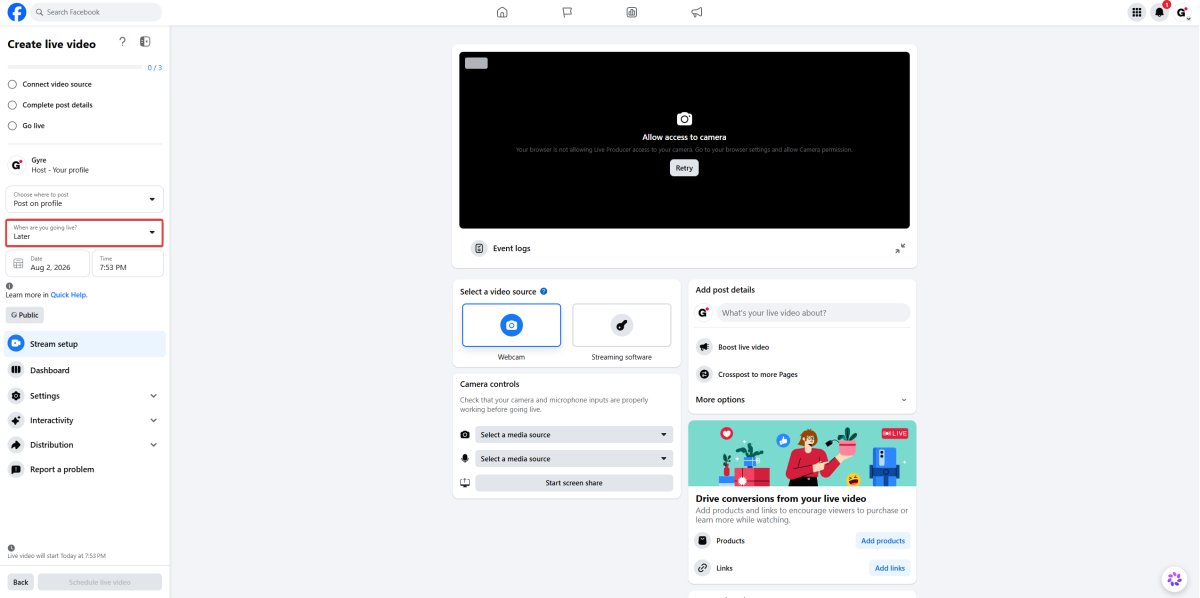
If you choose Go live, on the Stream setup screen pick When are you going live?: Now to start the technical broadcast immediately, or Later to set a specific date and time without creating a separate event.
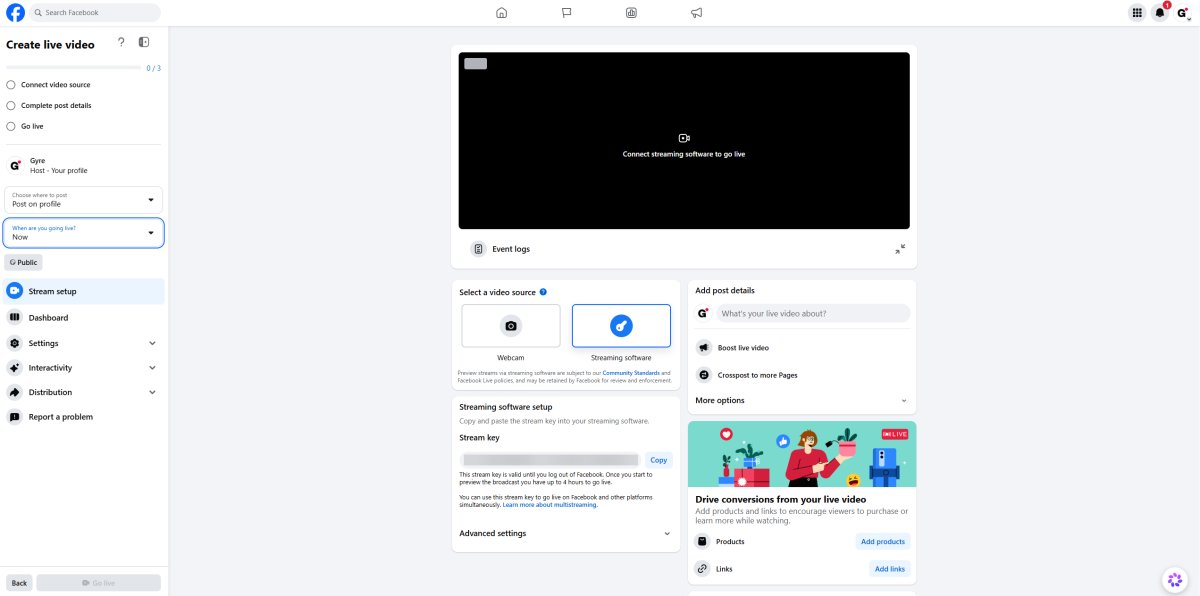
Next, select your video source: Webcam to stream straight from your computer’s camera, or Streaming software if you’re broadcasting through an encoder (OBS, vMix, or Gyre with a pre-recorded video).
If you picked Streaming software, copy the stream key from the Streaming software setup panel and paste it into your encoder settings, as described in the next section. The same key also works for sending your stream to more than one platform at once.
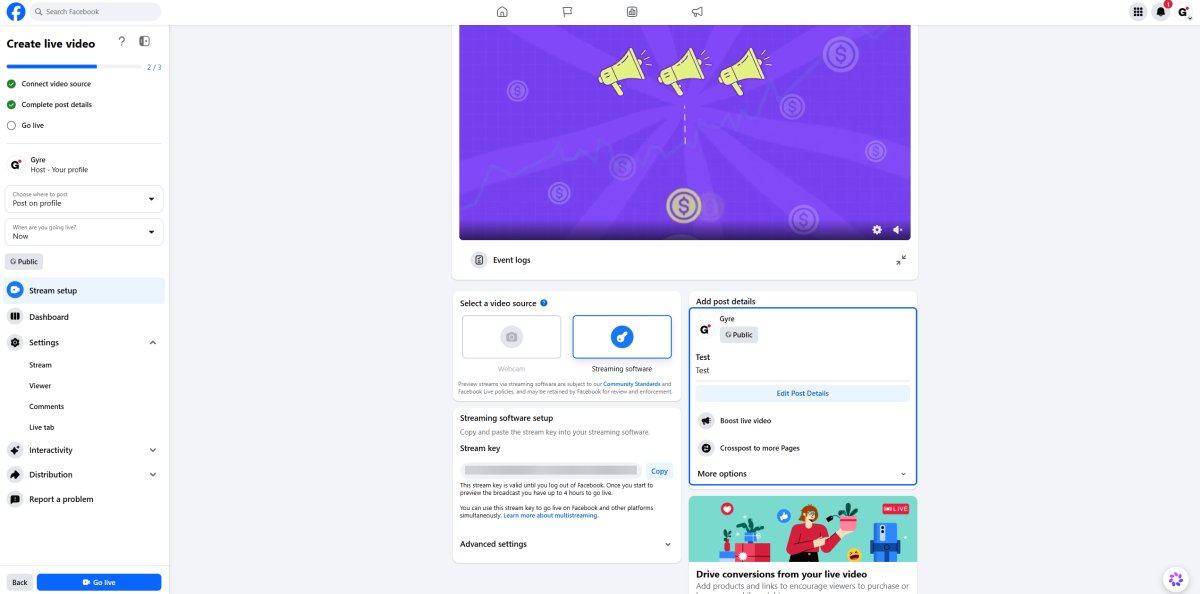
Fill in the post details (what your live video is about, privacy, and any products or links you want to attach), check the preview once Facebook picks up the signal from your camera or encoder, then click Go live.
If you chose Create a live video event instead, fill in the event details: cover photo, event name, start date and time, privacy, and description. The event will show up in your followers’ feed ahead of time, and the broadcast itself starts separately once the scheduled time arrives. Facebook’s own interface recommends scheduling the event at least 7 days in advance to help more people see it.
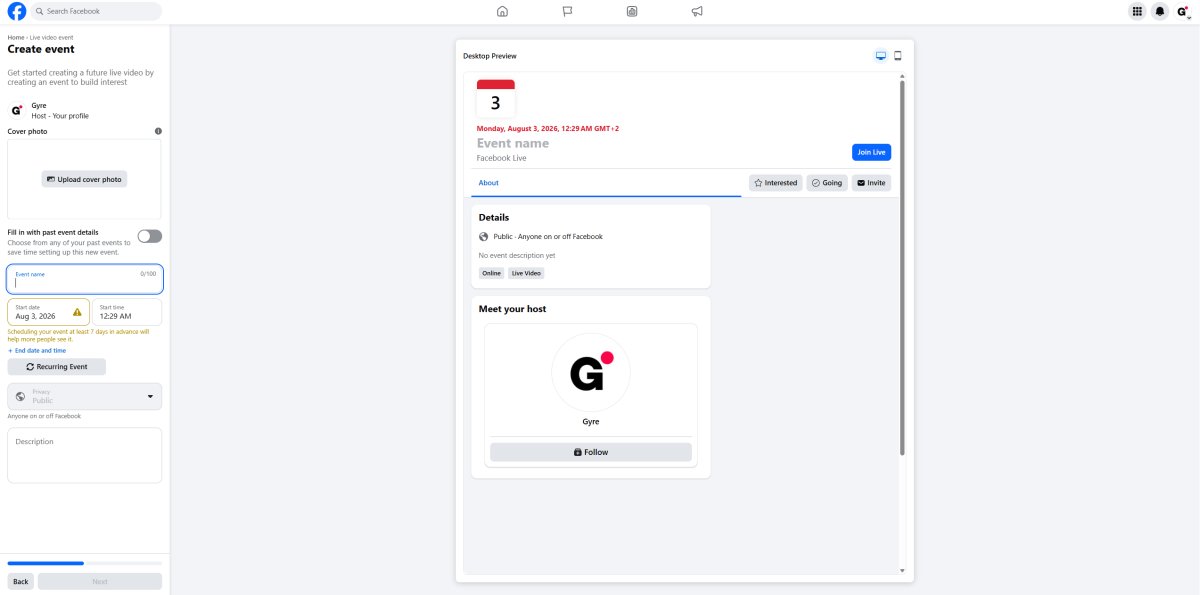
These are two different tools. Choosing “Later” in Stream setup simply delays the technical start of the broadcast by a few hours. “Create a live video event” builds a full public event page for advance promotion and audience building.
How Do You Use Facebook Live from A Smartphone?
If you decide to go live on Facebook through a smartphone to record your Facebook Live streams, you’ll need to follow these five steps:
- Open the Facebook app on your mobile device and log in to your profile.
- Click on the Live video option to activate your built-in camera.
- Select the camera type you will use (the front or the one on the back of your smartphone).
- Open the Settings section and choose the privacy specifications for your online broadcast (in particular, you can restrict access to your broadcast to specific groups or individual users).
- Start broadcasting by clicking the Go Live button. After that, all your subscribers will be notified that you went live and can join as viewers.
How to Add Your Facebook Stream Key in OBS
If you picked Streaming software as your video source and already copied the stream key as described above, the last step is connecting it to your encoder. Here’s what that looks like in OBS Studio:
- Open OBS and go to Settings → Stream.
- In the Service field, choose Facebook Live (or Custom if Facebook isn’t listed) and paste in the stream key you copied.
- Click Start Streaming in OBS. Once Facebook picks up the signal, the preview appears on the Stream setup screen, and you can click Go live.
Your stream key changes every time you log out of Facebook, and once Facebook detects a preview of your signal, you have up to 4 hours to actually start the broadcast. To skip re-copying it each session, Advanced settings in Stream setup let you turn on a persistent stream key, though that’s less secure since anyone with access to it could stream under your name.
Multistreaming: Facebook and YouTube at the Same Time
Because Facebook Live accepts an RTMP signal, the same feed from your encoder can go out to several platforms at once, for example Facebook and YouTube. Facebook confirms this itself: the Streaming software setup panel includes a “Learn more about multistreaming” link stating that the same key works for going live on multiple platforms simultaneously. If your Facebook and Instagram Pages are linked, synchronized broadcasting is also available directly in Meta Business Suite, where you just toggle on both destinations before going live. For combining Facebook with YouTube or other platforms outside the Meta ecosystem, you’ll need a third-party multistreaming tool — our guide on how to live stream to multiple platforms walks through the options.
A one-off stream isn’t the only option, though. Say you already have recorded broadcasts or other videos and want them running as Facebook Live 24/7 without you being on camera. That’s exactly what Gyre is built for: it connects to Facebook the same way, through Streaming software and the same stream key, but broadcasts pre-recorded video as a continuous live stream, and you don’t need to keep a computer running for it.
Facebook Live Monetization in 2026
Facebook has folded its separate earning tools (in-stream ads, Stars, subscriptions) into a single Facebook Content Monetization program. For live broadcasts specifically, two tools matter most:
- Facebook Stars. Viewers send you stars right during the broadcast, and Meta pays creators a flat $0.01 for every star received. It’s the simplest way to start earning from live streams.
- In-stream ads. To run ads for live video specifically, Meta requires a Page to have at least 10,000 followers and 600,000 total minutes viewed over the last 60 days, of which at least 60,000 minutes must come from live videos, along with at least five active videos, including three previously-live ones.
Exact thresholds for your Page are worth checking in the Monetization section of the Meta professional dashboard, since Meta periodically adjusts requirements by country and content category. To see how Facebook’s payout mechanics stack up against Twitch, YouTube, and Kick, our 2026 live streaming statistics roundup breaks down creator earnings by platform.
How to Grow Your Facebook Live Reach
Getting the technical setup right only gets you halfway there. To pull in more viewers, it helps to:
- plan ahead: a one-off stream can be delayed by a few hours right in Stream setup, but for a serious announcement aimed at reach, a separate event set up a week out, as Facebook itself recommends, works better;
- reply to comments actively during the stream, since Facebook surfaces highly engaged broadcasts to a wider audience;
- pin an important comment or question so new viewers can catch up on the stream’s context quickly;
- turn on live subscriptions to bring in viewers who join the stream but haven’t followed your Page yet;
- publish the recording as a regular video once the stream ends, since that gives you a second wave of views from people who missed the live broadcast.
Key Takeaways
- The fastest way onto Facebook Live is still the mobile app, but Stream setup with an encoder gives you scenes, overlays, and full quality control once your setup gets more ambitious.
- Since the Facebook Gaming app shut down, Meta Business Suite has become the hub for scheduling, publishing, and reviewing analytics for business Pages that stream regularly.
- Monetization now runs through Facebook Stars and in-stream ads, each with its own eligibility bar, so it’s worth checking your Page’s numbers before counting on either one.
- The same stream key that powers OBS also opens the door to multistreaming, so a single broadcast can reach Facebook and YouTube viewers at once.
- If keeping a channel active around the clock matters more than being on camera live, Gyre can turn your existing video library into a 24/7 Facebook Live stream.
FAQ
How do I start a Facebook Live from my phone?
Open the Facebook app, create a post, select “Live video,” set the title and privacy, then tap “Start live video.” No extra software is needed.
How do I stream to Facebook via OBS?
In the Create live video flow, choose Streaming software as your video source, copy the stream key from Stream setup, paste it into OBS settings (Service: Facebook Live), click “Start Streaming” in OBS, then confirm and go live once Facebook picks up the preview.
Can I stream pre-recorded video as a Facebook Live?
Yes. Tools like Gyre let you broadcast already-recorded video as a live stream on Facebook, including in a 24/7 continuous mode, without needing to keep a computer running the whole time.
How much can I earn from Facebook Live?
It depends on your reach and which monetization tools you qualify for. Facebook Stars pay a flat $0.01 per star, while in-stream ads require meeting Meta’s follower and watch-time thresholds. Check the Monetization section of your Page dashboard for your exact numbers.
Can I stream to Facebook and YouTube at the same time?
Yes. Facebook Live runs on RTMP, so a third-party multistreaming tool can take the same feed from OBS and send it to both platforms at once. For Facebook and Instagram specifically, linked Pages can also broadcast together straight from Meta Business Suite, no extra tool required.
What’s the difference between “Go live” and “Create a live video event” on Facebook?
“Go live” starts the technical broadcast now or delays it by a few hours. “Create a live video event” builds a separate public event page with a cover photo and description that appears in advance in your followers’ feed. Facebook recommends scheduling such events at least 7 days ahead to reach more viewers.