 10 min read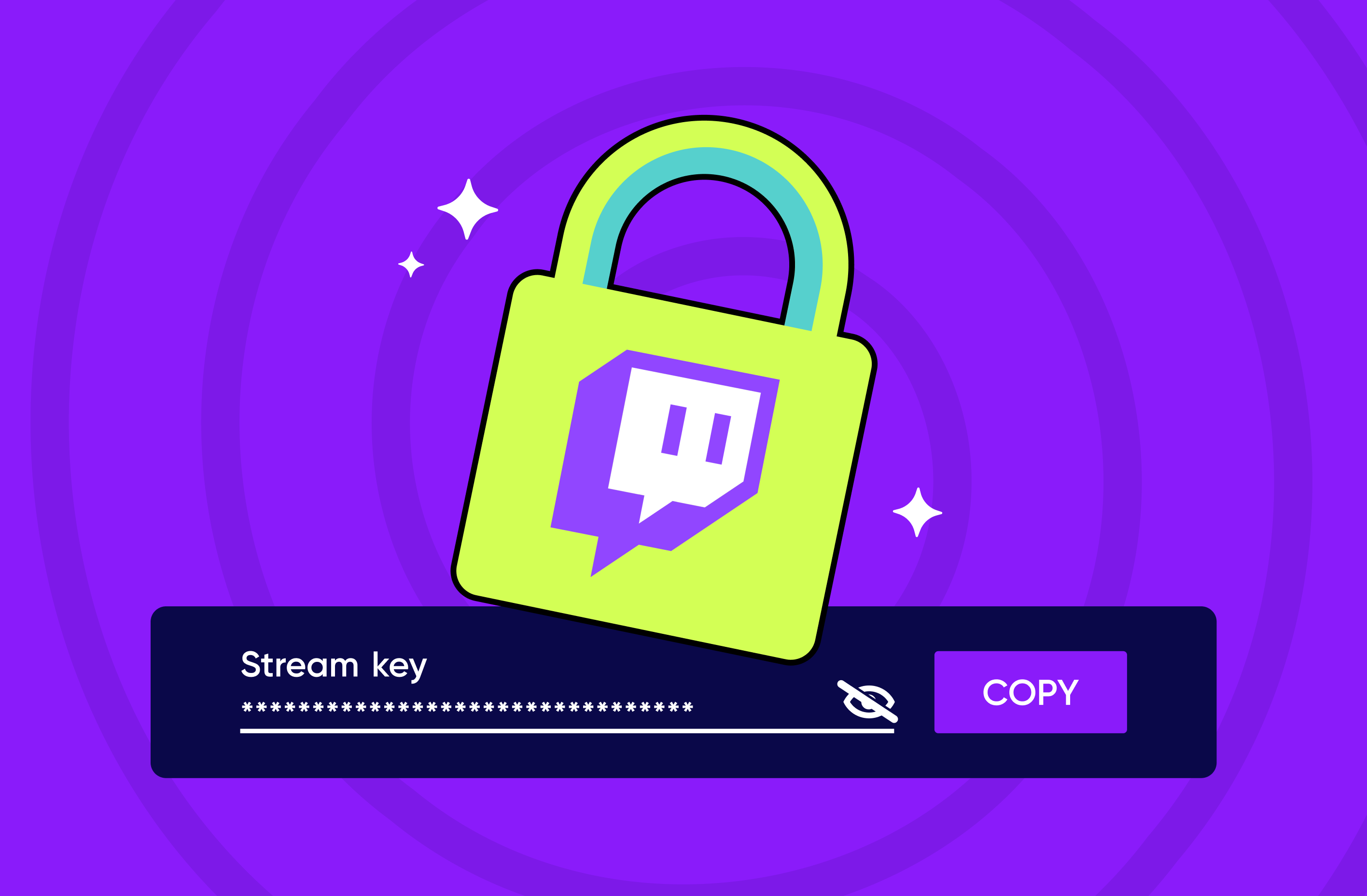

Key Takeaways
- A Twitch stream key is a unique code that lets your streaming encoder send video to your channel. Without it, no broadcast reaches Twitch.
- Find it in Creator Dashboard → Settings → Stream → Stream Key & Preferences → Primary Stream Key. The whole process takes under two minutes.
- Cloud tools like Gyre use your stream key to run 24/7 broadcasts from pre-recorded videos, so you don't need to sit in front of your computer. OBS Studio (version 28+) can skip the key entirely through its built-in account connection.
- Reset your key immediately if it was shown on screen, shared in a chat, or leaked anywhere. One click invalidates the old key on the spot.
- The Twitch mobile app does not display stream keys. Use a mobile browser in desktop mode as a workaround.
What Is a Twitch Stream Key?
A Twitch stream key is a unique alphanumeric code assigned to every Twitch account at signup. It serves as the password between your streaming software and Twitch's ingestion server, the entry point where your video feed enters the platform.
When you press "Start Streaming" in your encoder, the software sends audio and video over RTMP (Real-Time Messaging Protocol) to Twitch. The stream key tells the ingestion server exactly which channel should receive the feed. Without a valid key, the connection fails and nothing goes live.
Why Do Streaming Encoders Need It?
Every encoder must authenticate with Twitch before broadcasting. Desktop apps like OBS Studio, cloud services like Gyre, and hardware devices all rely on the stream key for that handshake. You paste it once, and the encoder stores it for every future session until you reset the key.
OBS (version 28 and above) also offers a shortcut: the Connect Account button, which uses OAuth to link your Twitch account directly. OBS then retrieves the key internally, so it never appears on screen. Cloud-based 24/7 streaming tools and hardware encoders still require manual key entry, because they connect via RTMP without a built-in OAuth flow.
How to Find Your Twitch Stream Key (Step-by-Step)
Your Twitch stream key lives inside the Creator Dashboard, not in your general account settings. The path is short: five clicks from the homepage to a copied key.
- Open twitch.tv in your browser and log in to your account.
- Click your profile avatar in the top-right corner.
- Select Creator Dashboard from the dropdown menu.
- In the left sidebar, expand Settings and click Stream.
- Under Stream Key & Preferences, locate Primary Stream Key.
- Click Copy to place the key on your clipboard. If you want to view it first, click Show and confirm the "I Understand" warning.
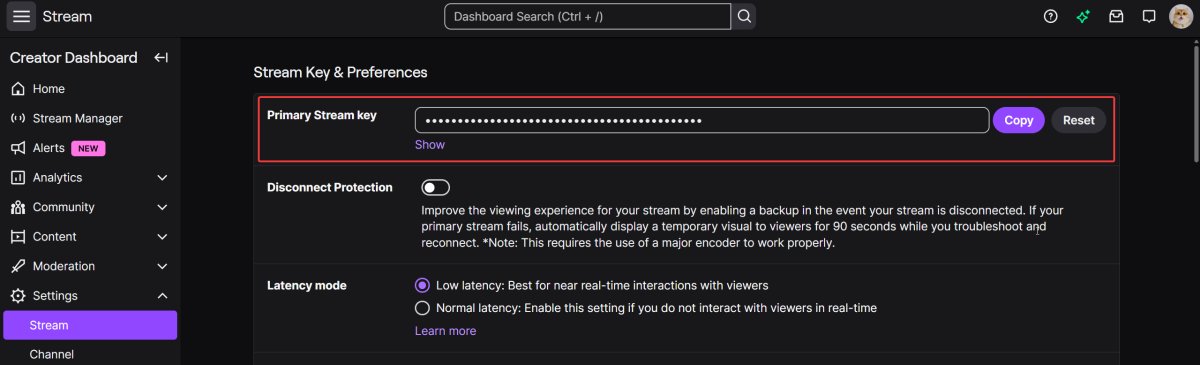
That's it. Paste the key into your encoder, and you're ready to broadcast.
How to Add Your Stream Key to Gyre
Gyre is a cloud-based tool built for automated, continuous live streaming. Instead of sitting in front of your screen for hours, you upload your video library, set a loop, and Gyre broadcasts it to Twitch 24/7 on your behalf. The entire process runs in the cloud, so you don't need a powerful computer or any locally installed software.
This makes Gyre especially useful for creators who already have a large back catalog of recorded content. Tutorials, compilations, highlight reels, music sets, ambient footage: all of it can become a permanent live stream that keeps your channel active and visible around the clock. Since Gyre connects to Twitch via RTMP, it needs your stream key.
- Log in to your Gyre account at my.gyre.pro.
- Create a new stream or open an existing one.
- Select Twitch as your streaming destination.
- Paste your Primary Stream Key and the RTMP URL (Twitch's default ingest is
rtmp://live.twitch.tv/app/). - Upload your video playlist, set the loop, and launch.
Once launched, Gyre auto-loops the playlist and restarts the stream if anything interrupts it. The stream key stays stored in your Gyre dashboard until you reset it on Twitch.
How to Add Your Stream Key to OBS Studio
OBS Studio is a free, open-source encoder popular with live streamers. It handles real-time broadcasting well, though it requires your computer to stay on and connected for the entire session. OBS offers two ways to link with Twitch.
Option A: Connect Account (Recommended)
- Open OBS Studio and go to Settings → Stream.
- Set Service to Twitch.
- Click Connect Account and log in through the popup browser window.
- Once authenticated, OBS retrieves the stream key internally. No copy-pasting needed.
This keeps the key hidden at all times. OBS refreshes the authentication token automatically, which eliminates the risk of accidental exposure.
Option B: Manual Stream Key Entry
- Open OBS Studio and navigate to Settings → Stream.
- Set Service to Twitch.
- Check Use Stream Key instead of connecting your account.
- Paste the key you copied from Creator Dashboard into the Stream Key field.
- Click Apply, then OK.
Manual entry works when OBS can't complete the OAuth login, for example behind certain firewalls or on shared machines where you don't want to store a full account session. Keep in mind that OBS requires your PC to remain powered on throughout the broadcast. If your goal is unattended or 24/7 streaming, a cloud tool like Gyre removes that limitation entirely.
How to Reset Your Twitch Stream Key
Resetting generates a new key and instantly kills the old one. Any encoder still using the previous key will lose connection and fail to reconnect until you update it.
- Go to Creator Dashboard → Settings → Stream.
- Under Stream Key & Preferences, find Primary Stream Key.
- Click Reset. The button will turn green with a checkmark once the key is regenerated.
- Copy the new key and paste it into every encoder you use.
When Should You Reset?
Reset your stream key in any of these situations:
- The key was visible on stream, even for a second. Automated scrapers monitor live broadcasts and can capture exposed credentials almost instantly.
- You shared it in a Discord server, forum post, or Git commit.
- You changed your Twitch password. Password changes silently invalidate the existing stream key, so your encoder will stop working until you copy the fresh one.
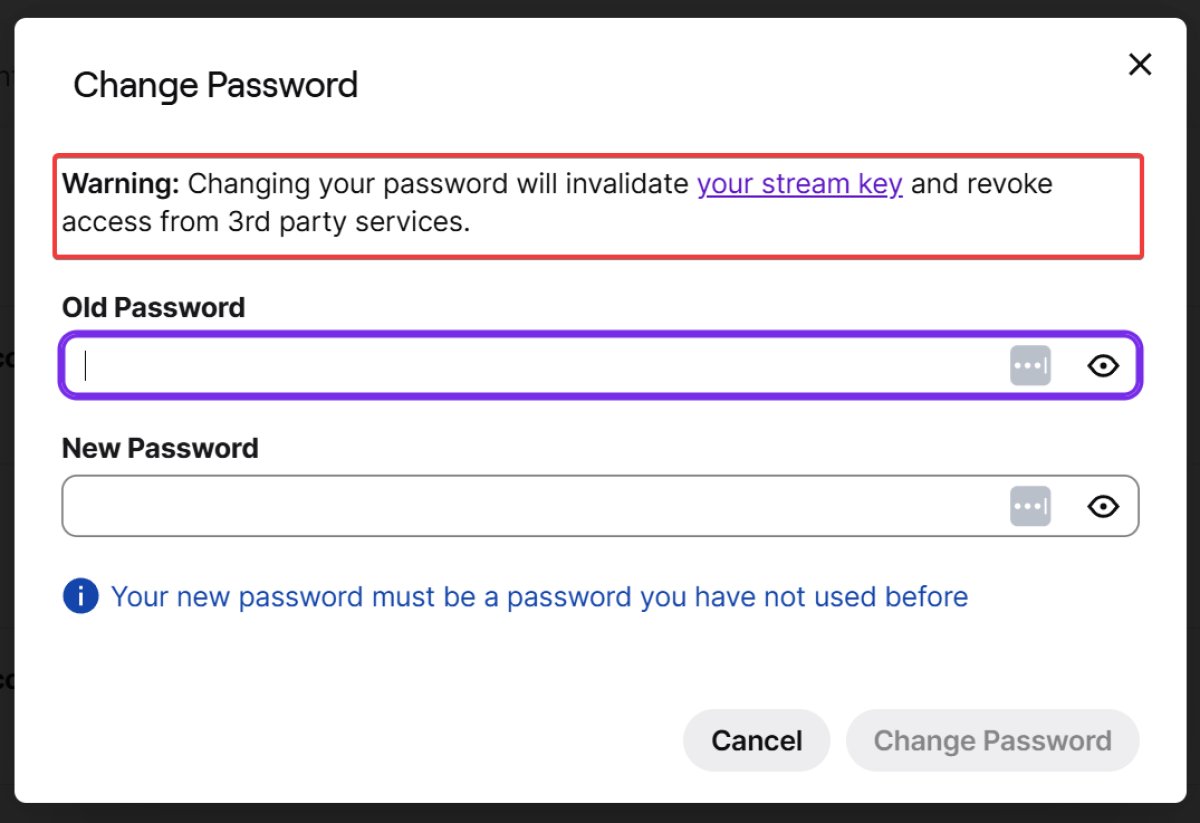
- A team member who had the key is no longer part of your channel.
- You notice any unauthorized stream activity on your channel.
If you use OBS with the Connect Account method, you'll also need to disconnect and reconnect your Twitch account in OBS after a reset. Otherwise, OBS may hold a stale token that won't authenticate.
How to Keep Your Twitch Stream Key Safe
Your stream key grants full broadcasting access to your channel. Anyone who has it can go live under your name without needing a password. Treat it with the same caution you'd give your account credentials.
- Never show the key on stream. Double-check that your OBS scene doesn't include the Settings window before you go live. Screen-share accidents are the most common way keys get leaked.
- Don't paste it in chats, forums, or tickets. Support teams will never ask for your stream key. If someone does, that's a red flag.
- Avoid storing it in plain text files. If you must save it somewhere outside your encoder, use a password manager.
- Enable two-factor authentication (2FA). Twitch requires 2FA for Affiliates and Partners, but every account benefits from it. 2FA adds a second barrier if someone tries to access your dashboard and copy the key.
A stream key is not the same as your account password. Resetting the key does not change your login credentials, and changing your password does not automatically update the key in your encoder. These are two separate security layers. If you're serious about growing your Twitch income, securing your key is a foundational step. You can learn more about revenue options in this guide to monetizing your streams.
Stream Key vs. RTMP URL: What's the Difference?
Two fields appear in most encoder settings: the RTMP URL (also called the server address) and the Stream Key. They serve different purposes.
The RTMP URL tells the encoder which Twitch ingestion server to connect to. Twitch's default is rtmp://live.twitch.tv/app/, but the platform operates dozens of regional servers. OBS auto-selects the closest one when you set the server to "Auto."
The stream key identifies your specific channel within that server. Think of the RTMP URL as the street address of a building and the stream key as the apartment number.
Both are required for a successful broadcast. When you're setting up a tool that asks for each separately, such as Gyre or a hardware encoder, paste the RTMP URL and stream key into their respective fields. You might also want to explore Twitch extensions and plugins to get more out of your channel once the technical setup is complete.
Conclusion
Finding your Twitch stream key takes less than two minutes: Creator Dashboard → Settings → Stream → Primary Stream Key → Copy. Once it's in your encoder, you're set to broadcast.
Keep the key private, reset it the moment anything looks off, and remember that it controls who can stream on your channel. Whether you go with a cloud solution like Gyre for hands-free 24/7 streaming or OBS Studio for live sessions, the stream key is the starting point. To keep leveling up your Twitch presence, dive into our guide on earning with Twitch Bits.
FAQ
Can I find my Twitch stream key on mobile?
Not through the Twitch mobile app. It doesn't include the Creator Dashboard settings where the key lives. The workaround: open twitch.tv in Chrome or Safari on your phone, request the desktop version of the site, and follow the same steps as on a computer. On iOS, tap the "AA" icon in the address bar and select "Request Desktop Website." On Android, tap the three-dot menu and check "Desktop site."
What happens if I reset my stream key?
The old key stops working immediately and Twitch generates a replacement. Any encoder still using the previous key will disconnect and won't go live again until you paste the new one. If you connected OBS through the "Connect Account" button, log out of Twitch in OBS and reconnect so the app picks up fresh credentials.
Can two people stream with the same key at the same time?
No. Twitch accepts only one active RTMP session per stream key. If a second encoder tries to connect using the same key, it kicks the first one offline. For team-based channels, coordinate so only one person broadcasts at a time, or use a relay service that ingests the feed once and distributes it.
Twitch stream key vs. RTMP URL: what's the difference?
The RTMP URL points to the Twitch ingestion server (for example, rtmp://live.twitch.tv/app/). The stream key identifies which channel the video should reach. You need both to start a broadcast. Most desktop software fills in the server automatically when you choose Twitch as the platform, but cloud tools like Gyre and hardware encoders require you to enter each value manually.
My Twitch stream key is not working. What should I do?
Start with the simplest fix: go back to Creator Dashboard → Settings → Stream, reveal the key, and copy it again. Invisible spaces at the beginning or end of the pasted value are a frequent culprit. If that doesn't solve it, check whether you recently changed your Twitch password, since doing so silently invalidates the existing key. Also confirm that 2FA is enabled on your account; Twitch blocks broadcasting without it. As a last resort, reset the key entirely and paste the fresh one into your encoder.
Can I have more than one stream key on Twitch?
Standard Twitch accounts come with a single primary stream key. There is no built-in option to generate secondary keys. If you need to broadcast from multiple setups, swap the same key between encoders (only one at a time) or use a multistreaming service that handles distribution from a single RTMP source.
How often should I reset my Twitch stream key?
There's no fixed schedule. Reset it after a suspected leak, a password change, a team roster update, or simply as a precaution every few months. Think of it like rotating any other sensitive credential.