 15 min read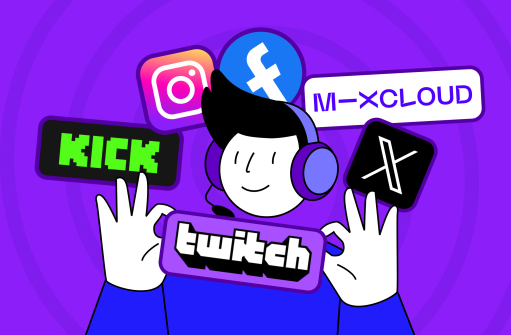

TL;DR
- Gaming and chat-heavy audiences still cluster on Twitch, while YouTube Live works best for tutorials, events, and broader content.
- Kick (launched December 2022) pays creators a 95/5 subscription split and has paid out more than $400 million to creators through its Partner Program since 2024.
- TikTok Live requires creators to be 18+ to receive Gifts and roughly 1,000 followers to unlock them, and its live audience overtook Twitch in global streaming rankings in Q1 2025.
- LinkedIn Live reaches a smaller, B2B audience but commands a markedly higher CPM than consumer platforms, making it a strong pick for professional and educational content.
- Tools like Gyre let you broadcast the same pre-recorded video as a live stream to YouTube, Twitch, and Kick at once over RTMP, instead of manually running separate streams on each platform.
Facebook Live: Large Social Audience
Facebook Live's built-in reach is hard to match. You can broadcast from mobile, desktop, a Page, a personal profile, or a closed Group, and native notifications reach your followers the moment you go live. Real-time comments, reactions, and polls run through the broadcast, and the VOD publishes automatically afterward for anyone who missed it.
The format works well for brands, nonprofits, SMBs, educators, and creators with an established Facebook following, especially for Q&A sessions, product launches, webinars, and community updates aimed at a broad, non-gaming audience.
The trade-off: monetization eligibility varies by region and page type, discovery favors people who already follow you, and some viewers are simply reluctant to engage publicly on Facebook. The platform's real strength is activating a community you already have, not building one from zero.
Twitch: Gaming & Interactive Streams
Twitch remains the reference point for live gaming, esports, IRL chats, and music. Discovery runs through categories — games, "Just Chatting," music, art — and community builds around Twitch-specific mechanics: emotes, raids, Clips, and channel points. Moderation is robust, and VODs and highlights let creators reuse content well after the stream ends.
On revenue, Twitch runs three subscription tiers — $4.99, $9.99, and $24.99 — with a 50/50 split by default for Affiliates and most Partners. Creators who qualify for the Partner Plus Program move up to 60/40 by holding 100 Plus Points for three consecutive months, and to 70/30 at 300 Plus Points. A Tier 1 sub is worth 1 Plus Point, Tier 2 is worth 2, and Tier 3 is worth 6; gifted subs and Prime Gaming subs don't count toward the total. Twitch also removed the $100,000 annual cap on the 70/30 tier in 2024, so that higher share now has no ceiling once you qualify.
In exchange for that split, you get deep engagement culture and a full monetization stack (subs, gifted subs, Prime, Bits, ads, sponsorships), balanced against heavy competition inside every category, strict DMCA rules, and a 70/30 split that still takes real consistency to reach.
Kick: Creator-First Streaming
Launched in December 2022 and backed by Stake.com, Kick has become the go-to alternative to Twitch for creators who prioritize payout over directory size. The interface feels familiar to anyone coming from Twitch, streams run at 1080p60, and Kick allows multistreaming without exclusivity — you can keep your Kick channel live while streaming elsewhere too, though turning on the multistreaming toggle drops your Kick Partner earnings to 50% of usual while it's active.
The headline number is the split. Kick still pays a 95/5 subscription share, putting roughly $4.74 of every $4.99 Tier 1 sub in the creator's pocket before processing fees. Since the Partner Program launched in 2024, Kick has paid out more than $400 million to creators. Partner eligibility asks for at least 30 hours streamed and 250 unique chatters over the last 30 days, 25 active subscribers, 250 followers, and an average of 75 concurrent viewers. In 2026, Kick began rolling out ads alongside the sub split, a shift that moves the platform from a purely disruptive alternative toward a more diversified monetization model without touching the core 95/5 share.
Audience size is where Kick still gives ground: it draws far fewer total viewers than Twitch or YouTube, organic discovery is still maturing, and the ad stack is only getting started. It's a clear economic play for creators who already bring their own community and are willing to accept a smaller directory in exchange for keeping almost all of the sub.
TikTok Live: Fastest-Growing Audience
TikTok Live plugs directly into the For You feed, so a broadcast has a real chance of reaching viewers well outside your follower base. Monetization runs on three mechanisms: LIVE Gifts, where viewers buy Coins and send virtual gifts that convert into cashable Diamonds; LIVE Subscriptions for recurring fan support; and LIVE Shopping for direct product demos and sales. Co-hosting with another creator is built in too, letting two audiences combine on a single stream.
Access to Gifts requires being 18 or older (19 in South Korea), roughly 1,000 followers, and an account free of recent Community Guidelines violations. TikTok keeps close to half of every Gift's value, and creators cash out once they cross a minimum withdrawal around $50.
TikTok Live passed Twitch in global streaming rankings in Q1 2025 and added roughly 14.9% more viewership in Q3 2025 alone, the fastest growth among the major live platforms that year, according to Stream Hatchet's yearly live streaming trends report; the platform's Chat category alone averaged over 2.2 million concurrent viewers that quarter. The format suits short-form entertainment, comedy, beauty, fitness, and brands with a demonstrable product for LIVE Shopping, pulling in the youngest audience (16–24) of any platform in this guide. What you give up is that roughly 50% cut on Gifts, the vertical-only format, and the fact that pre-recorded streaming to TikTok Live is largely limited to verified business and partner accounts.
X (formerly Twitter) Live: Real-Time Social Streaming
X Live puts broadcasts directly into a high-velocity newsfeed: anyone can start a public Live with one tap, and native reposts, replies, and quote-posts amplify reach almost immediately. Pairing Live with Spaces (audio) opens the door to hybrid community programming without leaving the platform.
The format fits news, commentary, sports talk, product launches, and creators whose value is in timely conversation. The strength is instant distribution and strong share mechanics; the limitation is that discovery favors whatever is trending that day, the content has little life once the moment passes, and monetization paths are still being built out.
Instagram Live: Engage Followers Instantly
On Instagram, going Live feels like a natural extension of Stories: followers get a top-of-feed alert the moment you start, with no search required. The platform supports multi-host Collab Lives, Q&A stickers, badges, and shopping tools. Afterward, the video saves to Stories and archive and can be repurposed as a Reel to keep the reach going.
The format suits lifestyle creators, educators, beauty and fitness brands, and DTC brands whose audience already lives on Instagram and values immediacy — high engagement with existing followers is the main advantage, alongside commerce-friendly features. The trade-off is limited long-tail discovery, a portrait-first format, and tighter session-length and bitrate constraints than desktop-first live streaming sites.
LinkedIn Live: Premium B2B Reach
LinkedIn Live stands apart on one detail: the audience carries professional context and real purchasing authority. Streaming ties to a personal profile or company Page, triggers push notifications to followers, and integrates with LinkedIn Events, which add an RSVP page, automatic reminders, and a built-in replay. There's no native camera button, though — you connect a third-party broadcast tool such as Restream, StreamYard, Switcher Studio, or Socialive, or use a direct custom RTMP/RTMPS ingest for advanced setups.
Getting access requires at least 150 followers or connections and a recent history of original posts, according to LinkedIn's own Help documentation. From June 22, 2026, every Live broadcast must be tied to a scheduled event: LinkedIn removed spontaneous, unscheduled Lives, though scheduling can happen just minutes ahead of going live. Third-party broadcast software stays mandatory either way.
The case for LinkedIn Live is engagement quality: Live video generates far more comments and reactions than native pre-recorded video on the platform, and ad rates run well above what Instagram or Facebook typically charge. It fits consultants, B2B SaaS founders, sales teams, and corporate trainers chasing qualified leads over raw reach; the cost is the mandatory third-party or RTMP setup and the end of spontaneous streaming from mid-2026 onward.
Telegram Live: Direct Community Streaming
Telegram approaches streaming differently from traditional social platforms: the broadcast lives inside a Channel or Group and can support a massive audience, but the culture leans toward closed communities. "Join as speaker" turns a stream into an interactive town hall, the persistent chat acts as the community's running thread, and privacy controls allow invite-only streams.
The format suits communities that value privacy and control over who gets in: Web3 projects, niche education, member clubs, internal teams, or paid cohorts. The advantage is an owned, algorithm-free feel with reliable notifications; the limitation is minimal public discovery and a thinner creator toolset than the mainstream social platforms.
Mixcloud Live: Audio-Focused Streaming
Mixcloud Live is built for DJs, radio shows, podcasters, and ambient or lo-fi creators — essentially anyone whose storytelling centers on audio rather than picture. The platform includes tracklists, chapters, and solid audio archiving that works especially well for sets and talk radio, plus subscription tools for fans on long-running shows.
The audience arrives expecting long sessions, licensing gets real respect, and the replay culture runs deep — many listeners return to a set for weeks. In exchange, video tooling is limited, discovery runs on genre and tags, and the platform doesn't produce the casual "browse and stumble" discovery you get on YouTube or Twitch.
How Much Does the Creator Actually Keep?
The headline split rarely tells the whole story. Kick's 95/5 sounds unbeatable next to Twitch's standard 50/50, but Twitch creators who reach 100–300 Plus Points over three consecutive months climb to a 60/40 or 70/30 share instead. TikTok sits at the other extreme, keeping roughly half of every Gift's value, while LinkedIn Live pays nothing in tips at all — its payoff shows up in CPM and leads rather than platform payments. Here's what a standard monthly subscription or gift actually nets a creator across the main platforms in 2026.
| Platform | Creator/Platform Split | Standard Sub Price | What the Creator Gets (Tier 1) |
|---|---|---|---|
| Kick | 95/5 | $4.99 | ~$4.74 (before processing fees) |
| Twitch (standard Affiliate/Partner) | 50/50 | $4.99 | ~$2.50 |
| Twitch (Partner Plus, 70/30) | 70/30 (300+ Plus Points) | $4.99 | ~$3.50 |
| TikTok Live (Gifts) | ~50/50 on Gift value | Variable (Coins) | ~50% of what the viewer pays |
| YouTube Live (memberships) | 70/30 | From $4.99 | ~$3.49 per Tier 1 membership |
| Facebook Live (Stars) | Varies by region and eligibility | N/A (Stars) | ~$0.01 per Star received |
The raw percentage doesn't capture everything: Twitch and YouTube offset lower splits with much larger discovery and a stronger ad CPM, while Kick trims the platform's cut but still operates on a smaller, growing viewer base. On LinkedIn Live the conversation shifts entirely — the metric that matters isn't a sub split at all, but the cost per qualified lead a broadcast generates.
Compare YouTube Alternatives
| Platform | Audience | Monetization | Requirements | Pre-Recorded Support |
|---|---|---|---|---|
| Facebook Live | Existing FB communities, brands, educators | Stars, in-stream ads (eligibility), brand deals | Page or profile in good standing; region-dependent monetization eligibility | Supported via Live Producer's RTMPS ingest |
| Twitch | Gaming, “Just Chatting,” music, talk | Subs (50/50 standard, up to 70/30 via the Plus Program), Bits, ads, sponsorships | Affiliate/Partner status; Plus Program tiers need 100–300 Plus Points for 3 consecutive months | Supported via RTMP; multistreaming allowed since Twitch dropped exclusivity in 2023 |
| Kick | Creator-first payouts, gaming/IRL | 95/5 subscription split; $400M+ paid to creators since 2024 | 30 hrs streamed + 250 chatters (30 days), 25 subs, 250 followers, 75 avg. concurrent viewers | Supported via open RTMP; 50% revenue while multistreaming |
| TikTok Live | Young (16–24), highly viral, live-shopping audience | LIVE Gifts (~50% platform cut), LIVE Subscriptions, TikTok Shop commissions | 18+ for monetization (16+ to go Live); ~1,000 followers for LIVE Gifts | Largely restricted to verified business/partner accounts |
| X Live | Real-time news, commentary, product reveals | Evolving tools + brand integrations | Public account that follows X's rules | Supported via RTMP ingest |
| Instagram Live | Lifestyle, DTC, education, community | Badges, shopping, brand deals | No formal application; portrait, mobile-first format | Limited; no broad third-party RTMP ingest for pre-recorded loops |
| LinkedIn Live | B2B professionals, decision-makers | No native tipping; value comes from a premium ad CPM and lead-gen rather than tips | 150+ followers/connections; from June 22, 2026, every Live must be tied to a scheduled event | Gated behind a preferred third-party tool or custom RTMP; approval-based |
| Telegram Live | Private/controlled communities | Member dues, off-platform subs | Channel or group admin rights | Supported for Channels/Groups |
| Mixcloud Live | DJs, radio, long audio sets | Fan subscriptions, tips | Rights-conscious upload/streaming account | Supported for audio; limited for video |
Looking for alternatives to YouTube that maximize reach? Consider multistreaming to test real audience fit fast.
Gyre: Stream Pre-Recorded Videos to All Platforms at Once
Managing multiple live streams can get messy fast — unless you use Gyre live streaming. With Gyre, you control everything from one account, running it in the cloud without keeping a powerful computer online 24/7.
Gyre’s Start+ and Pro+ plans let you activate 4 or 8 parallel streams. You choose whether to run them all on one platform (YouTube allows unlimited streams per channel) or split them across several platforms — mixing playlists, formats, and audiences.
Unlike juggling separate tools, Gyre supports all the streaming platforms covered in this article: Facebook Live, Twitch, Kick, X (Twitter), Instagram, Telegram, Mixcloud, and of course YouTube. That means you don’t have to pick a single destination or invest in different solutions — you can test everything at once and see where your content performs best.
Under the hood, Gyre pushes your video out over RTMP, so a single pre-recorded upload can go live on YouTube, Twitch, and Kick at the same time instead of you manually repeating the setup on each platform.
Gyre makes managing multiple platforms seamless through Playlists that organize video files and loop them into curated sequences, a Scheduler that sets auto-start and auto-stop for streams in advance so content runs even while you're offline, a video converter that optimizes files for each platform to avoid technical issues, and cloud hosting that removes the need for heavy hardware since everything runs from the cloud.
In short, Gyre turns complex multistreaming into a simple, automated workflow. Whether you want to test streaming alternatives to YouTube or scale across every major live platform simultaneously, Gyre is your all-in-one solution.
Which Platform Should You Choose?
Match the platform to your content and your goal, not the other way around.
- Competitive gaming, esports, or IRL chat: Twitch stays the default choice for chat culture and ecosystem depth. If payout matters more than discovery and you can accept a smaller audience, Kick is the more direct economic play.
- Young audience and virality: TikTok Live. Algorithmic reach extends well past your follower count, and LIVE Shopping converts without sending anyone to an outside link.
- Personal brand or B2B product: LinkedIn Live. Higher CPM and lead quality offset a smaller raw audience, especially in SaaS, consulting, and corporate training.
- An existing community on Meta: Facebook Live for broad reach, Instagram Live for fast, close engagement with followers you already have.
- News, commentary, or hot launches: X Live leans on repost-driven virality and timely conversation.
- Closed or paid communities: Telegram Live, for privacy and control over who gets in.
- Audio, DJ sets, or live podcasts: Mixcloud Live, thanks to its licensing-friendly approach and an audience built for long sessions.
Whichever you choose, accelerate results with automation: multistream, test formats, and keep a steady schedule using tools that broadcast to multiple platforms and stream pre-recorded videos reliably.
Key Takeaways
- Twitch leads for live gaming; YouTube Live leads for tutorials, events, and general content.
- Kick offers a 95/5 revenue split in favor of the creator — the most generous in the industry.
- TikTok Live has the youngest audience (16–24) and the highest viral potential.
- Tools like Gyre let you stream to multiple platforms simultaneously via RTMP.
- For B2B or educational creators, LinkedIn Live and YouTube Live offer the highest CPM.
FAQ
What is the best alternative to YouTube Live in 2026?
It depends on your niche: Twitch for gaming, TikTok Live for viral reach and a young audience, Kick for the best revenue split, and LinkedIn Live for professional and B2B content.
Can I stream to multiple platforms at once?
Yes — tools like Gyre, Restream, and Streamlabs let you stream simultaneously to YouTube, Twitch, Kick, and other platforms using a single RTMP stream.
Which platform pays streamers the most?
Kick offers creators 95% of subscription revenue. YouTube Live has the highest ad CPM for general content. Twitch offers 50–70% depending on creator status.
What happened to Facebook Gaming?
Meta shut down Facebook Gaming in October 2022. Streamers who used it mostly migrated to YouTube Live, Twitch, and Kick.