 16 min read

TL;DR
- Three levers do most of the work in 2026: the thumbnail and title as a pair, which set your click-through rate; Shorts, which run on their own ranking system and pull in viewers who have never seen your channel; and 24/7 live streams, which keep watch time accumulating between uploads.
- YouTube puts half of all channels and videos in a 2% to 10% impressions CTR band. Read your own number against your own history and against one traffic source at a time, not against a screenshot from someone else’s dashboard.
- Satisfaction signals (post-watch surveys, shares, returning viewers) now carry more weight than raw watch time. A five-minute video people finish and share can outrank a twenty-minute video they abandon.
- The first 24 to 48 hours decide how far a video travels. The algorithm tries it on a small sample, then either expands reach or quietly stops.
- Shorts and long-form rank in separate systems. A weak Short no longer drags your long-form down, and a viral one won’t lift it either unless the topics line up.
- AI Overviews are compressing click-through on Google search results, which makes external traffic a weaker bet than it was two years ago. On-platform discovery carries more of the load now.
Start with the content, not the tactics
No packaging fixes a video nobody wanted. Before anything else, write your content strategy as one sentence: who the video is for, what they walk away with, and why they’d pick you over the next result. Everything below assumes that sentence exists.
From there, quality stops being a vague standard and becomes a short list of things you either did or didn’t do:
- The first 5 to 10 seconds state what the viewer gets, without a logo animation in front of it.
- The video has a visible structure: a promise, sections that deliver it, a payoff. Chapters make that structure legible to both viewers and the algorithm.
- Something changes every 20 to 30 seconds. A cut, a graphic, a location, a shift in pace.
- B-roll covers the talking-head stretches that don’t need a face on screen.
- Captions are on and corrected. YouTube reads them, and a large share of the audience watches with the sound off.
- The end screen points at one specific next video, chosen before filming rather than after.
Write SEO-optimized titles and descriptions
Titles have two jobs at once: match what someone typed, and be worth clicking when they see it. Say plainly what the viewer gets, and put your primary keyword where it reads naturally rather than bolting it onto the end.
How to find the right keywords
- Google Keyword Planner, YouTube search autocomplete, and YouTube Studio between them show what people actually type, at no cost.
- Map one or two primary keywords per video. Three or more dilutes relevance and confuses the search system about what the video covers.
- Work related terms into the first lines of the description, which get indexed by both YouTube and Google. Tags belong at the bottom of the priority list: YouTube’s own documentation says they mainly help when a term in your niche is commonly misspelled.
Balancing broad and niche terms
- A broad phrase buys reach. A narrow one carries intent. Pair one of each rather than picking a side.
- Example: “workout at home” plus “20-minute dumbbell HIIT for beginners.”
Thumbnail and title work as one unit
Click-through rate (CTR) is the share of people who click after your thumbnail appears in front of them, and it’s the single number with the most influence over your view count. The thumbnail and the title get judged together, in the same glance, so writing them separately is where most channels lose clicks. Bold type, a tight crop on a face, one visual idea per image, and a title that adds information the image doesn’t already carry.
What counts as a good CTR?
Half of all channels and videos on the platform land somewhere between 2% and 10%, according to YouTube’s documentation. That’s a wide band, and it’s wide for a reason: the number moves with where the impressions came from. A video pulling most of its impressions from the home page will naturally show a lower rate, since it’s competing against everything else in the feed, while impressions from your own channel page run higher because those viewers already know you. Compare like with like, over time, on your own channel.
Why the first 24 to 48 hours decide your reach
A new upload goes out to a small test audience first. The algorithm watches CTR, retention, and satisfaction on that group before deciding whether to widen distribution. A flat start in that window means fewer impressions afterward, which is why it pays to concentrate your promotion there instead of spreading it across the week. Line up the first comments, the social post, and the subscriber notification for publication day.
Test thumbnails instead of guessing
YouTube Studio has thumbnail A/B testing built in, under Content, as “Test & compare.” Upload up to three options and the platform serves them to your real audience and reports which one earns the higher CTR. That beats asking a friend which one looks better, because the friend isn’t the audience.
Use Shorts to feed views into your long-form videos
Shorts remain the fastest way to get a new channel or a new topic in front of people. The barrier to entry is low and the distribution is the widest on the platform. What changed is that Shorts and long-form now rank in separate systems, so a Short that flops no longer weighs down your regular uploads, and a Short that takes off doesn’t automatically carry them either.
How Shorts bring viewers to your channel
- Cut Shorts from the strongest moments of your long-form videos: the hook, the turn, the fact people didn’t expect. Point at the full version in the description and the pinned comment.
- Use a Short to announce a long-form release or a 24/7 stream a few hours before it goes live.
- Publish a run of Shorts on one topic. A series builds the habit of coming back, which is what makes the eventual jump to a fifteen-minute video feel reasonable.
- Keep the topic and the pace close to your long-form work. A viral Short that has nothing to do with your niche brings subscribers who will never watch anything else you make.
What makes the Shorts algorithm different
The Shorts feed ranks on different inputs: whether a viewer stops mid-swipe, how much of the clip they watch, how fast they swipe away, and how they react afterward. Since YouTube redefined what counts as a Shorts view, almost any play registers, so completion is what actually drives distribution. A Short with 1,000 views and high completion travels further than one with 100,000 views that people bail on.
Analytics also tracks a separate “shown in feed” count for Shorts, alongside regular impressions. Impressions cover your thumbnail appearing across the home page, search, and suggested panels. “Shown in feed” only counts appearances inside the vertical feed itself. Comparing the two tells you whether a Short is being discovered by scrollers or by people who came looking for you, and each of those has a different fix.
Run 24/7 streams for always-on views
Continuous streams generate longer sessions, steady engagement signals, and discovery that keeps working when you aren’t publishing. Gyre broadcasts video you’ve already made as a 24/7 live stream, with a schedule for when each broadcast starts and ends, so the channel stays visibly active between releases.
Why streams send strong signals to YouTube’s algorithm
Live sessions add session starts, because viewers drop back into the same stream repeatedly through the day, and chat activity plus dwell time both register as quality signals. That matters more in 2026 than it used to, because YouTube now weighs watch time against satisfaction: post-watch surveys, returns to the channel, shares. A long live session that people comment in and come back to is worth more to the recommendation systems than a high view count with no interaction behind it.
Boosting watch time and viewer retention
Loop long, lean-back content: music, study sets, ambient footage, gameplay. Live chat and on-screen widgets together produce better retention and longer average view duration. Average view duration (AVD) is total watch time divided by plays, and on a stream people can wander in and out of, it runs well above what a standard upload produces.
Metadata expansion without new uploads
Every stream is another title, another description, another set of chapters working for you in search. You can restart a stream with fresh metadata to test different phrasing, and you can run more than one broadcast at a time, which multiplies the number of searchable surfaces pointing at the same library of content.
Automated regularity with Gyre
Gyre includes a calendar for scheduling broadcasts ahead of time. Consistency is a real ranking signal for the home page, and this is the cheapest way to hold it while you spend your hours on editing and planning instead of going live manually.
Streams as built-in announcements and reminders
Scheduled streams fire notifications, show up in subscriber feeds, and sit there as a standing billboard for whatever you’re promoting.
Promote your videos on social media and in communities
Repurpose clips for TikTok, Reels, and Shorts. Post threads on X, share into Facebook groups and LinkedIn where it fits, and cross-promote through Reddit, Discord, and niche forums.
Reddit, forums, and Discord done right
Lead with something useful: a tip, a behind-the-scenes detail, a resource. Then share the video or stream as the fuller answer to what you just raised. Read the rules of each community first, and don’t drop links into threads you haven’t participated in.
Plan around AI Overviews cutting search clicks
Google’s AI Overviews now answer a lot of informational queries directly on the results page, which compresses click-through for everything below them. For creators that means external traffic from search is a thinner channel than it was, and it’s a poor foundation to build a growth plan on. Two practical responses: put the direct answer in the opening lines of your description and use chapters, so YouTube can surface the specific segment that matches a query; and treat on-platform discovery, Shorts and live included, as the primary route rather than the backup.
Create a central hub with an embed and live chat
Embed your stream on a site or landing page alongside the chat and the schedule. It gives you an indexable page you control, independent of any feed algorithm.
Build a loyal community around your channel
Community is what turns a view into a returning viewer, and returning viewers carry real weight in suggested videos.
Engaging with chat and comments
Pin the answers people keep asking for, put good comments on screen, and reply while the thread is still warm. Early replies land inside the same window the algorithm is using to judge the video.
Chat bots and automation
Bots like Nightbot or StreamElements handle commands (!music, !discord), spotlight active chatters, and run polls or trivia. On a 24/7 stream that’s the difference between an active room and an empty one at 3 a.m.
Discord and social hubs
Use Discord for the always-on touchpoints: alerts, polls, feedback, watch parties. It keeps a line to your audience open when YouTube distribution dips.
Use analytics to refine your strategy
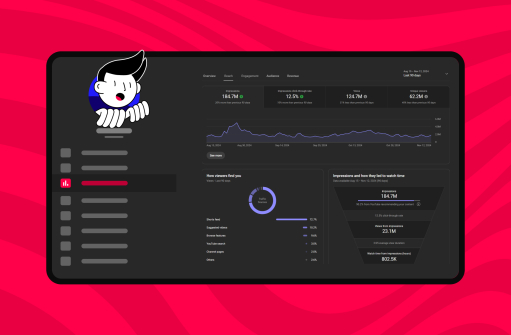
Let YouTube Studio tell you where the funnel leaks instead of guessing at it.
Key insights from YouTube Studio
- CTR, meaning impressions that turned into views
- Audience retention, absolute and relative
- Average view duration, which shows how long the average play lasts before someone leaves
- Traffic sources: YouTube search, suggested videos, Browse Features (the home page), external
- The moments where retention spikes and where it collapses
Traffic source, how to increase it, and difficulty
| Traffic source | How to increase it | Difficulty |
|---|---|---|
| YouTube search | Keyword in the title, the opening lines of the description, and spoken aloud early in the video; a clear match to search intent | Medium |
| Suggested videos | Strong retention, playlists, series, end screens pointing at genuinely related content | Medium |
| Browse Features (home page) | Consistent publishing, high CTR, and satisfaction signals such as likes, shares, and returning viewers | High |
| External | Social platforms, Discord, an embed hub, cross-promotion in communities | Low |
| Live and 24/7 streams | Regular broadcasts through Gyre, keywords in the stream title, an active chat | Low |
Turning data into action
- Rewrite weak titles and replace thumbnails that underperform your channel average.
- Extend the segments where retention climbs; cut the ones where it drops.
- Schedule uploads and streams around the hours your audience is actually on the platform.
Pre-publish optimization checklist
Run the list below before you hit publish. Seven checks, a few minutes, and all of them land inside the 24 to 48 hour window that decides your reach.
- The primary keyword appears in the title, in the first lines of the description, and is spoken aloud in the first 30 seconds.
- Two or three thumbnail variants are queued for A/B testing, rather than one chosen on instinct.
- Chapters are set for anything longer than three or four minutes.
- The end screen points at one specific relevant video or playlist, not at whatever you uploaded most recently.
- The video is added to a themed playlist immediately. Playlists autoplay the next video, which turns a single view into a session and pushes both watch time and suggested-video placement.
- A Shorts cut of the strongest moment is ready to publish alongside it.
- The first comments and the social post are scheduled for publication time, so CTR and engagement have support inside the test window.
Experiment with formats and themes
Try loop-friendly sets of two to six hours, episodic series, seasons, or collaborations. Variety keeps both the audience and the recommendation systems from settling into one shape.
Loopable content and weekly topics
Theme days give programming a rhythm people can plan around. “Focus Fridays” and “Boss-Fight Saturdays” cost nothing and give a returning viewer a reason to remember when to show up.
Collaborations with other creators
Swap intros, co-host a segment, or share playlists. Adjacent audiences are the cheapest new audiences available, because the topical match is already there.
Run giveaways and engagement boosters
Ethical incentives keep people around longer: wallpapers, exclusive mixes, shout-outs. Announce them in the title, the description, and on overlays so viewers know before they decide whether to stay.
Optimize ad placement without hurting viewers
If you’re monetized, place mid-rolls where the video already pauses for breath. Fewer, better-positioned breaks protect the viewing experience, and the retention you keep is worth more than the extra impression you’d have squeezed in.
Common mistakes to avoid
Ignoring SEO and metadata
Skipping keywords costs you the search surface entirely. A clear primary keyword in the title and description is what lets the system work out who to show the video to.
Using copyrighted material
Copyright claims end a live stream fast, and Content ID checks broadcasts in real time. Stick to properly licensed or royalty-free assets, and screen pre-recorded files before they air.
Neglecting live chat and mobile viewers
An empty chat drains the energy out of a stream. And most watch time now happens away from the desktop, split between phones and TV screens, so on-screen text that only works on a large monitor is losing you viewers on both.
Treating a stream as set-and-forget
Even a 24/7 stream needs maintenance: refresh titles, rotate visuals, rework the loop, check analytics weekly. Streams that stagnate stop being recommended, and that’s usually a metadata problem rather than a content one.
Key Takeaways
- Thumbnail CTR is the biggest single lever. Going from 3% to 6% doubles the views you get from the same impressions, and gives the algorithm a reason to serve more of them.
- The first 24 to 48 hours after publishing are decisive, because the algorithm tests every video on a small audience before expanding reach.
- Shorts deliver fast views and bring new audiences to your long-form content, on a ranking system that operates separately from it.
- Playlists and end screens turn a single view into a session, which is what raises channel-level watch time without a single extra upload.
- Live streams, including 24/7 broadcasts through Gyre, keep views and watch time accumulating while you’re offline.
Get the fundamentals right first: something worth watching, packaged so people find it and click it. Then scale what you already have with always-on live streams. That combination is what keeps a channel growing between uploads instead of only on the days you publish.
FAQ
Why are my YouTube views low?
The usual causes are a thumbnail CTR under 2%, weak retention in the first 30 seconds, or a topic that doesn’t match what your audience currently watches. All three are visible in YouTube Analytics, and they point to different fixes, so check them before changing anything.
How do I get more views on a new channel?
Shorts are the fastest route in: low production barrier, wide distribution, and a ranking system independent of your long-form track record. Pair them with optimized long-form videos so the audience Shorts bring in has somewhere to go next.
Is buying views worth it?
No. Purchased views come with zero retention, which drags down your channel averages and the satisfaction signals the algorithm now leans on hardest. It also breaks YouTube’s terms and puts monetization at risk.
How many views do I need to get monetized?
Views alone don’t get a channel monetized. Full ad revenue requires 1,000 subscribers plus either 4,000 valid public watch hours in the last 12 months or 10 million valid public Shorts views in the last 90 days, per YouTube’s Partner Program requirements. An earlier tier opens fan funding at 500 subscribers with 3,000 watch hours or 3 million Shorts views.
Do 24/7 live streams count toward views and watch time?
Yes. Live views and the watch time behind them count the same way they do on regular uploads, and they feed the same distribution signals. Watch hours from Shorts in the Shorts feed are the exception, since those don’t count toward the 4,000-hour threshold.
How long does it take before a new video starts getting views?
Most of the answer arrives in the first 48 hours, while the video is still in its test window. Videos that clear that stage keep picking up impressions for weeks, and search-driven topics can build slowly for months, so don’t write off a video after day two.