18 min read

TL;DR
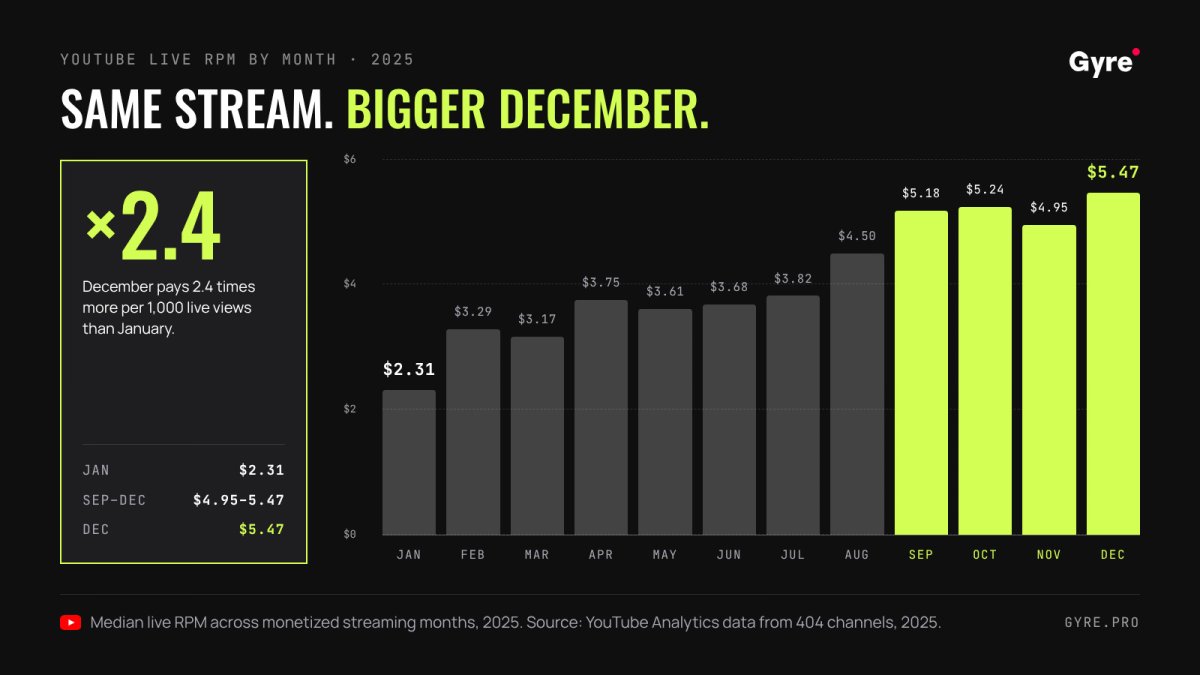
- Median YouTube live stream RPM in 2025 rose from $2.31 in January to $5.47 in December, a 2.4x gap, and stayed near or above $5 from September through December.
- Q4 runs October through December. YouTube ad revenue reached $11.4 billion in Q4 2025, about 27% more than in Q1, and January is the slowest month, when budgets reset. In 2026, Black Friday falls on November 27 and Cyber Monday on November 30.
- A stream view out-earned a video view on the same channels in 8 of 11 niches, led by Kids & Teens (3.4x), Entertainment (2.6x), and Gaming (2.2x). Education & Science, Business & Finance, and Lifestyle are the exceptions.
- How often you stream matters more than any single stream: channels streaming 8+ times a month got a median 50.2% of their ad revenue from live, against 4.4% at one stream a month.
- Before the peak, switch on automatic mid-roll ads, stream only music you own or have licensed, and launch a 24/7 stream before Black Friday so it runs through the holidays.
What YouTube RPM is and why it changes every month
RPM (revenue per mille) is what you actually earn per 1,000 views after YouTube’s cut, from every revenue source on the channel. CPM (cost per mille) is what advertisers pay per 1,000 ad impressions. For the full breakdown, see our guide on how CPM and RPM differ and how to raise them.
Think of CPM as an auction price. When more brands compete for your viewers, each ad impression costs more, YouTube CPM in Q4 climbs, and your RPM rises with it. That’s why RPM has seasons: it bottoms out in January, climbs through the year, and peaks in the last quarter. Your content can stay exactly as it is, and the number will still move.
To check yours, open Analytics in YouTube Studio and go to the Revenue tab. The Live filter there shows what live streams and live replays earned on their own.
YouTube RPM by month: how much more Q4 pays
Q4 (October through December) is when YouTube pays the most per view, and for live streams December pays best and January worst. An analysis of YouTube Analytics data from 404 channels across 13 niches, covering 2025 and the first quarter of 2026, tracked median live stream RPM month by month:
| Month | Median live RPM, 2025 | Index (January = 100) |
|---|---|---|
| January | $2.31 | 100 |
| February | $3.29 | 142 |
| March | $3.17 | 137 |
| April | $3.75 | 162 |
| May | $3.61 | 156 |
| June | $3.68 | 159 |
| July | $3.82 | 165 |
| August | $4.50 | 195 |
| September | $5.18 | 224 |
| October | $5.24 | 227 |
| November | $4.95 | 214 |
| December | $5.47 | 237 |
Look at September first. That’s where the high season really starts: from September through December, the median never dropped below $4.95. November dipped a little under October, so don’t expect a smooth ramp up to Christmas. December still comes out on top, at 2.4 times the January rate.
These are medians, so your channel will land above or below them depending on niche, where your viewers live, and your ad settings. The pattern holds either way. Leave a stream untouched, and it still earns more in December than in January.
Regular uploads follow a slightly different curve. In a separate analysis of 300 monetized channels covering May 2025 to May 2026, median RPM across all formats peaked at $2.35 in November, dipped to $2.12 in December, and fell to $1.56 in January. Live RPM peaked a month later, in December. The two studies cover slightly different periods, so treat that gap as a pattern worth watching rather than a rule.
Why do advertisers pay more in November and December?
Advertisers pay more for YouTube ads in November and December because that’s when they have the most money to spend. YouTube’s own numbers show it: ad revenue reached $11.4 billion in Q4 2025, according to Alphabet’s Q4 2025 earnings call, up from $8.93 billion in Q1 2025.
In a January 2026 breakdown of ad revenue seasonality, the ad platform Freestar points out that more ad dollars reach publishers from October through December than at any other point in the year, and that brands burn through whatever is left of their annual budgets in December. Freestar works with website ads, not YouTube, but its calendar matches the live RPM curve above.
In 2026, the busiest stretch looks like this:
- Black Friday on November 27 and Cyber Monday on November 30, the biggest retail campaign window of the year
- The weeks before Christmas, when people are most ready to buy gifts
- New Year’s week, the last days of annual ad budgets
Every extra advertiser in the auction pushes the price per impression up, and that lifts RPM for every monetized channel at once. Then January hits.
According to Freestar, the first two weeks of the year are when marketing teams set up new campaigns instead of running them. Fewer bidders, lower prices. In the live data, the January median came in at less than half of December’s.
Live vs video RPM by niche
Your YouTube niche decides two things: how high your RPM starts and how much going live changes it. The 404-channel study also compared live RPM with video RPM on each channel, month by month:
| Niche | Live RPM vs video RPM | Live pays | What fits a 24/7 stream |
|---|---|---|---|
| Education & Science | $17.58 vs $21.48 | 0.8x | Recorded lessons, lecture series, study streams |
| Transport* | $14.85 vs $5.23 | 2.8x | Long ride and route footage |
| Crafting & DIY* | $9.28 vs $2.61 | 3.6x | Tutorials and build sessions |
| Music | $6.17 vs $6.00 | 1.0x | Lo-fi, jazz, and holiday music playlists |
| Business & Finance* | $4.66 vs $5.19 | 0.9x | Course and webinar archives |
| Food* | $4.50 vs $4.17 | 1.1x | Recipe compilations |
| Lifestyle | $3.80 vs $4.08 | 0.9x | Vlog and travel compilations |
| Entertainment | $2.70 vs $1.03 | 2.6x | Episode and sketch compilations |
| Gaming | $2.49 vs $1.15 | 2.2x | Gameplay and walkthrough archives |
| Gadgets & Tech* | $2.33 vs $0.71 | 3.3x | Evergreen how-tos; news-led reviews age fast |
| Kids & Teens | $1.45 vs $0.43 | 3.4x | Cartoons, songs, learning episodes |
All figures are 2025 medians. Rows with an asterisk come from fewer than 10 streaming channels, so treat them as a hint rather than a settled number. How much Q4 adds also depends on the niche. In the 300-channel analysis, median RPM across all formats rose most in Q4 for Business & Finance (+60%, small sample), Food & Cooking (+39%), Crafting (+22%), Kids & Teens (+22%), and Music (+21%), and least for Gaming (+9%), Lifestyle (+6%), and Entertainment (+4%).
The pattern follows ad prices. In niches where video ads are cheap (Kids & Teens, Entertainment, Gaming, Gadgets & Tech), going live pays two to three times more per view. In premium niches, a live view earns a bit less than a video view. Even so, Education’s $17.58 is the highest live rate in the whole table, so 24/7 lesson and study streams still make sense at 0.8x.
Some of the most popular 24/7 formats sit outside this table or near its bottom. Music earns roughly equal rates per view live and on video, and just $0.35 per streamed hour at the median. That’s why 24/7 music streams win on volume, with hundreds of hours on air every month. Ambient, fireplace, and church streams don’t get their own rows at all; for seasonal ideas in these formats, see our evergreen live stream ideas by category.
A quick note on kids’ content. YouTube doesn’t allow personalized ads on content set as made for kids, only contextual ones, which is why Kids & Teens sits at the bottom of the table. And yet live pays 3.4 times more than video there, one of the biggest gaps in the study.
Do live streams earn more per view than videos?
In most niches, yes: a YouTube live stream view earns more than a video view because it lasts longer. On the median channel in the study, one stream generated about 73% of the watch time of one regular upload, from a fraction of the views. One channel kept people on its streams for 38 minutes on average, against 8 minutes on its videos.
That extra time turns into money in three ways:
- Longer sessions fit more ad breaks per viewer, so every 1,000 views carry more paid impressions. In niches with cheap video ads, that’s what moves the rate.
- Mid-roll ads keep running for as long as the stream does. In automatic mode, YouTube picks natural moments for the breaks and rates this mode as having more earning potential than scheduled or manual breaks.
- A 24/7 stream is live during everyone’s evening, wherever they are, so it earns around the clock instead of only after you publish something new.
Ads aren’t the only income from a live stream. As of November 2026, YouTube’s partner earnings overview says creators get 55% of net revenue from ads on their videos and 70% from Super Chat, Super Stickers, and channel memberships.
How often you stream matters most. Channels that streamed once a month got a median 4.4% of their ad revenue from live. Channels with 8 or more streams a month got 50.2%, and their live RPM ($5.67) beat their own video RPM ($4.59).
Now the less exciting part. The median stream drew 45 views, and the median channel made $1.88 in ad revenue per hour it streamed. If you’re on camera for every one of those hours, that’s a bad hourly rate. If the hours come from a 24/7 stream of videos you already published, they cost you nothing, and that’s exactly where the study found its top earners.
That’s the whole Q4 math. Every hour is worth more in November and December, and whoever puts the most hours on air takes home the biggest share of the difference.
Your back catalog can run as a 24/7 live stream before the December peak. Gyre runs it from the cloud, so no PC has to stay on. Start your stream →
A worked example: what a 24/7 stream adds in Q4
Treat this as an illustration: say your stream averages 1,000 views a day and earns the median live RPM. Over 30 days in January, at $2.31, that’s about $69. Over 30 days in December, at $5.47, those 30,000 views bring in about $164. That’s roughly $95 more, and you didn’t change a thing.
Your RPM and view count will be different. The Gyre calculator uses your channel’s real data to estimate what a 24/7 stream would add, and it takes about 30 seconds.
A heads-up if you compare years: since August 24, 2026, YouTube counts a public view from the first frame of playback, live streams included. YouTube says earnings still follow engaged views and watch hours, so compare this December with last year’s by revenue and watch time rather than by the public view count.
Here’s what it looks like on real channels. From January to June 2025, the four 24/7 streams on StrEat, a 2.86M-subscriber gaming channel, brought in over three-quarters of its revenue, and viewers stayed 8:22 on average against 2:16 on its videos. In March and April 2025, one stream on Lesnoy, an 845K-subscriber DIY channel, added 260,000 watch hours, with an average view duration of 13:33 against 8:33 on regular uploads.
When a 24/7 stream won’t pay off in Q4
A 24/7 stream isn’t the right move for every channel, and it’s better to know that before Black Friday than after. It’s unlikely to pay off in these cases:
- There’s no back catalog to build from. A stream made of a handful of clips or a single static image runs into YouTube’s rules on generic or repetitive content.
- The music isn’t yours or properly licensed. A Content ID match can interrupt the broadcast in the middle of the holidays.
- Big view counts are the goal. The median stream in the study drew 45 views, and the money comes from hours on air rather than from one viral broadcast.
- Your niche pays a bit less live than on video, and you plan to stream instead of uploading. In Education & Science, Business & Finance, and Lifestyle, streams work as extra hours on top of your videos, not as a replacement.
If none of these apply, Q4 is the best time of year to test the format, because every hour you add is worth the most.
How to launch a 24/7 stream before the Q4 peak
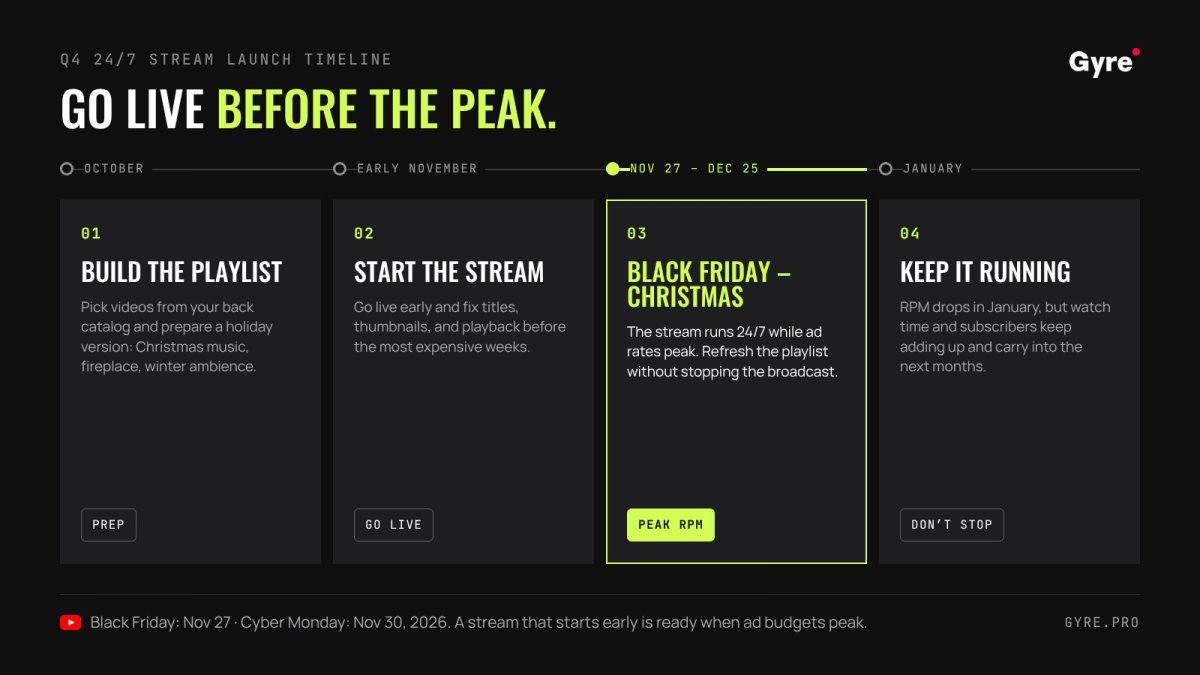
Give yourself enough time to get the stream stable before the most expensive weeks. A simple timeline:
| When | What to do |
|---|---|
| October | Pick the videos for the playlist and prepare a holiday version: Christmas music, fireplace, winter ambient, or seasonal episodes from your archive |
| Early November | Launch the stream, then fix titles, thumbnails, and playback issues while ad rates are still climbing |
| Black Friday to Christmas | Keep the stream on air 24/7 and update the playlist without stopping the broadcast |
| January | Keep it running: RPM drops, but watch time and subscribers keep accumulating |
If you’re starting late, squeeze the first two rows into one week. December, the best-paying month in the data, is still ahead of you.
Method 1: manual streaming with OBS Studio
OBS Studio is free and can stream pre-recorded files. Add your videos as a media source, set them to repeat, paste your YouTube stream key, and go live. The problem is your computer: it has to stay on day and night, and a long internet outage, a crash, or a system update ends the broadcast with nobody around to restart it. The Gyre features page compares this setup with a cloud stream side by side.
Method 2: a cloud stream with Gyre
- Upload your videos to Gyre Storage. If a file’s codec, resolution, or bitrate doesn’t fit YouTube’s requirements, the built-in converter fixes it.
- Build a playlist, plus a separate holiday one if you’re running a second stream.
- Paste your YouTube stream key, or connect the channel through your Google account so the stream details fill in on their own. Add start and stop times in the scheduler if you need them.
- Hit start. The stream runs 24/7 from Gyre’s cloud, even with your computer turned off.
Settings that decide what the stream earns
Turn on mid-roll ads before you go live. As of November 2026, the path in YouTube Studio looks like this: click Create, then Go live, start or schedule your stream, then open Edit and Monetization and check that Monetization is set to On. Next, pick how mid-rolls run: Automatic (YouTube’s recommended option), Scheduled every 6 to 30 minutes, or Manual. One detail from YouTube’s Monetize your live stream page: streams with captions on don’t get side-by-side mid-rolls, the ones that play next to the stream instead of cutting into it.
Stick to music you own or have licensed. YouTube scans every live stream for third-party content, and a match can swap your broadcast for a placeholder image or, if it keeps happening, interrupt or end the stream. Even licensed tracks can trigger this unless the rights holder adds your channel to its Content ID allowlist. Our guide to running a 24/7 music stream on YouTube lists safe places to get music.
And skip the static picture with nothing happening on screen. YouTube’s channel monetization policies rule out generic or repetitive content, including image slideshows with little or no narrative or educational value. Build the stream from real videos in your archive.
A yearly plan keeps your stream on air through this peak and the next one. See Gyre plans →
After Q4: January, and why a yearly plan pays off
January brings the lowest ad rates of the year, and every channel feels it. Seasonality hits the whole channel at once. When the Lesnoy stream lost 44% of its results from March to April, the rest of the channel dropped along with it.
A stream you launch in November doesn’t start from scratch in January, though. It keeps the audience and subscribers it picked up during the peak, and it’s already running when rates climb back through spring and summer. By September, the median live rate was more than double January’s. That alone is a good reason to keep it on.
A yearly plan locks in your price for 12 months and covers next year’s Q4 too, so you head into the next peak with a stream that’s been running for a full year.
Key Takeaways
- A 24/7 stream that’s live before Black Friday on November 27 collects hours through Cyber Monday, Christmas, and New Year, when ad rates are at their highest.
- Set mid-rolls to Automatic before launch, and pick High frequency if nobody will be watching over the stream.
- Videos you’ve already published and music you own or have licensed keep the stream monetized and on air.
- Check your niche in the table: where live pays more than video, put more hours on air; where it pays a bit less, use streams to add hours your uploads can’t.
- In January, leave the stream running and compare it with the same months next year, not with December.
FAQ
Why does YouTube pay more in Q4?
Because more advertisers are bidding for the same ad slots. From October through December, brands spend more than at any other time of year and use up what’s left of their annual budgets, so each impression costs more and your RPM goes up with it. In 2025, median live RPM in December was 2.4 times the January rate.
When does the Q4 RPM spike start and end?
It starts in September and ends in the first days of January. In 2025 data, median live RPM stayed near or above $5 from September through December, peaked in December at $5.47, then fell to its yearly low in January as advertisers reset their budgets.
How much more does December pay than January on YouTube?
For live streams, about 2.4 times more. Median live RPM was $5.47 in December 2025 against $2.31 in January, across monetized streaming months on 127 channels. Your own ratio depends on niche, audience location, and ad settings, so compare your December and January in YouTube Analytics.
Why does YouTube RPM drop in January?
Advertisers pull back right after the holidays. In the first weeks of January, brands set up new campaigns for the year instead of running them, so fewer of them bid for ad slots. Fewer bidders mean cheaper impressions, and your RPM falls with them. In 2025, live RPM then recovered gradually through spring and summer.
Do YouTube live streams earn more than regular videos?
In most niches, yes. Measured channel by channel and month by month, a stream view out-earned a video view in 8 of 11 niches, with Kids & Teens at 3.4 times. Education & Science, Business & Finance, and Lifestyle are the exceptions, where live pays slightly less per view.
Do YouTube live streams have mid-roll ads?
Yes. Pre-roll and display ads turn on automatically when a stream is monetized, and mid-rolls run during the broadcast in Automatic, Scheduled, or Manual mode. On a 24/7 stream, use Automatic: in Manual mode, no mid-rolls run unless someone inserts them.
Does Q4 boost RPM in every niche?
Yes, but by very different amounts. In an analysis of 300 monetized channels covering May 2025 to May 2026, median RPM rose about 60% in Q4 for Business & Finance, a small sample, but only 4% for Entertainment and 9% for Gaming. Kids & Teens gained 22%, even though made-for-kids content only carries contextual ads.
Is it worth starting a 24/7 live stream in November?
Yes, if you have a back catalog to build it from. December is the best-paying month of the year, and a stream that starts in November is already running when Black Friday, Cyber Monday, and Christmas push rates up. Keep it on through January to hold on to the audience it built.